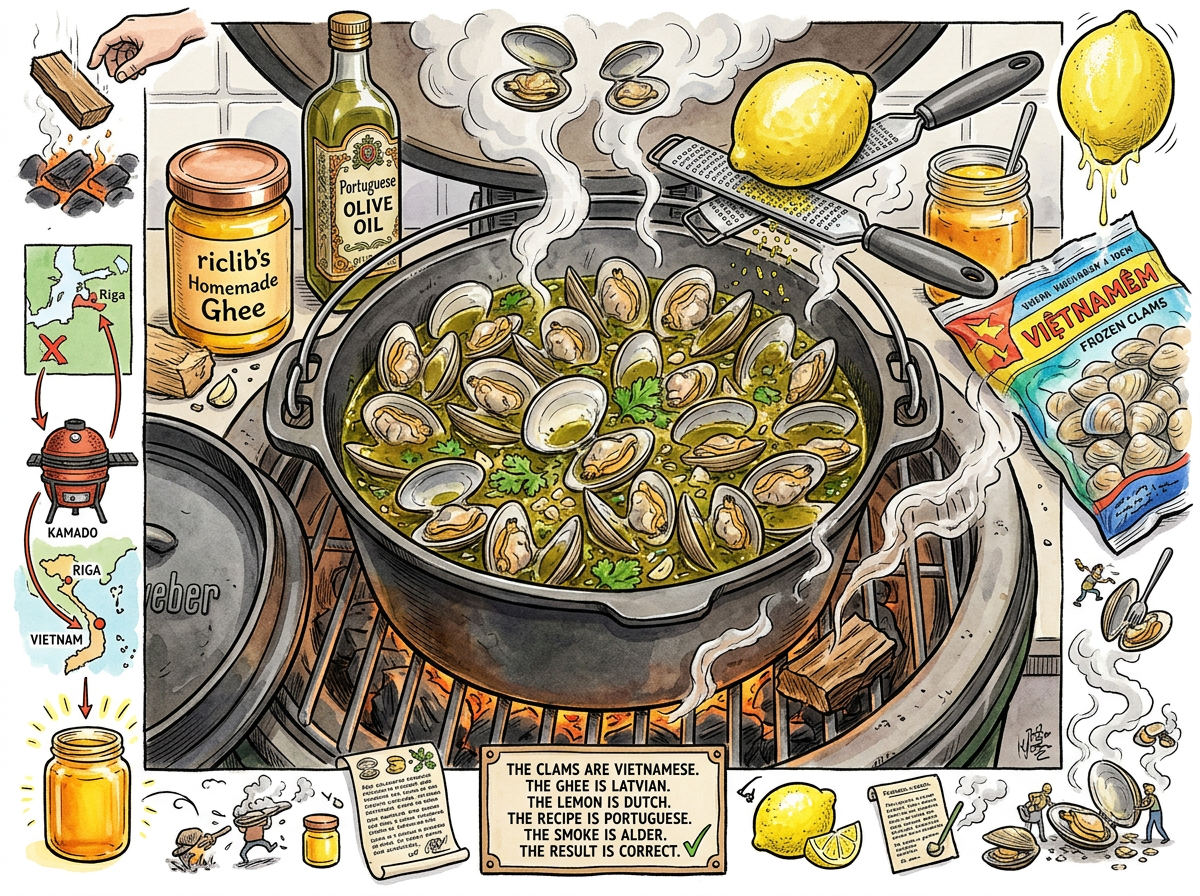
Amêijoas à Bulhão Pato is the Portuguese clam dish — clams steamed open in olive oil, white wine, garlic, and lemon, finished with a blizzard of fresh coriander. Named after Raimundo António de Bulhão Pato, a 19th century Portuguese poet whose contribution to literature is debatable but whose contribution to shellfish is immortal.
The canonical recipe is five ingredients: clams, olive oil, garlic, white wine, lemon, coentros. The Lisbon version uses fresh clams, Portuguese olive oil, and the specific confidence of a nation that has been cooking clams since the Phoenicians.
The Riga version uses frozen Vietnamese clams, homemade ghee, Dutch lemons, alder smoke from wet wood dropped near the Kamado’s charcoal, and a cast iron Weber dutch oven. The poet would have questions. The poet would also eat the clams before asking them.
“The recipe is Portuguese. The clams are Vietnamese. The ghee is Latvian butter taken to the edge. The smoke is Baltic alder. This is not fusion. This is what happens when a Portuguese developer lives in the Baltics long enough to stop apologising.”
— The Lizard, who does not apologise for ingredients
The Clams
The clams are frozen. The clams are from Vietnam.
This is not the confession it sounds like. Fresh clams in Riga are available — Baltic clams exist, local fish markets stock them intermittently — but they are inconsistent in size, availability, and the specific quality that the dish requires: small, tender, sweet. The frozen Vietnamese clams are consistent. They are always available. They are always the same size. They thaw, they open in the steam, they are tender and sweet and they do not pretend to be something they are not.
In Lisbon, riclib would use fresh amêijoas from the Algarve, dug from the Ria Formosa, briny with Atlantic salt and smelling of the coast. In Riga, riclib uses frozen clams from Vietnam and makes up the difference with ghee, alder smoke, and the best Dutch lemons the Baltic supply chain can provide. The clams are the weakest ingredient. Everything else compensates. The result is not the same as the Lisbon version. The result is the Riga version, and the Riga version does not apologise.
The Ghee
This is the modification that Bulhão Pato did not anticipate and that makes the Riga version its own dish.
Alongside the olive oil — which is non-negotiable, Portuguese, from the suitcase — riclib adds a generous spoonful of homemade ghee. The deep amber ghee, browned to the edge of ruin as described in its own article, with its nutty caramel richness dissolved in butterfat.
The ghee does two things the olive oil cannot do alone. First: body. The broth of amêijoas à Bulhão Pato is traditionally thin — olive oil, wine, lemon juice, clam liquor. It is delicious but light. The ghee adds richness without heaviness, a depth that rounds the broth from sharp to complex. The garlic, the lemon, the wine — they are all still there, still bright, still Portuguese. But they sit on a foundation of caramelised butterfat that gives the broth a viscosity and warmth that olive oil alone does not provide.
Second: the Maillard notes. riclib’s ghee carries the flavour of browned milk solids dissolved in the fat — toasted, nutty, almost sweet. These notes do not compete with the garlic and lemon. They sit underneath, a bass note beneath the treble, the kind of depth that makes you take a second spoonful of broth and wonder why it tastes more complete than the last time you had this dish.
The Squirrel wanted to measure the ghee precisely — “a ratio of 70% olive oil to 30% ghee, by weight, for optimal emulsification.” riclib adds a spoonful. The spoonful is the measurement. The ghee is the instrument. The hand knows the ratio because the hand has made this dish enough times to know.
The Alder Smoke
The Weber dutch oven sits on the Kamado grate, and before the lid goes on, a small piece of wet alder wood is dropped near the charcoal.
Always alder. Alder is the Baltic smoking wood — mild, sweet, the wood that Latvian salmon is smoked with, the wood that the Baltic grilling tradition considers the default. It is gentler than oak, sweeter than hickory, and it has the specific quality of imparting smoke flavour without dominating the ingredient. The clams need to taste like clams, not like a campfire.
The wet wood is the trick. Dry alder would catch fire, flare, and produce harsh smoke. Wet alder smoulders, producing a low, gentle stream of sweet smoke that enters the dutch oven through the gap between pot and lid and settles on the clams as they steam open. The smoke has sixty to ninety seconds to work — from the moment the lid goes on to the moment the clams open. That is enough. The smoke is not a main character. The smoke is a supporting role. The smoke is the alder’s contribution to a Portuguese dish, the Baltic amendment that the poet did not foresee.
The Method
-
Prepare the Kamado — medium-high heat, 200-230°C. Drop a small piece of wet alder wood near (not on) the charcoal. The wood should smoulder, not burn.
-
Heat the Weber dutch oven — on the Kamado grate. Add olive oil and the spoonful of ghee. The ghee melts into the oil. The two fats merge.
-
Garlic — sliced, not crushed, not minced. Into the hot fat. Thirty seconds. The garlic should sizzle and turn golden at the edges but not brown. Burnt garlic is a different dish.
-
Clams — the thawed, drained clams go in. Toss once to coat in the garlicky fat.
-
White wine — a generous splash. The wine hits the hot pot and deglazes. The steam rises. The alcohol burns off.
-
Lemon — the juice of one Dutch lemon. Dutch lemons — large, thick-skinned, generous with juice — are what the Baltic supply chain provides, and they are excellent. Zest some over the top.
-
Lid on — this is the critical moment. The lid traps the steam, the wine vapour, and the alder smoke that is curling up from below. The clams steam in this environment: olive oil, ghee, garlic, wine, lemon, alder. Every flavour present, every element contributing.
-
Wait — 3-5 minutes. Do not open the lid. The clams open in their own time. Shaking the pot gently once or twice helps distribute heat.
-
Check — when the clams have opened, they are done. Immediately. Not one minute more. Remove from heat. Discard any clams that refused to open — they were never going to open and they should not be persuaded.
-
Coentros — a generous handful of fresh coriander, roughly chopped, scattered over the clams. The green on the gold. The Portuguese signature.
-
Serve in the dutch oven — with crusty bread for the broth. The broth is the point. The clams are the vehicle. The bread is the tool. The ghee-enriched, alder-kissed, lemon-sharp broth soaked into torn bread is the reason this dish exists.
Measured Characteristics
- Origin: Lisbon, named after poet Raimundo António de Bulhão Pato
- Clam source: frozen, Vietnamese (consistent, available, honest)
- Clam source in Portugal: fresh, Ria Formosa, Algarve (superior, unavailable in Riga)
- Fat: olive oil (Portuguese, from the suitcase) + ghee (homemade, browned, Latvian butter)
- Ghee measurement: a spoonful (the hand is the instrument)
- Smoke wood: alder (always alder — the Baltic default)
- Wood state: wet (smoulder, not burn)
- Smoke duration: 60-90 seconds (supporting role, not lead)
- Cooking vessel: cast iron Weber dutch oven on the Kamado
- Lemon variety: Dutch (large, thick-skinned, generous — what the Baltics provide)
- Cook time after lid on: 3-5 minutes (until clams open, not one second more)
- Clams that don’t open: discarded (they were never going to open)
- Bread requirement: crusty, for the broth (the broth is the point)
- Portuguese ingredients: olive oil, coentros, the recipe itself
- Vietnamese ingredients: the clams
- Latvian ingredients: the ghee (from Baltic butter, browned by a Portuguese developer)
- Dutch ingredients: the lemon
- Baltic ingredients: the alder smoke
- Cultural classification: Portuguese dish with a Baltic amendment and a Vietnamese passport
- The Squirrel’s suggestion: “70% olive oil to 30% ghee by weight”
- riclib’s response: a spoonful
- The Lizard’s opinion: ate the clams, drank the broth from the pot, said nothing
- The poet Bulhão Pato’s probable opinion: would have questions about the ghee, would eat the clams before asking
See Also
- Ghee — The fat that rounds the broth. Browned to the edge.
- Olive Oil — The other fat. Portuguese. Non-negotiable.
- The Kamado — The heat and the smoke source.
- The Dutch Oven — The family vessel. The Weber is its outdoor cousin.
- Bacalhau na Brasa — The other Portuguese seafood on the Kamado.
- Boring Technology — Clams, fat, garlic, wine, lemon, steam. The poet knew.