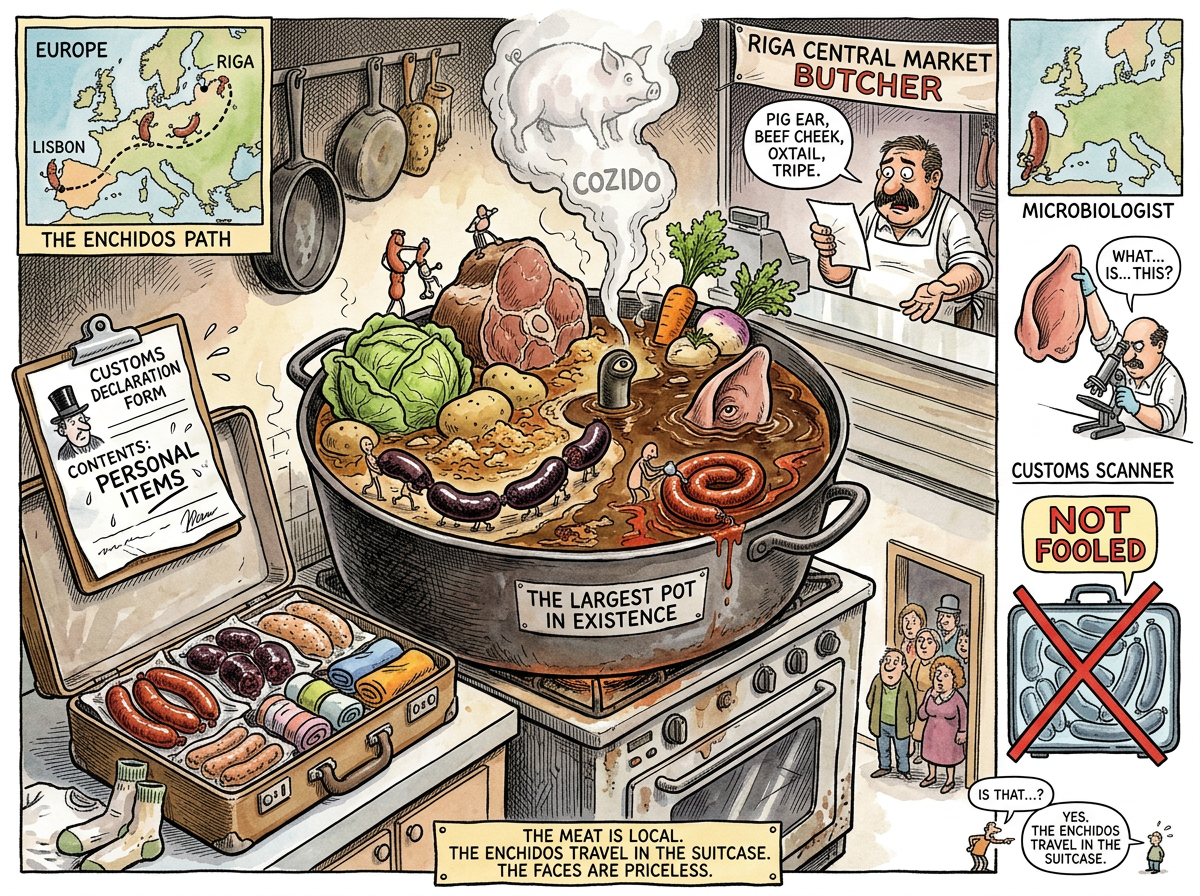
Cozido à Portuguesa is the Portuguese boiled dinner — the one-pot, everything-in, every-animal-represented dish that feeds a family of twenty and uses parts of the pig that the pig itself had forgotten it possessed. Beef, pork, chicken, chouriço, morcela, farinheira, cabbage, potatoes, carrots, turnips, rice — all boiled together in a single enormous pot until the broth becomes the collective autobiography of every ingredient and the dining table resembles a Portuguese grandmother’s idea of restraint, which is to say, no restraint at all.
Making cozido in Riga requires two separate supply chains, two separate acts of cultural translation, and one act of international sausage smuggling that riclib would prefer not to discuss in detail but which this article will discuss in complete detail.
“The cozido requires everything. The supermarket has some of it. The suitcase has the rest. The customs officer has questions. The developer has a poker face.”
— The Lizard, who does not sweat at customs because the Lizard’s blood is cold
The Two Supply Chains
Supply Chain One: The Suitcase (Enchidos)
The enchidos — the Portuguese cured and smoked sausages — cannot be sourced in the Baltics. Chouriço, morcela (blood sausage), farinheira (flour sausage) — these are Portuguese products made with Portuguese methods, cured in Portuguese smoke, and available exclusively in Portuguese shops, which in Riga do not exist.
The enchidos travel in the same suitcase as the 32 cans of bacalhau. Vacuum-sealed, packed between clothing, occupying the space where normal people put souvenirs. The suitcase, upon X-ray, presents an outline that is — to be charitable — concerning. Cylindrical objects. Dense. Numerous. Packed with purpose.
riclib is one of the few people alive who is genuinely afraid of explaining the contents of his bag to a customs officer on an internal European flight. Not because the contents are illegal — they are sausages, they are cured meat, they are perfectly legal within the EU. But because explaining to a Baltic customs officer that the twelve vacuum-sealed cylinders in your checked bag are Portuguese blood sausage, flour sausage, and paprika-cured pork sausage requires a vocabulary that does not exist in the intersection of Portuguese charcuterie and Baltic airport security.
“What is in the bag?”
“Sausages.”
“What kind of sausages?”
“Portuguese sausages.”
“What is in the sausages?”
“Blood.” (morcela)
“…”
“And flour.” (farinheira)
“…”
“And pork. Smoked pork.” (chouriço)
The conversation has never happened. riclib has walked through customs every time without being stopped. But the fear is there, on every flight, the specific anxiety of a man whose luggage contains twelve vacuum-sealed sausages and a customs declaration that says “personal items” because “Portuguese blood sausage for a boiled dinner that requires explaining to people who have never heard of half the ingredients” does not fit in the box.
Supply Chain Two: The Market (The Faces)
The meat — beef, pork, chicken — is sourced locally at the Riga Central Market. This is where the cultural translation occurs.
A proper cozido uses cuts that a Portuguese butcher hands over without a second thought: beef shank, beef cheek, oxtail, pork ribs, pork ear, pork snout, tripe. In Lisbon, you ask for these and the butcher reaches for them the way a bartender reaches for the house wine. In Riga, you ask for these and the butcher makes a face.
The face is specific. It is the face of a professional who has been asked for something they have in the back — technically, physically present — but which they have never considered food. The pig ear produces the most consistent face: a pause, a glance at the request, a glance at the customer, a brief internal recalibration of what this interaction is, and then a slow walk to the section of the cold room where the pig ears live, next to the parts that are destined for animal feed or industrial processing, not for a man standing at the counter with a shopping bag and the specific confidence of someone who has eaten pig ear before and intends to eat it again.
The beef cheek produces a face of mild academic interest — the butcher knows the cheek exists, knows that it is technically a cut, but has never had a retail customer ask for it. The oxtail produces recognition — oxtail is known, if uncommon. The tripe produces the longest pause, because the butcher needs to determine whether the customer is serious, and in Latvia, nobody has asked for tripe at the market counter since approximately 1997.
riclib has been buying these cuts long enough now that certain vendors recognise him. The face has evolved from confusion to tolerance to something approaching curiosity. One vendor now sets aside oxtail when he sees riclib approaching, which is either excellent customer service or the butcher’s way of getting the weird cuts off the display before other customers see them.
The vegetables — cabbage, potatoes, carrots, turnips — are Baltic-standard. Excellent. No faces required.
The Method
The cozido is not complicated. The cozido is large.
The principle is sequential boiling: the toughest cuts go in first, the delicate ones last. Everything cooks in the same broth. The broth accumulates flavour from each addition. By the time the cabbages go in — last, briefly — the broth has been through beef, pork, chicken, and three kinds of sausage, and the cabbages absorb a summary of the entire dish in fifteen minutes.
-
Start with beef — shank, cheek, oxtail. These need hours. Into cold water, bring to a simmer, skim the foam, and let the collagen do its slow conversion to gelatin. Two to three hours.
-
Add the pork — ribs, ear (if you survived the butcher’s face), any tough pork cuts. Another hour.
-
Add the chicken — whole or in pieces. The chicken needs less time but benefits from the broth that has already been built. Thirty to forty-five minutes.
-
Add the enchidos — the smuggled goods. Chouriço, morcela, farinheira. The chouriço bleeds paprika into the broth. The morcela holds its shape (barely — it must be treated gently or it falls apart). The farinheira begins its inevitable dissolution, as it does in every dish it enters, because the farinheira’s destiny is to become broth. Twenty to thirty minutes.
-
Add the vegetables — potatoes, carrots, turnips. Root vegetables can handle the broth. Thirty minutes.
-
Add the cabbage — last, briefly. Quartered, dropped in, fifteen minutes maximum. Overcooked cabbage is a war crime that even the cozido cannot forgive.
-
Cook rice separately — in some of the broth, ladled out, because rice cooked in cozido broth is rice that has absorbed the autobiography of every ingredient.
-
Serve on a platter — the traditional presentation is everything arranged on a massive platter: meats in the centre, sausages around them, vegetables on the outside, rice on the side. The platter should look like a food market collapsed onto a single dish. This is the correct aesthetic.
Measured Characteristics
- Origin: Portugal (predates the nation)
- Cooking vessel: the largest pot in the house (this is the only specification)
- Total cook time: 4-5 hours (sequential, not simultaneous)
- Enchido supply chain: suitcase (Lisbon → Riga, vacuum-sealed, between socks)
- Enchidos smuggled per trip: 12+ (chouriço, morcela, farinheira)
- Customs encounters: 0 (so far)
- Customs anxiety level: high (every flight)
- Meat supply chain: Riga Central Market (local)
- Butcher’s face when asked for pig ear: specific (see article)
- Butcher’s face when asked for tripe: longer (see article)
- Butcher’s face when asked for oxtail: recognition (the easiest ask)
- Butcher who now sets aside oxtail: 1 (loyalty earned through persistent weirdness)
- Vegetables: Baltic-standard (excellent, no faces required)
- Cabbage cooking time: 15 minutes maximum (non-negotiable)
- Rice: cooked separately, in cozido broth (the broth is the point)
- Feeds: 20 (or 4 people for a week, which is the Riga reality)
- The Squirrel’s suggestion: sous vide the beef separately for precision, then add to the pot at service
- riclib’s response: the beef goes in the pot raw because the pot is the point
- The Lizard’s opinion: [ate everything including the pig ear, said nothing]
- Items in the suitcase: 32 cans of bacalhau, 12 enchidos, olive oil, customs anxiety
- Items the customs officer does not know about: all of the above
- Items the customs officer would have questions about: the morcela (blood sausage)
- Answer to the customs officer’s questions: “personal items” (technically correct)
See Also
- Favas com Entrecosto — The other Portuguese pot dish. Smaller scale. Same patience.
- Bacalhau à Brás — Shares the suitcase supply chain. Different shelf in the cupboard.
- The Dutch Oven — The vessel for smaller braises. The cozido exceeds it.
- Boring Technology — A pot. Water. Time. Every part of every animal. Unchanged for centuries.