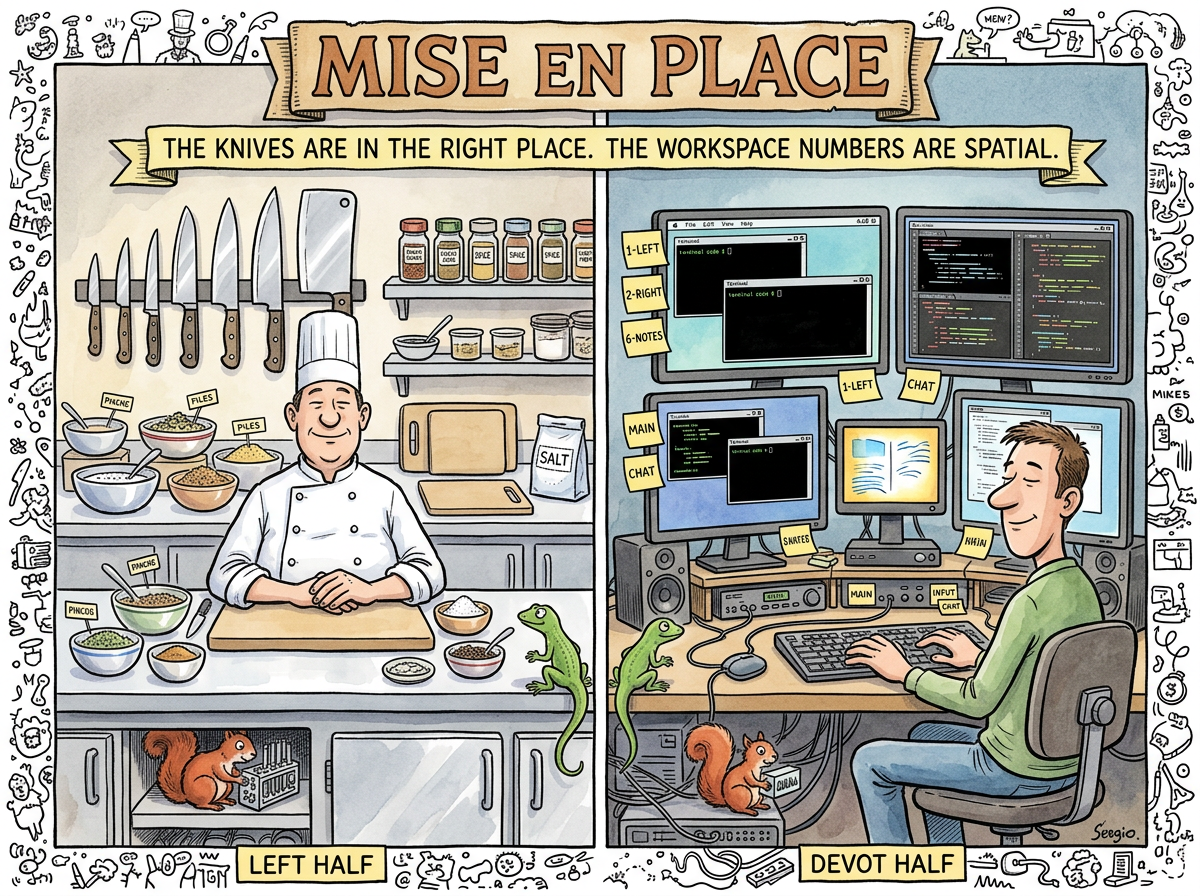
Mise en Place (Developer) is the practice of configuring a workspace — naming devices, numbering workspaces, positioning monitors, dimming screens, arranging windows — not as procrastination, not as configuration carnival, but as the necessary precondition for the work that follows. It is the developer equivalent of a chef arranging the station before service: knives in the right place, bowls pre-measured, cutting boards clean, salt within reach. The chef does not cook during mise en place. The developer does not code during the nesting. Both are working.
The distinction between Mise en Place and the Configuration Carnival is the distinction between sharpening a knife and collecting knives. One enables the cut. The other replaces it.
The ADHD Kitchen
For a developer with ADHD, mise en place is not a preference. It is medication.
The ADHD brain cannot generate its own order. Executive function — the ability to prioritize, to sequence, to hold a plan in working memory while executing it — is the thing that ADHD impairs. The brain that can hyperfocus on a problem for eight hours cannot decide which of three tasks to start first. The brain that can write 4,000 lines in one night cannot remember which workspace has the terminal.
The Configuration Carnival is what happens when the ADHD brain’s need for order meets a system with infinite configuration options. The developer sits down to write a note. The developer spends three hours configuring the note-taking tool. Three supertags. Zero vegetables. The configuration replaced the task.
Mise en Place is what happens when the same need for order meets a bounded system — a workspace with a finite number of monitors, a finite number of audio devices, a finite number of workspaces. The developer spends a Saturday morning naming devices, numbering workspaces, and positioning windows. The configuration enables the task.
The difference is not discipline. The difference is scope. The Configuration Carnival has no natural boundary — there is always another setting, another plugin, another layer of abstraction. Mise en Place has a natural boundary: the physical room. Two monitors. One tiny screen. Two audio devices. Five workspaces. When the room is right, the mise en place is done. The ADHD brain recognizes “done” when the body agrees — when the eyes land on the right screen, when the hands reach for the right shortcut, when the workspace numbers match the spatial layout and the nervous system stops sending the low-frequency signal that something is wrong.
“The Squirrel names things because she likes naming. The developer names things because his brain requires it. Same action. Different medication.”
— The Lizard, The Nesting
The Spatial Workspace
Workspace 1 is left. Workspace 2 is right. Workspace 7 is also left. Workspace 8 is also right. Workspace 6 is the tiny screen.
These numbers are not arbitrary. These numbers are wayfinding. The brain does not parse “workspace 9” and compute which monitor it maps to. The brain knows that 1 is left and 2 is right because 1 is left and 2 is right. The mapping is spatial, not logical. The body learns it. The hands know it. The cognitive cost drops to zero.
This is mise en place at the workspace level: the numbers serve the nervous system, not the computer. SUPER+1 goes left. SUPER+2 goes right. SUPER+6 goes to the notes. The developer does not think. The developer reaches. The reach lands.
The Orthogonal Name
“RODECaster Video S Pro” and “RODECaster Video S Pro 1.”
These are the default names that PipeWire assigns to two audio endpoints on the same device. They are technically correct. They are cognitively expensive. Every time the developer opens sound settings, the brain must parse “Pro” versus “Pro 1,” compare them, remember which is which, and select the right one. This takes two seconds. It happens ten times a day. Twenty seconds of friction. Twenty seconds of the ADHD brain’s limited executive function budget spent on a problem that was created by a default label.
“RODECASTER Main” and “RODECASTER Chat.”
These are the renamed endpoints. They are orthogonal — one word differs, and that word describes the function. The brain does not parse. The brain does not compare. The brain glances and knows. The cognitive cost drops to zero. The twenty seconds are returned to the budget.
Mise en place is the practice of eliminating these micro-costs. Not because any single one matters. Because the ADHD brain’s executive function budget is finite, and every micro-cost draws from the same account that hyperfocus needs to activate.
The Smallest Screen
The largest screens show code. The largest screens show browsers. The largest screens show the work.
The smallest screen shows where the work goes.
A 290mm monitor — smaller than a paperback — running a journal webapp and Obsidian, side by side, always visible, always on workspace 6. The developer does not open the journal. The journal is open. The developer does not decide to record something. The journal is there, in the peripheral vision, a gentle presence that says: record this.
This is mise en place at the attention level: the thing that should be visible is visible. The thing that should be reachable is reachable. The decision to engage is removed. The engagement is structural.
The chef does not decide to reach for the salt. The salt is where the hand goes. The developer does not decide to open the journal. The journal is where the eye goes.
Measured Characteristics
- Time spent on mise en place: 1–3 hours (Saturday morning, typically)
- Frequency: once per major environment change (new machine, new monitor, new device)
- Cognitive cost of a well-configured workspace: ~0 per interaction
- Cognitive cost of a default-configured workspace: 2–5 seconds per interaction (×100/day)
- Executive function budget saved: significant (unmeasured, felt)
- Configuration items in a typical mise en place: 10–20
- Configuration items in a Configuration Carnival: ∞
- The distinction: scope (bounded vs unbounded)
- Vegetables purchased during mise en place: still 0
- But the kitchen is ready: yes
- The Squirrel’s contribution: naming (accidentally correct)
- The Lizard’s contribution: boundaries (always correct)
See Also
- ADHD — The superpower that forgot to buy vegetables. The reason mise en place is medication.
- Configuration Carnival — The anti-pattern. When configuration replaces the task instead of enabling it.
- Hyperfocus — What happens after mise en place. The lock that activates when the room is right.
- Perfectionism — The shoe on the wrong foot. The neurological discomfort that mise en place resolves.
- The Nesting — The story where mise en place was practiced, documented, and named.