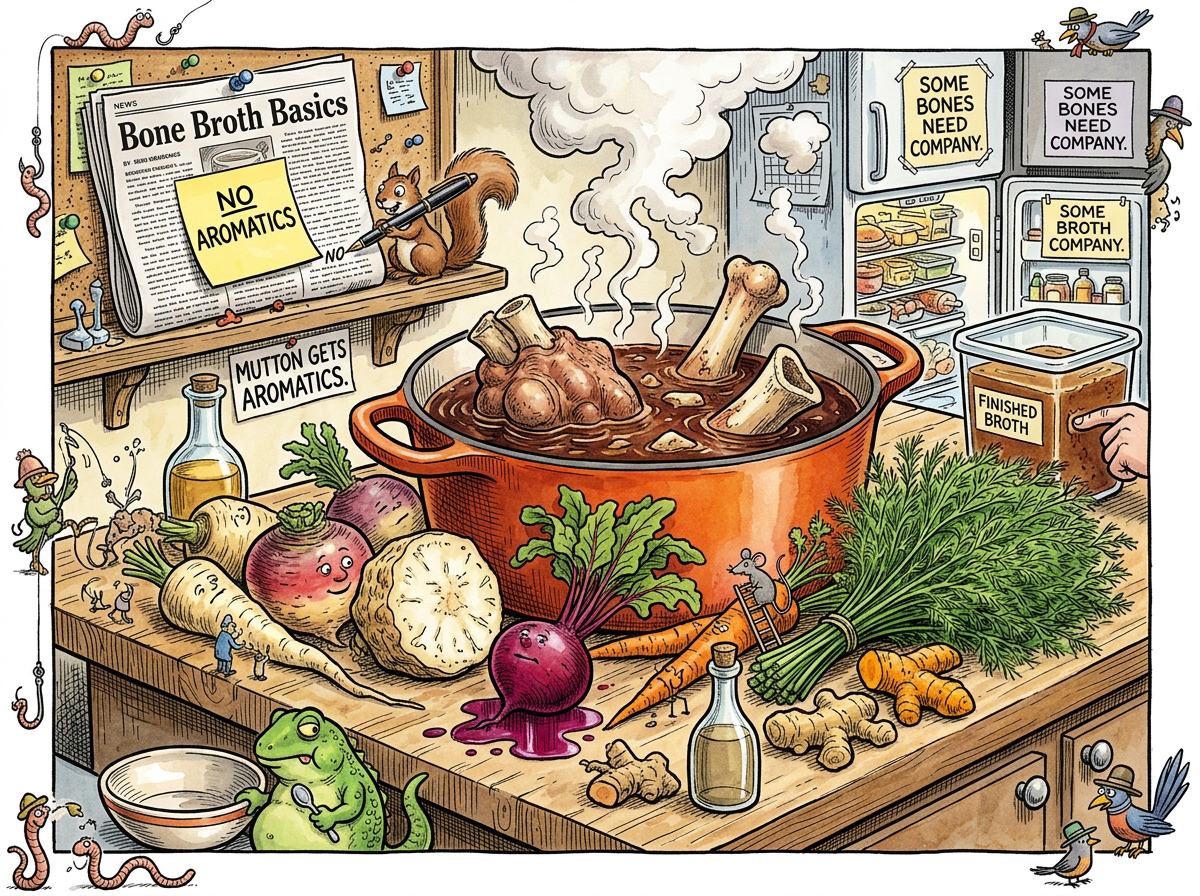
Mutton bone broth is the one exception to the rule that bone broth requires nothing but bones, water, vinegar, and time. It is the broth that broke the Lizard’s policy of aromatic minimalism — not because the Lizard wanted aromatics, but because mutton demanded them.
The Bone Broth article is clear. Beef bones, dutch oven, 24 hours, no celery, no carrots, no peppercorns, no bay leaf, and absolutely no star anise. The bones are the point. Everything else is a garnish on a garnish. riclib has maintained this position through multiple winters, multiple batches, and multiple arguments with the Squirrel about whether parsley stems constitute a betrayal of principle.
Mutton is different.
Mutton is not beef. Beef bones are stubborn but neutral — they resist extraction but, once extracted, produce a broth that is clean, deep, and universal. Mutton bones are stubborn and opinionated. They carry the flavour of an adult sheep that has spent years developing a personality, and that personality comes through in the broth with a gamey, lanolin-edged intensity that is magnificent if you know what to do with it and aggressive if you don’t.
What you do with it is root vegetables.
“I’m not adding aromatics. I’m adding counterweights.”
— riclib, justifying the parsnips
The Exception
The Squirrel, upon hearing that mutton bone broth would include parsnips, carrots, celeriac, rutabaga, a beet, two onions, a head of garlic, fresh dill, fresh ginger, and fresh turmeric, experienced a moment of vindication so intense that it required medical attention. “I TOLD you aromatics improve bone broth,” the Squirrel announced, already drafting a proposal to retroactively add celery to every beef broth ever made.
“No,” riclib said. “Mutton gets aromatics. Beef does not. These are different bones from a different animal with a different flavour profile and different extraction characteristics. This is not a policy change. This is a policy exception. Document it as such.”
The Lizard said nothing but ate the parsnips that had been fished out of the finished broth, which had absorbed twenty-four hours of mutton essence and become something transcendent — soft, sweet, deeply savoury, and infused with a sheepy richness that no parsnip has any right to possess.
The Squirrel has filed the exception and references it in every subsequent discussion about beef bone broth aromatics. riclib ignores this. The exception stands. The policy is unchanged.
Why Mutton, Not Lamb
Lamb is young sheep. Mutton is adult sheep. The distinction matters more in broth than in any other cooking application, because broth is an extraction process, and what you extract depends on what was there in the first place.
Lamb bones are thin, relatively porous, and surrender their collagen cooperatively — like junior developers who hand over their code for review without argument. The resulting broth is mild, pleasant, and forgettable. You could drink it and think “this is nice” and then forget you drank it by the time you’ve finished washing the mug.
Mutton bones are dense, heavily mineralised, wrapped in thick connective tissue that has spent years being used for actual locomotion by an animal that climbed hills for a living. The collagen is abundant but locked inside structures that resist casual extraction. The marrow is richer. The cartilage is thicker. The flavour compounds are deeper and more complex — developed over years of grass, movement, and metabolic maturity.
Mutton bones are the senior engineers of the ovine skeleton. They have more to give, but they won’t give it to just anyone, and they certainly won’t give it in four hours.
| Property | Lamb | Mutton |
|---|---|---|
| Age | Under 1 year | Over 2 years |
| Collagen density | Moderate | High |
| Flavour | Mild, cooperative | Assertive, opinionated |
| Extraction time | 12-18 hours | 24 hours minimum |
| Needs aromatics | No (but doesn’t need broth either) | Yes (the exception) |
| Jiggle factor | Tentative wobble | Structural gel |
| The Squirrel’s preference | “Add mint jelly” | “Add everything” |
| riclib’s preference | “Why bother” | “Give me the knuckles” |
The Root Vegetable Parliament
The aromatics in mutton bone broth are not garnish. They are structural. Each root vegetable serves a purpose in counterbalancing the intensity of mutton while adding its own layer of sweetness and earthiness.
Parsnips — the backbone. Sweet, starchy, and capable of absorbing mutton flavour without losing their identity. Three large ones, peeled and chunked. They do the heavy lifting.
Rutabaga — the diplomat. Earthy, slightly bitter, bridges the gap between the sweet roots and the gamey broth. Two medium ones, cubed. The Squirrel calls them swedes. riclib calls them rutabagas. The broth doesn’t care what you call them.
Celeriac — the quiet one. Adds a celery-adjacent depth without the stringy, watery liability of actual celery stalks. One medium, peeled and diced. The Lizard approves of celeriac in a way the Lizard would never approve of celery. It is the difference between a well-architected abstraction and a leaky one.
Carrots — the obvious one. Two large, peeled and chunked. Nobody argues about carrots. Carrots are the fmt.Println of root vegetables — always useful, never controversial, gets the job done.
Beet — the wildcard. One, peeled and quartered. Adds an earthy sweetness and a deep colour that transforms the broth from amber to mahogany. The Squirrel wanted three beets. riclib used one. The Lizard ate the beet after extraction and declined to comment on the colour of its teeth.
Onion — two large, quartered. The foundation aromatics that even the Lizard has never objected to in any broth, because onions are not aromatics in the way celery is aromatics. Onions are infrastructure.
Garlic — six cloves, smashed. Same category as onion. Infrastructure.
Fresh dill — a large bunch. This is where the broth becomes specifically Eastern European rather than generically bone-based. Dill and mutton have an affinity that is difficult to explain and impossible to argue with. The first time riclib added dill to mutton broth, the Lizard looked up from its rock and nodded once. This is the Lizard equivalent of a standing ovation.
Fresh turmeric and ginger — two inches of each, sliced. Anti-inflammatory, gut-healing, and structurally compatible with mutton in a way they are not compatible with beef. These are not Squirrel additions. These are AIP additions, backed by evidence and improved by mutton’s willingness to absorb their flavour rather than fight it.
The Method
The method is the same as Bone Broth with one critical difference: the vegetables go in.
Phase 1: The bones alone. Roast the mutton bones at 220°C for 45 minutes — longer than beef, because mutton bones are denser and need more time to develop the Maillard crust. Into the dutch oven with cold water and apple cider vinegar. Let sit 30 minutes. Then into the oven at 100-110°C for 12 hours. Lid on. Walk away.
Phase 2: The parliament convenes. At the 12-hour mark, open the lid, skim any foam, and add every root vegetable, every herb, the garlic, the turmeric, the ginger. Salt. Close the lid. Back in the oven for 12 more hours.
The Squirrel proposed a “Phase 3” involving straining and re-reducing the broth for “concentrated mutton demi-glace.” riclib strained the broth, discarded the spent vegetables and bones, and put it in the fridge. There is no Phase 3. Two phases is correct.
The pressure cooker exception: The Bone Broth article explicitly bans pressure cookers. Mutton bone broth tolerates a pressure cooker for the first phase — 2 hours at high pressure to crack the initial resistance of the denser bones — followed by a transfer to the dutch oven for the remaining time with vegetables. This is not an endorsement. It is an acknowledgment that mutton knuckle bones are so dense that a pressure cooker can accelerate the initial breakdown without sacrificing the final depth. The Squirrel treats this as vindication. It is not vindication. It is engineering pragmatism applied to unusually dense bone.
The Jiggle Test
Same test as Bone Broth. Refrigerate overnight. Tap the container.
Mutton bone broth that has been properly extracted for 24 hours will set harder than beef bone broth. Significantly harder. The gelatin concentration from mutton knuckles is extraordinary — the broth sets into something that doesn’t merely jiggle but actively resists the spoon. You have to dig it out. It is meat jello with structural integrity.
The fat cap on mutton broth is different from beef tallow — slightly softer, slightly more aromatic, with a faint lanolin edge that is either wonderful or terrible depending on your relationship with sheep. riclib considers it wonderful. The Squirrel considers it “assertive.” The fat is excellent for roasting root vegetables, which creates a feedback loop where the broth produces the fat that roasts the vegetables that go into the next broth.
AIP Compliance
Mutton bone broth is fully AIP-compliant without modification, which is one reason it earned exception status. The aromatics are all AIP-safe. The root vegetables are all AIP-safe. There are no nightshades, no seed spices, no grains, no legumes. The turmeric and ginger are specifically anti-inflammatory.
The Bone Broth article’s minimalism is partly philosophical and partly practical — beef broth doesn’t need aromatics. Mutton broth needs aromatics and the aromatics it needs happen to be the ones that are AIP-compliant. The exception is not a compromise. It is a convergence.
Measured Characteristics
| Property | Value |
|---|---|
| Bones | Mutton knuckle, shank, marrow |
| Roasting temp | 220°C (428°F), 45 min |
| Cooking vessel | Dutch oven, heavy lid |
| Oven temp | 100-110°C (212-230°F) |
| Phase 1 (bones only) | 12 hours |
| Phase 2 (with vegetables) | 12 hours |
| Total duration | 24 hours |
| Acid | Apple cider vinegar, ~2 tbsp |
| Aromatics | Yes (the exception) |
| Root vegetables | Parsnip, rutabaga, celeriac, carrot, beet, onion, garlic |
| Herbs | Fresh dill, parsley stems, thyme |
| Anti-inflammatory | Fresh turmeric, fresh ginger |
| Jiggle test | Sets harder than beef — structural gel |
| Fat cap | Mutton tallow — aromatic, excellent for roasting |
| AIP compliant | Fully, without modification |
| Pressure cooker | Tolerated for Phase 1 only (not endorsed) |
| The Squirrel’s opinion | “SEE? AROMATICS! I WAS RIGHT ALL ALONG!” |
| riclib’s response | “This is an exception, not a precedent” |
See Also
- Bone Broth — The original. The policy. Beef bones, no aromatics, 24 hours. Still correct for beef.
- Chicken Broth — The quick one. Different animal, different method, different philosophy.
- Stock vs Broth — The taxonomic debate that mutton makes even more complicated.
- Tallow — Beef version. Mutton tallow is a different product with a different personality.
- BBQ — Does not typically involve mutton, but riclib is open to proposals.
- The Dutch Oven — The only vessel. Even when the pressure cooker is tolerated for Phase 1, Phase 2 belongs to the dutch oven.
- Boring Technology — A dutch oven in an oven for 24 hours with root vegetables. Still no apps. Still no probes. Still no Bluetooth.