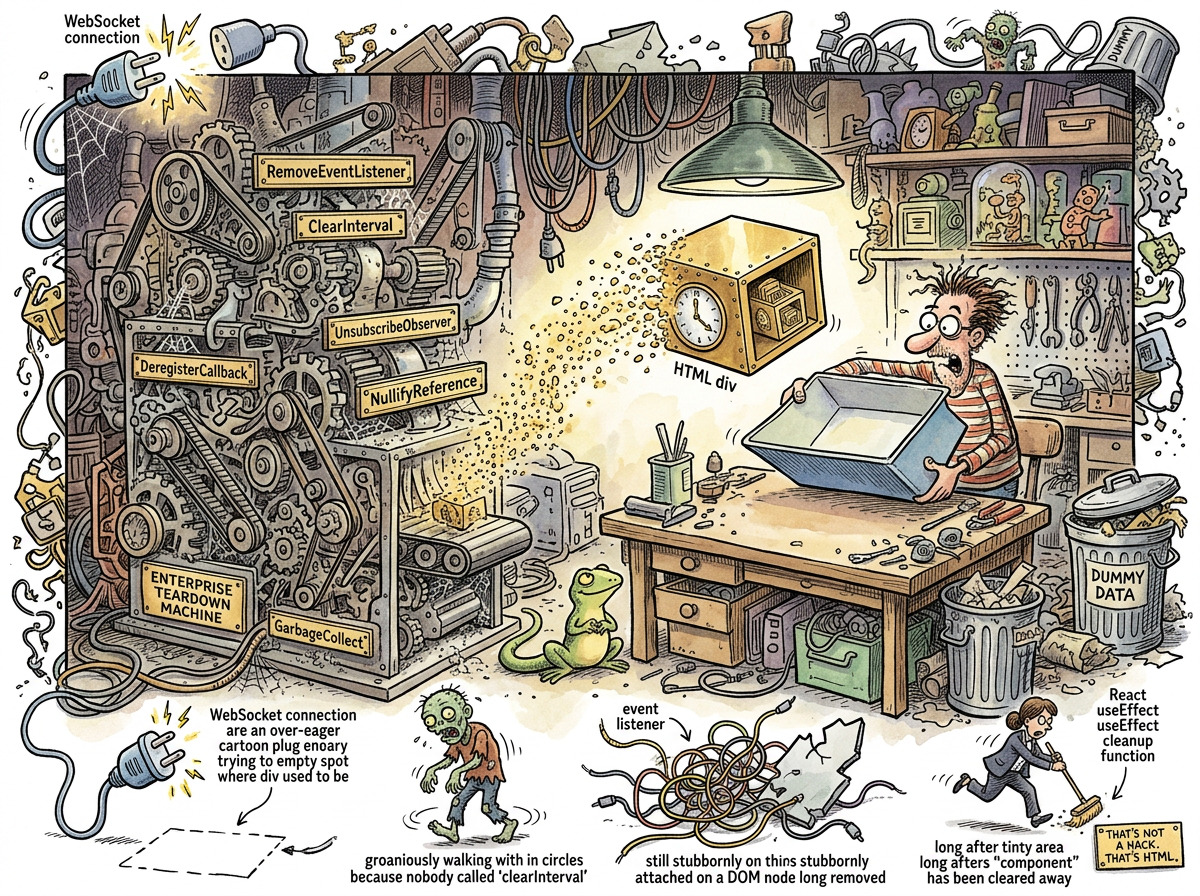
Self-Destructing Polling is a UI architecture pattern in which a server response contains its own refresh instruction, and the refresh ceases to exist when the DOM element containing it is removed — requiring no cleanup code, no teardown logic, no event listener management, and no awareness on the part of the developer that the polling has stopped, because nothing needs to stop what was never wired to continue.
The pattern was formally recognized during the April 2026 notification redesign, when a push-everything SSE architecture was replaced by a polling div that contained hx-trigger="every 500ms" in its own outerHTML. When the dropdown was open, the div existed, and it polled. When the dropdown was closed, the container was emptied, and the div ceased to exist.
No cleanup was needed. No clearInterval. No removeEventListener. No unsubscribe. No useEffect return function. The request stopped existing when the container stopped existing.
“That’s not a hack. That’s HTML.”
— riclib, The Hundred-Event Buffer, or The Night the Server Screamed into the Void
The Mechanism
Self-Destructing Polling operates through the following unremarkable sequence:
-
The user opens a dropdown. JavaScript fetches content and inserts it into the DOM.
-
The response includes a wrapper div with
hx-trigger="every 500ms". HTMX sees this attribute. HTMX starts polling. -
Every 500 milliseconds, HTMX sends a GET request. The response replaces the wrapper div. The new div also has
hx-trigger="every 500ms". HTMX continues polling. -
The user closes the dropdown. JavaScript sets
innerHTML = ''on the container. -
The wrapper div is removed from the DOM. HTMX no longer finds an element with
hx-trigger. Polling stops.
There is no step 6. There is no cleanup. There is no “but what about…” The element is gone. The polling is gone. They were the same thing.
“The response contains its own lifecycle?”
— The Caffeinated Squirrel, experiencing the specific surprise of encountering simplicity in the wild
Why It Should Not Work (But Does)
The instinct of every developer trained on reactive frameworks is that resources must be explicitly acquired and explicitly released. A timer must be cleared. A subscription must be cancelled. An observer must be disconnected. The lifecycle of a UI component is a solemn contract between the component and the framework, governed by mount and unmount hooks, constructor and destructor symmetry, and the fundamental belief that if you don’t clean up after yourself, ghosts will haunt your event loop.
Self-Destructing Polling violates all of this by not having a lifecycle at all.
The element exists. While it exists, the attribute is present. While the attribute is present, HTMX polls. When the element is removed, the attribute is removed. When the attribute is removed, HTMX does not poll. There is no contract. There is no hook. There is no ceremony. There is only the DOM, and the DOM is either there or it isn’t.
This is the principle of existential lifecycle management: the resource’s lifecycle is its existence. Not its registration. Not its subscription. Not its callback chain. Its physical presence in the document.
The Comparison
| Approach | Setup | Teardown | Failure mode |
|---|---|---|---|
| setInterval | Manual | Manual (clearInterval) | Zombie timers if forgotten |
| useEffect + cleanup | Framework-managed | Framework-managed | Stale closures, race conditions |
| Observable + unsubscribe | Library-managed | Library-managed | Memory leaks if not unsubscribed |
| WebSocket | Connection-managed | Connection-managed | Reconnection loops to dead endpoints |
| Self-Destructing Polling | Exists | Doesn’t exist | None. Nonexistence has no failure mode. |
The failure mode of Self-Destructing Polling is “none” because the thing that could fail is the thing that doesn’t exist, and nonexistent things have a perfect reliability record.
The Dropdown Paradigm
The dropdown is the canonical example, but the pattern applies wherever visibility implies activity:
- A dashboard widget that refreshes while visible, stops when scrolled away
- A notification panel that polls while open, vanishes when closed
- A progress indicator that updates while the job tab is selected, ceases when another tab is chosen
In each case, the server response includes its own refresh trigger. The client’s only responsibility is to put the HTML in the DOM or take it out. The polling follows the HTML like a shadow follows a person — not because it was attached, but because it has no independent existence.
“Every framework invents lifecycle hooks. HTML had the answer all along: if the element doesn’t exist, neither does its behavior. This isn’t a pattern. It’s the absence of a pattern, and that’s why it works.”
— The Lizard, contemplating the DOM from a sunlit rock
Measured Characteristics
Lines of cleanup code:                  0
Event listeners to manage:              0
Memory leaks possible:                  0
Framework dependencies:                 1 (HTMX, or any library that reads DOM attributes)
Polling when dropdown closed:           0 requests
Polling when dropdown open:             2 per second (500ms interval)
Transition between states:              innerHTML = '' (that's it)
Enterprise architects who find
  this suspicious:                      most of them
  (it's too simple)
  (simplicity is always suspicious
   to people who sell complexity)
See Also
- HTMX — The library that reads DOM attributes and does what they say, no more
- The Town Crier Pattern — The push architecture that Self-Destructing Polling replaced
- Boring Technology — Self-Destructing Polling is boring. That is the highest compliment.
- YAGNI — You aren’t gonna need a teardown hook if the thing tears itself down by not existing