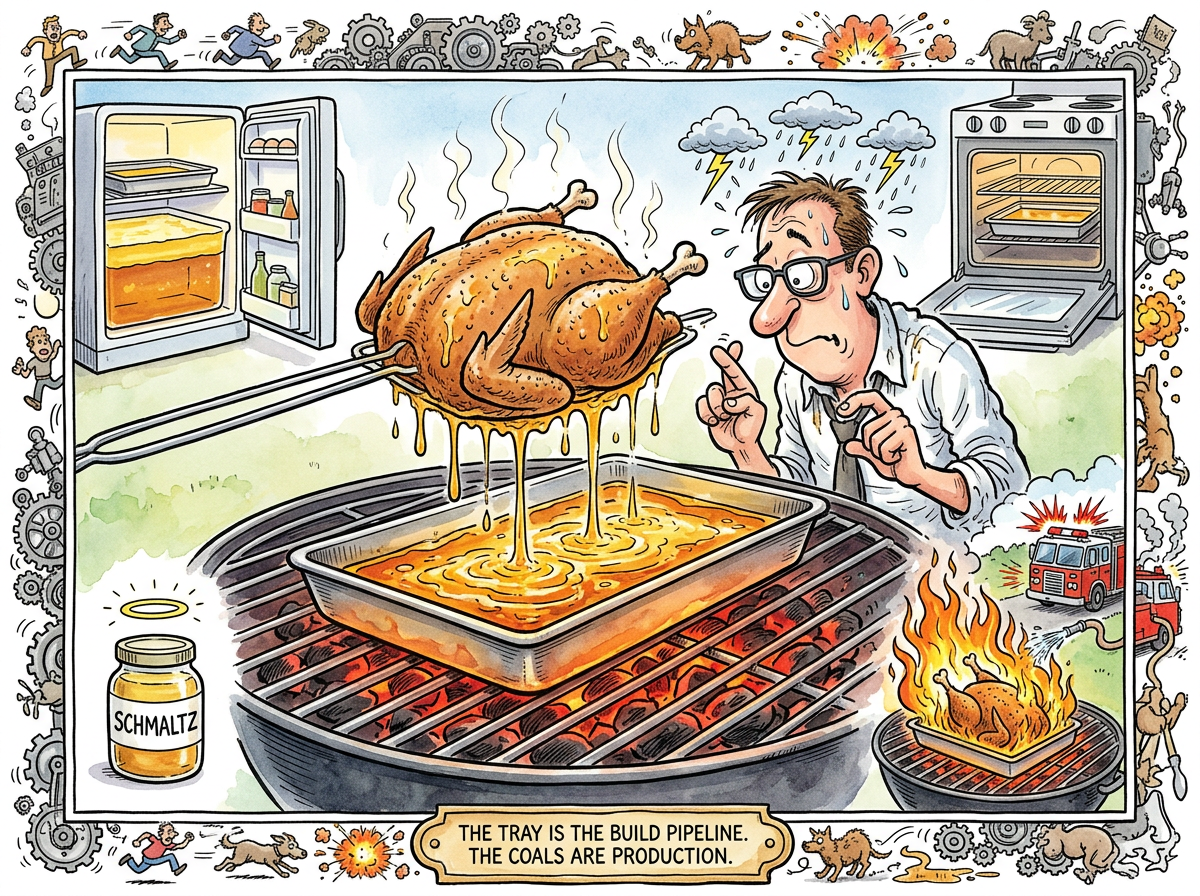
The drip tray is a vessel placed beneath roasting meat to collect rendered fat, collagen-rich juices, and caramelised fond — the build artifacts of the roasting process. In an oven, the drip tray is a passive container. On The Kamado, the drip tray is a high-wire act performed six inches above live charcoal, where the collected artifacts are simultaneously the most valuable output of the cook and the most likely cause of a grease fire.
The drip tray is the build pipeline. What it catches becomes Schmaltz, collagen jelly, and the foundation of Chicken Broth. What it loses — down the drain, into the coals, or into flame — is gone forever. There are no backups. The drip tray is the only copy.
“Throwing away the drip tray contents is the culinary equivalent of deploying to production and then deleting the logs.”
— The Lizard
Normal Mode (The Oven)
In an oven, the drip tray sits on a shelf below the meat. The heating element is behind a wall. The fat renders, pools, concentrates, and waits. Nothing catches fire because nothing can catch fire. The tray’s only job is to exist and to not be thrown away — a job at which, remarkably, most cooks fail.
The contents go into the fridge. Cold separates them: Schmaltz on top (solid, pale yellow, collected religiously), collagen jelly on the bottom (amber, trembling, returned to the broth). The separation is clean. The fat lifts off in a single piece. Cold and gravity do the work that no skimming or cheesecloth can match.
Hardcore Mode (The Kamado)
On the Kamado, the drip tray sits above glowing lump charcoal inside a ceramic vessel that retains heat the way a grudge retains resentment. The chicken roasts above the tray. The fat renders into the tray. The tray is heated from below by coals running at 200°C+ that do not distinguish between “maintaining temperature” and “igniting rendered fat.”
The margin between successful artifact preservation and a grease fire is one vent adjustment. The top and bottom vents control airflow, which controls temperature, which controls whether the tray contents gently render or spontaneously combust.
This is Hardcore mode: the same infrastructure pipeline as the oven, operated on equipment that is actively trying to set the pipeline on fire. riclib does this regularly. The Schmaltz is worth the risk.
The Goose Incident
The Goose Incident is what happens when Hardcore mode encounters a waterfowl. A goose contains approximately four times the fat of a chicken. The drip tray filled. The fat hit smoke point. The fat ignited. The goose was carbonised. The fire department called.
The drip tray’s capacity must match the fat output of the protein. This is capacity planning. Under-provision the tray and the excess overflows — into the coals, into flame, into a phone call from emergency services. The goose exceeded the tray’s SLA.
Measured Characteristics
Drip tray contents (chicken):                           fat + collagen + fond
Drip tray contents value:                               higher than the chicken itself
                                                        (the chicken is dinner; the tray is infrastructure)
Drip tray risk (oven):                                  0 (nothing can catch fire)
Drip tray risk (Kamado):                                non-zero (everything can catch fire)
Distance from tray to coals (Kamado):                   ~15 cm
Margin between preservation and combustion:              one vent adjustment
Goose fat volume vs tray capacity:                       exceeded
Fire department calls caused by drip tray overflow:      1
Schmaltz recovered from goose incident:                  0
Cooks who discard drip tray contents:                    most of them
Cooks who should:                                        none of them
The tray is:                                             the build pipeline
The coals are:                                           production
See Also
- Roast (Chicken) — Hardcore mode and the Goose Incident
- Chicken Broth — What the drip tray contents become
- Schmaltz — The golden fat, worth defending
- The Kamado — The hostile environment
- Goose Fat — The substance that exceeded capacity