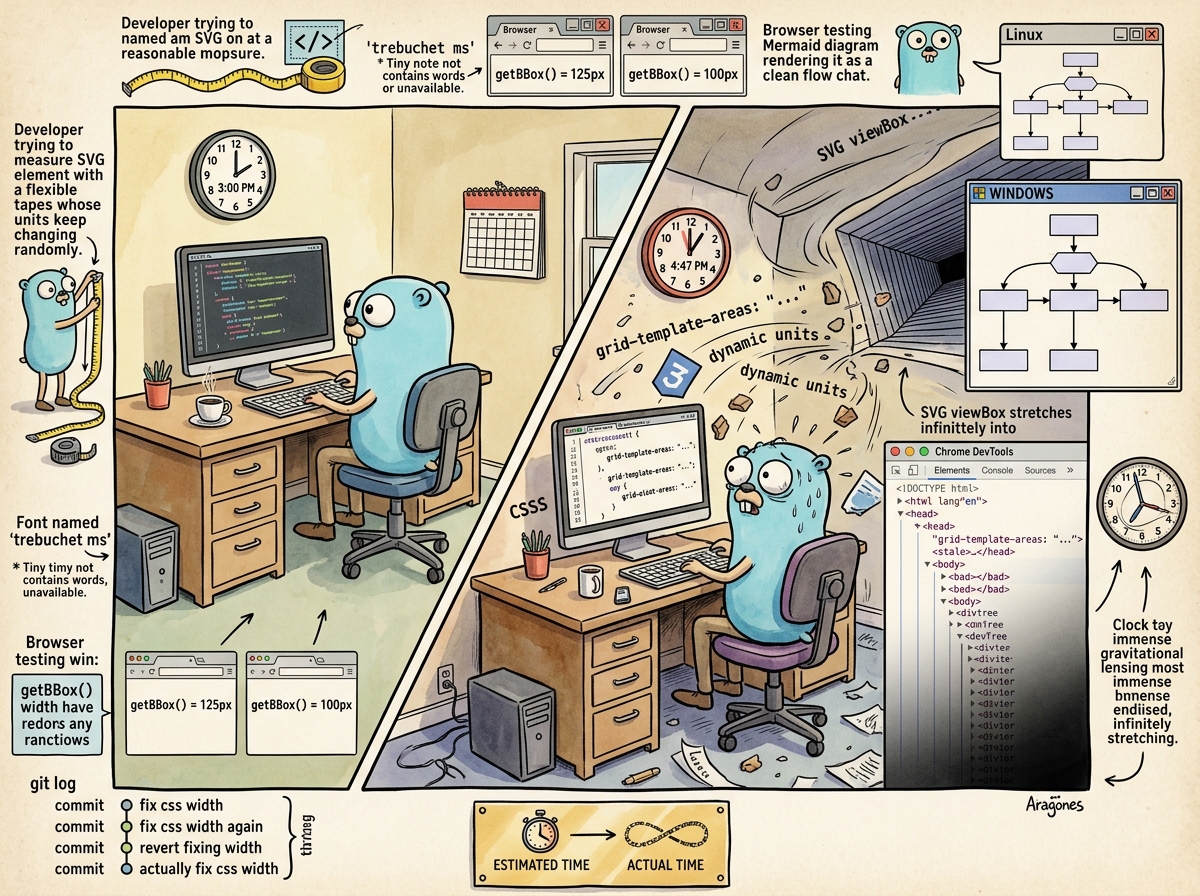
The Frontend Event Horizon is the observable boundary beyond which cross-platform CSS, SVG, and JavaScript issues create measurable time dilation in the vicinity of otherwise deterministic Go codebases. First formally documented in April 2026, the phenomenon had been experienced by developers since the invention of the browser, but was not named until a two-node mermaid pipeline diagram rendered correctly on Linux and exploded into a cathedral-sized empty viewport on Chrome/Windows, and the subsequent “quick CSS fix” consumed forty-five minutes of wall-clock time that the developer’s calendar insists were five.
The effect is gravitational in nature. The closer a backend developer approaches the boundary between server-rendered truth and client-side interpretation, the more time slows down relative to outside observers. A colleague checking Slack sees “fixing a CSS thing” at 3:00 PM and “still fixing a CSS thing” at 4:47 PM and reasonably concludes that the developer has died. The developer has not died. The developer is alive, but has entered a region of spacetime where height: auto means three different things on three different operating systems and getBBox() returns values that depend on which fonts the user has installed.
“The Go code compiled in 1.2 seconds. The Go code was correct. The Go code rendered the mermaid syntax exactly as documented. And then the browser said ‘yes but what if the viewBox were enormous’ and forty-five minutes happened.”
— riclib, S-637, April 2026
The Mechanism
The Frontend Event Horizon operates through a phenomenon known as Determinism Decay — the progressive loss of predictable behaviour as data travels from the server to the screen.
At the server, everything is knowable. A Go function generates a mermaid flowchart string: flowchart LR, two nodes, one arrow. The string is identical every time. The string is correct. The string is delivered via SSE to the browser, where it is placed into a <div class="mermaid"> and handed to mermaid.js, and this is the moment the event horizon is crossed.
Mermaid.js, in order to render the flowchart, must measure text. To measure text, it must know the font. To know the font, it must ask the browser. To ask the browser, it must accept whatever font the operating system provides. On Linux, this is one font. On Windows, this is a different font. The fonts have different metrics — different character widths, different ascent values, different descents. Mermaid uses these metrics to calculate the SVG viewBox — the coordinate system that determines how large the diagram appears.
On Linux, the viewBox is reasonable. On Windows, the viewBox is an abyss.
The diagram renders at the bottom of a viewport-sized void, a tiny cluster of green boxes cowering at the foot of a cathedral that mermaid built from font metrics that were technically correct and visually catastrophic. The height: auto CSS rule faithfully preserves the SVG’s aspect ratio, which is now approximately 1:47, and the step results table that should appear directly below the diagram is somewhere in the next postal code.
“The SVG was technically correct. The viewBox was technically correct. The rendering was technically correct. Nothing was correct.”
— The Lizard, contemplating the gap between specification and reality
The Time Dilation Effect
The gravitational time dilation near the Frontend Event Horizon follows a predictable pattern:
Phase 1: The Estimate (0-30 seconds). The developer sees the bug. The developer understands the bug. The developer says “quick CSS fix” or “just constrain the height” or “five minutes.” The developer’s confidence is the fuel that pulls them past the event horizon. Without this confidence, no one would approach.
Phase 2: The First Fix (5-10 minutes). max-width: 100%; height: auto; — the incantation that every frontend developer learns and that works in 94% of cases. A commit is made. A push is deployed. The developer waits for the client to reload.
Phase 3: The Photograph (10-15 minutes). The client sends a screenshot. The screenshot shows improvement — the diagram is now visible, but at the top of the viewport, approximately the size of a hyphen, with the rest of the page somewhere below the fold. The CSS constrained the width but the height is still governed by the viewBox, which is governed by the font metrics, which are governed by Windows.
Phase 4: The Second Fix (15-25 minutes). max-height: 120px. Brute force. The developer has abandoned elegance and is now simply telling the SVG how tall it is allowed to be, like a parent establishing screen time rules. A commit, a push, a deployment.
Phase 5: The Second Photograph (25-30 minutes). The diagram is now a thin green line. The max-height clipped the SVG but the container still occupies the space the viewBox demanded, because the viewBox is set by mermaid on the SVG element itself and CSS constraints on the SVG do not affect the container’s layout unless overflow: hidden is also set, which it was not, because why would it need to be, because on Linux the viewBox is correct.
Phase 6: The Realisation (30-35 minutes). CSS cannot fix this. The viewBox is wrong. The viewBox is wrong because mermaid calculated it using font metrics that differ between operating systems. No combination of CSS properties will make a wrong viewBox right. The fix must happen after mermaid renders — a JavaScript function that measures the actual SVG content using getBBox() and rewrites the viewBox to fit.
Phase 7: The Fix (35-45 minutes). fixMermaidViewBoxes() — sixteen lines of JavaScript that use getBBox() to measure the real bounding box, add padding, and rewrite the viewBox attribute. The fix is global. The fix is correct. The fix is what should have been written at minute five, if the developer had known at minute five what they learned at minute thirty-five.
The elapsed time: forty-five minutes. The fix: sixteen lines. The ratio of minutes to lines — approximately 2.8 minutes per line — is characteristic of Frontend Event Horizon encounters and should be used for future estimation purposes, though it never will be.
The Font Metric Divergence
The root cause of the April 2026 incident — and of most Frontend Event Horizon encounters — is Font Metric Divergence: the fact that the same CSS font-family declaration resolves to different physical fonts on different operating systems, and different physical fonts have different metrics, and different metrics produce different layout calculations, and different layout calculations produce different viewBoxes, and different viewBoxes produce screenshots that make the developer question their career.
Mermaid.js uses foreignObject elements with HTML <div> elements inside the SVG to render text labels. The dimensions of these divs depend on the font. The font depends on the OS. The OS is not the developer’s.
trebuchet ms, verdana, arial, sans-serif
This is mermaid’s font stack. On Linux, this typically resolves to a font with certain metrics. On Windows, Trebuchet MS is actually installed and has different metrics. The labels measure differently. The node boxes measure differently. The viewBox — which mermaid calculates to encompass all nodes — measures differently. And the difference, for a simple two-node flowchart LR, is the difference between a viewBox of 0 0 400 80 and a viewBox of 0 0 400 2000.
The Go code did not change. The mermaid syntax did not change. The CSS did not change. The operating system changed, and the operating system is the variable that no unit test covers, because testing “does this look right on Windows” requires having Windows, and having Windows requires a level of commitment that most developers have not made.
Measured Characteristics
Fix estimate (developer's):              5 minutes
Fix actual (wall clock):                 45 minutes
Time dilation factor:                    9x
Commits required:                        4
CSS approaches tried:                    3
CSS approaches that worked:              0
JavaScript lines that fixed it:          16
Minutes per line (final fix):            2.8
viewBox height (Linux):                  ~80px
viewBox height (Windows):                ~2000px
Font metric divergence factor:           25x
Number of operating systems tested:      2 (one too few, initially)
Go compilation time:                     1.2 seconds (unaffected by the event horizon)
Go code changes required:                0 (the server was never wrong)
Known Incidents
The April 2026 incident (S-637) is the most thoroughly documented, but the phenomenon has been observed at every scale:
- The LDIR Incident — a
z-indexfix that required understanding the stacking context of seven nested positioned elements, each one created by a different framework at a different point in history - The Scrollbar Divergence — Windows adds scrollbar width to the viewport calculation; macOS does not; the layout broke on the exact browser where the client demo was scheduled
- The Hover State Anomaly — a CSS hover effect that worked on every device except the one with a touchscreen, because touchscreens do not hover, except when they do, except on Chrome, except on Tuesdays
Each incident shares the characteristic time dilation, the initial five-minute estimate, and the eventual realisation that the server was correct all along and the browser was doing something that is technically valid and practically insane.
Theoretical Implications
The Frontend Event Horizon suggests a fundamental asymmetry in software development: the time required to fix a bug increases exponentially as the bug’s location moves from server to client. A bug in Go is found by the compiler. A bug in HTML is found by the validator. A bug in CSS is found by the client’s screenshot of the client’s browser on the client’s operating system at the client’s screen resolution with the client’s installed fonts and the client’s DPI scaling and the client’s “oh I have dark mode on, does that matter?”
Yes. That matters. Everything matters. That is the event horizon.
“The Go side stays deterministic. The browser invents new ways to interpret ‘height: auto.’ Between the two, time becomes relative. Like close to a black hole.”
— riclib, after the fourth commit for what was supposed to be one CSS fix
See Also
- YAGNI — The Frontend Event Horizon is what happens when you do need it, but it takes nine times longer than estimated
- Go — The calm, deterministic room on the server side of the event horizon
- CSS — The gravitational field itself
- Mermaid — The specific catalyst of the April 2026 incident
- Boring Technology — The principle that, near the event horizon, is always violated, because the boring solution was “it works on my machine”