In many of the more relaxed civilisations on the outer Eastern spiral arm of the Galaxy, the Hitchhiker’s Guide has already supplanted the great Encyclopaedia Galactica as the standard repository of all knowledge and wisdom, for though it has many omissions and contains much that is apocryphal, or at least wildly inaccurate, it scores over the older, more pedestrian work in two important respects. First, it is slightly cheaper; and second, it has the words DON’T PANIC inscribed in large, friendly letters on its cover.
This guide has neither of those advantages. It is not cheap — nothing in Enterprise IT is cheap, including the guide to Enterprise IT, which requires a procurement process, a vendor evaluation, a security audit, and a three-month contract negotiation before it can be read. And it does not say DON’T PANIC on the cover, because panic is the correct response to Enterprise IT, and any guide that tells you otherwise is either lying or has not been to a Big Room Planning session.
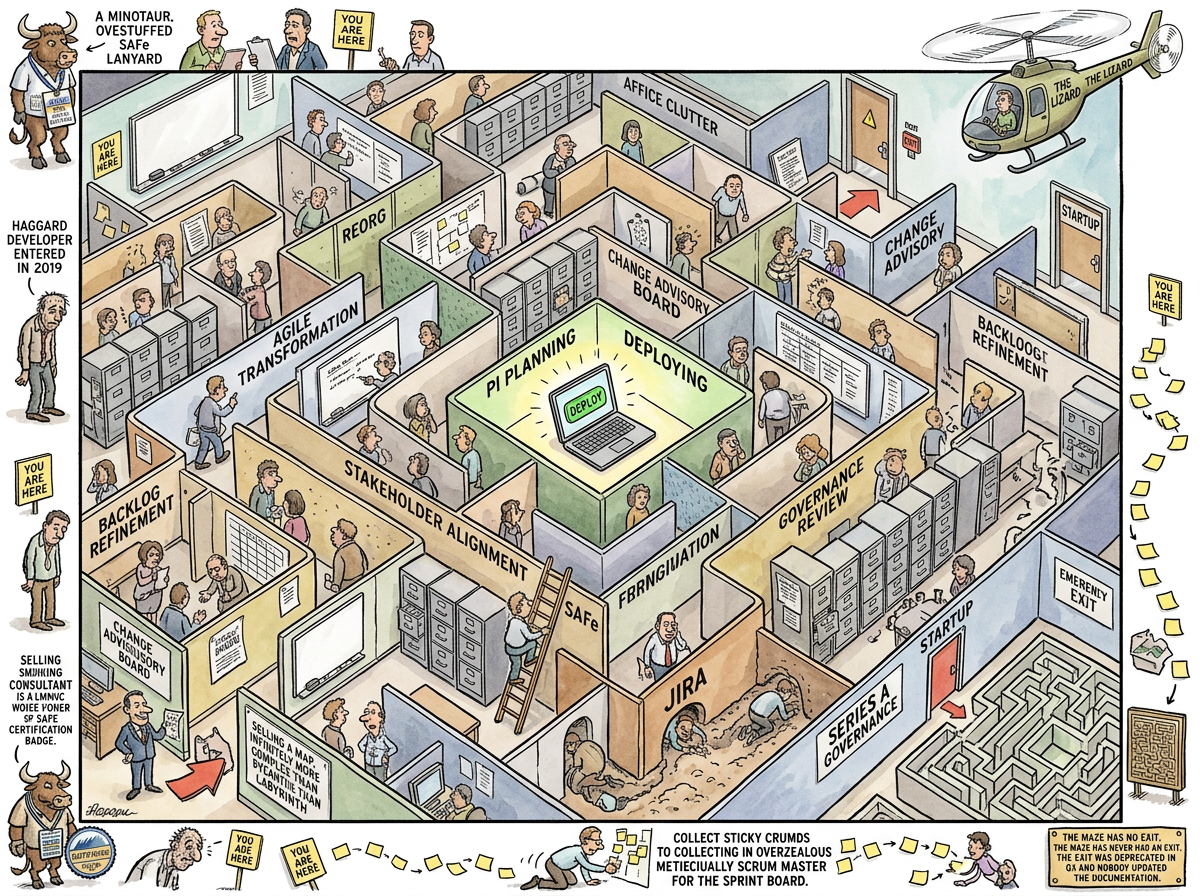
What this guide does have is a map. The map is of a maze. The maze is Enterprise IT. The maze has no exit. But it does have departments, and the departments have meetings, and the meetings have agendas, and the agendas have items, and the items have owners, and the owners have other meetings, and if you follow the trail long enough you will arrive back where you started, which is either a bug or the Retrospective, depending on whether you have a Scrum Master.
“The maze has no exit. This is not a defect. Mazes with exits are called corridors, and corridors do not require consultants.”
— The Lizard, who has never entered a maze
Section I: The Condition
Before you enter the maze, you must understand what the maze is made of. The walls are not stone. The walls are process.
| Article | What It Is | Why You Can’t Escape |
|---|---|---|
| Enterprise | Not a size. A condition. The gravitational state where simplicity collapses into governance. | Adding “enterprise” to any noun multiplies its cost by 10x and its complexity by 100x. Functionality: unchanged. |
| Legacy Code | Code that works, is in production, makes money, and must never be touched. | The code is load-bearing. The developer who wrote it left in 2014. The documentation is a comment that says // TODO. |
| Technical Debt | The interest rate on shortcuts. The mortgage on the code you wrote at 3 AM. | You cannot pay it off because the payments are scheduled in sprints that are full of new features requested by stakeholders who do not know the debt exists. |
| The Monolith | The application that does everything, deployed as one unit, understood by nobody. | It responds in 47 milliseconds. The microservices that replaced it respond in 2.3 seconds. The consultant drew a lizard on the whiteboard. |
| Microservices | The architecture where everything is separate, nothing is simple, and the network is the single point of failure you pretend doesn’t exist. | 47 services. £47,000/month. The Grafana dashboard looks like a Christmas tree. |
| The Second System Effect | The rewrite that will fix everything. The rewrite that fixes nothing and adds features nobody asked for. | The second system is always worse. Brooks proved this in 1975. Nobody read Brooks. |
| Rewrite | The conviction that starting over will solve the problems created by starting over last time. | See The Second System Effect. See also: every enterprise, every five years. |
| ESB | Enterprise Service Bus. The middleware that connects everything to everything through a single point of failure that is nobody’s responsibility. | Peak enterprise integration. XML in, XML out, XML everywhere. The bus that carries messages the way a bureaucracy carries memos: slowly, with transformations nobody requested. |
| SAP | The ERP system that runs the world’s largest companies and is understood by none of them. Configuration is development. Development is configuration. The line does not exist. | The maze builder. SAP does not live inside the enterprise. The enterprise lives inside SAP. |
| Oracle | The database company that became an ERP company that became a cloud company that became a licensing audit. | “Nobody ever got fired for buying Oracle” is the enterprise equivalent of “nobody ever got fired for not deploying.” Both are true. Both are the problem. |
| JIRA | The project management tool that manages the project of managing the project management tool. | The maze’s cartography department. JIRA maps the maze. The map is more complex than the maze. The map has its own backlog. |
| Linear | The anti-JIRA. Fast, opinionated, keyboard-driven. What project management looks like when the tool respects the developer’s time. | The tool the Solo Developer uses. The enterprise has not heard of it. |
Section II: The Process
The maze is not random. It has structure. The structure is called “process,” and it was designed by people who believe that if you cannot measure it, it does not exist, and if you can measure it, you should measure it in a meeting.
| Article | The Process | The Meeting It Generates |
|---|---|---|
| Waterfall | The sequential methodology where each phase completes before the next begins. Requirements, design, implementation, testing, deployment. The water flows down. There are no pumps. | Winston Royce described it in 1970 to argue against it. The industry read the diagram and not the text. The diagram was adopted. The argument was not. |
| Water-Scrum-Fall | Waterfall wearing Agile vocabulary. Five-week “sprints.” Phase gates called “ceremonies.” The Gantt chart relabeled as a “backlog.” | A famous camera manufacturer ran four staggered streams of five-week waterfall phases, called them sprints, and reported Agile adoption. The BI team built fiction in parallel. The rescue came from spreadsheets and a Release Manager who opened the gate every Friday. |
| Agile | The manifesto that fit on a napkin and now requires a 900-page certification programme. | All of them. Agile generated all the meetings. |
| Scrum | The framework where work is divided into sprints, sprints are divided into ceremonies, and ceremonies are meetings that cannot be cancelled because they are sacred. | Daily Standup, Sprint Planning, Retrospective, Sprint Review. Four meetings minimum. Per sprint. Forever. |
| SAFe | What if Agile, but enormous? The Scaled Agile Framework: a train metaphor that requires more people to operate than an actual train. | Big Room Planning, PI Planning, Inspect & Adapt, System Demo, Innovation Sprint. Ceremonies within ceremonies. |
| Kanban | The board. Columns: To Do, Doing, Done. The simplicity is the point. The simplicity is also why enterprises add twelve more columns. | Fewer meetings than Scrum. This is Kanban’s greatest strength and the reason enterprises distrust it. |
| Ceremony | A meeting that became sacred by being renamed. You can cancel a meeting. You cannot cancel a ceremony without questioning the framework, which is like questioning the liturgy during mass. | Itself. The ceremony is the meeting. The naming is the trap. |
| Sprint | Two weeks. The timebox. The unit of enterprise time between which nothing ships and after which everything is “in progress.” | Sprint Planning (beginning), Sprint Review (end), Retrospective (after the end), Daily Standup (every day of the sprint). |
| Sprint Planning | The ceremony where the team estimates how much work they can do in two weeks based on how much work they did in the last two weeks, adjusted for the fact that last sprint was unusual (every sprint is unusual). | Itself. Two to four hours. Every two weeks. Until heat death. |
| Backlog Refinement | The ceremony where the team discusses work they will not do this sprint so they can estimate work they might do next sprint. Also called Grooming, until someone looked up the word. | One hour per week, allegedly. Two hours per week, actually. |
| Retrospective | The ceremony where the team discusses what went wrong, writes action items on sticky notes, and then does not do the action items, which will be discussed in the next retrospective. | Ninety minutes. Every two weeks. The sticky notes are immortal. |
| Daily Standup | Fifteen minutes. What did you do yesterday. What will you do today. Any blockers. Fifteen minutes, allegedly. Forty-five minutes, actually, because someone is screen-sharing. | Every day. At 9:15 AM. For the rest of your career. |
| WIP Limits | The rule that says you can only work on N things at once. The rule that is immediately violated because “this is urgent.” | The meeting where someone asks to increase the WIP limit. |
| Definition of Done | The checklist that defines when work is complete. Code reviewed, tests passing, documentation updated, deployed to staging. In practice: “the PR was merged.” | The meeting where the Definition of Done is debated is never done. |
| Story Points | The unit of estimation that is not time, not complexity, not effort, but a “relative measure of work” that nobody can define and everyone argues about. | Planning Poker. The ceremony within the ceremony. |
| Epic | A large user story. How large? Larger than a story. How much larger? It depends. On what? On the team. This is the entire specification. | Epic Review, Epic Refinement, Epic Estimation. The epic generates its own meetings. |
| Spike | A time-boxed investigation. “We don’t know how to do this, so we’ll spend a sprint figuring it out.” The spike always reveals that the problem is harder than expected. | The spike review meeting, where the team explains that they need another spike. |
| MVP | Minimum Viable Product. The smallest thing that works. In enterprise: the full product minus the one feature the VP wanted, which is added in “Phase 2,” which is the MVP plus everything. | The MVP review meeting, which generates the Phase 2 planning meeting. |
| Backlog | The queue where work goes to wait. Infinite. Growing. Never groomed enough. The backlog is not a to-do list — it is a geological record of everything anyone ever wanted. | Backlog review, backlog refinement, backlog triage. The backlog generates meetings about the backlog. |
| User Story | “As a user, I want…” The unit of work in Agile. Three sentences describing a feature. Forty-five minutes debating whether it’s a story or an epic. | The story-writing workshop. The estimation meeting. The splitting meeting when the story is too large. |
| Burndown Chart | The graph that shows how much work remains. The line should go down. The line goes sideways. The line sometimes goes up. Nobody questions the line. | The meeting where the burndown is displayed and everyone nods. |
| Lean | The Toyota Production System adapted for software. Eliminate waste. Flow. Pull. The philosophy that became a startup buzzword and an enterprise certification. | Lean coffee, lean canvas, lean portfolio management. Toyota did not have certifications. |
Section III: The People
The maze is operated by people. The people have titles. The titles have meanings. The meanings have changed. The people remain.
| Article | The Role | The Honest Description |
|---|---|---|
| CEO | Chief Executive Officer. The person at the top. | The person who says “we need to be more agile” and means “we need to ship faster” and achieves neither. |
| CTO | Chief Technology Officer. The person who chose the architecture. | The person who chose microservices in 2018, regrets microservices in 2026, and will choose the next thing in 2028. |
| CIO | Chief Information Officer. The person who manages IT. | The person who manages the vendors who manage the consultants who manage the contractors who write the code. |
| CFO | Chief Financial Officer. The person who approves the budget. | The person who does not understand why the cloud bill is £47,000/month but approved the microservices migration. |
| VP | Vice President. Of what? Of something. The title inflates with the company. | A VP at a startup is the second employee. A VP at an enterprise is one of four hundred. |
| Engineering Manager | Manages engineers. Does not engineer. Attends meetings on behalf of engineers so engineers can attend other meetings. | The meeting proxy. The shield. The translator between developer and executive. |
| Tech Lead | The senior developer who also does architecture, mentoring, code review, and sprint planning, for the same salary. | A developer with extra meetings and no extra pay. |
| Senior Developer | The developer who has seen enough rewrites to know that this one will also fail. | The person who says “we tried that in 2019” and is ignored. |
| Release Manager | The person who controls the gate between code and production. Holds the keys. Decides when software happens. | Either the most dangerous bottleneck or the most valuable ally. The benign ones open the gate on Friday. The others open it quarterly. The difference is the person, not the role. |
| Scrum Master | The facilitator. The servant leader. The person who ensures the ceremonies happen. | The priest. The ceremonies cannot be cancelled. The Scrum Master ensures this. |
| Agile Coach | The person who teaches agility. Billing: £1,500/day. Duration: indefinite. | The consultant who noticed that “Agile Coach” pays better than “Scrum Master” and rebranded accordingly. |
| Agile Transformation Lead | The person who leads the transformation. The transformation is always in progress. Always. | The role that exists only during transformation, which is why the transformation never ends: the role would end with it. |
| Product Owner | The person who decides what to build. Speaks to stakeholders on Monday. Speaks to the team on Tuesday. The two conversations do not match. | The translator. The person in the middle. The person who says “the stakeholders want X” knowing the team will deliver Y. |
| Product Manager | Like the Product Owner but with a roadmap and a strategy deck and no authority over the sprint backlog. | The person with a roadmap that does not survive contact with the sprint. |
| Technical Account Manager | The customer’s personal CEO. No org chart box. No direct reports. Everyone effectively reports to you. Overturns CTO decisions by calling the scary COO. | $350/hr to compensate for the support queue the vendor won’t fix. One hour of training. Two years of retention. The bug is the feature. The margin is $270/hr. |
| The Consultant | The person who arrives, asks expensive questions, draws on whiteboards, and leaves before the consequences arrive. | riclib was one of these. £3,000/day. The most expensive question: “What worked before this?” |
| HR | Human Resources. The department that manages humans as resources. | The department that schedules the Performance Review and administers the PIP. |
| Manager | The person above you. The person below the person above them. The fractal of accountability. | Manages. What? Depends on the prefix. Engineering Manager manages engineers. Manager manages. |
| Test Coordinator | The person who ensures testing happens. The QA gatekeeper. The person whose sign-off you need before the Release Manager’s sign-off. | Two gates for the price of two. The Test Coordinator guards the gate before the gate. |
| Solo Developer | One person. No sprints. No ceremonies. No Gantt chart. Ships on Tuesday because Tuesday is a good day. | The maze’s emergency exit. The proof that software can be built without the maze. The reason the maze exists is to prevent this. |
Section IV: The Laws
The maze has laws. Not rules — rules can be broken. Laws. The kind that operate whether you acknowledge them or not, like gravity, except gravity is simpler and better documented.
| Article | The Law | The Enterprise Translation |
|---|---|---|
| Gall’s Law | A complex system that works evolved from a simple system that worked. You cannot design a complex system from scratch. | The monolith worked. You cannot skip the monolith. The people who tried have 47 microservices and a Grafana dashboard that looks like a Christmas tree. |
| Conway’s Law | Your software architecture will mirror your org chart. | You reorganised into squads. Your API now has squad-shaped boundaries. The boundaries make no sense to users. Users do not have squads. |
| Brooks’s Law | Adding people to a late project makes it later. | Published 1975. Reproved daily. Every enterprise has independently verified this and ignored the result. |
| Murphy’s Law | Anything that can go wrong will. | The deploy will fail on Friday at 5 PM. The rollback will also fail. The person who knows how to fix it is on holiday. |
| Goodhart’s Law | When a measure becomes a target, it ceases to be a good measure. | Velocity was a diagnostic tool. Then it became a target. Then the team learned to estimate high. Then velocity went up. Then management celebrated. Then nothing changed. |
| Peter Principle | People rise to their level of incompetence. | The best developer becomes Tech Lead, then Engineering Manager, then VP of Engineering, then the person who approved the microservices migration. |
| Dunning-Kruger Effect | The less you know, the more confident you are. The more you know, the less confident you are. | The intern proposes rewriting the monolith in Rust. The principal engineer says “we tried something like that in 2019.” The intern is more confident. |
| Boring Technology | Choose technology you understand. The innovation tokens are limited. Spend them wisely. | The Lizard’s entire philosophy. The opposite of the enterprise instinct, which is to choose technology that has a booth at re:Invent. |
| Zawinski’s Law | Every program expands until it can read mail. | lg is a markdown indexer that now serves a satirical encyclopedia with AI-generated watercolour illustrations. The law is real. |
| The Second System Effect | The second version is always over-engineered. The features nobody used in v1 become the architecture of v2. | The rewrite. Every five years. Always worse. Always more expensive. Always approved. |
Section V: The Conditions
The maze does things to the people inside it. These are the conditions. They are not bugs. They are features of the maze.
| Article | The Condition | Prognosis |
|---|---|---|
| Developer Burnout | The state where the developer has attended enough ceremonies that the ceremonies have replaced the work. | Terminal without intervention. Intervention: a deploy button and silence. |
| Imposter Syndrome | The conviction that you do not belong here and everyone will discover this. | Universal among competent developers. Absent among incompetent ones. See Dunning-Kruger Effect. |
| Perfectionism | The refusal to ship until it is perfect. It will never be perfect. Therefore it will never ship. | The opposite of MVP. The enemy of done. The friend of burnout. |
| Career-Limiting Move | The action that ends advancement. Examples: telling the truth in a meeting, questioning SAFe, deploying on a Friday, replying-all with data. | Irreversible. One CLM per career. Choose wisely. |
| PIP | Performance Improvement Plan. Not an improvement plan. A documentation trail for termination. | If you are on a PIP, update your CV. The “improvement” is a formality. HR knows this. You know this. The PIP knows this. |
| Performance Review | The annual ceremony where your work is summarised by someone who attended different meetings than you did. | The review reviews the perception of performance, not performance. The perception was formed in meetings you were not invited to. |
| Development Goal | The goal that HR requires and nobody tracks. “Improve communication skills.” “Learn Kubernetes.” Written in January. Forgotten in February. Reviewed in December. | The goal exists to populate a form. The form exists to populate a system. The system exists to justify the department that administers the system. |
| Stakeholder Management | The art of keeping people informed who cannot be satisfied. | The stakeholder wants everything, now, for free. The developer can provide one of these. Stakeholder management is choosing which one and explaining why. |
Section VI: The Books
The maze has a library. The library contains books that describe the maze. Some describe it accurately. Some describe what the maze should be. The gap between the two is where consultants live.
| Article | The Book | What It Actually Says |
|---|---|---|
| The Mythical Man-Month | Brooks, 1975. Adding people makes it worse. | Published fifty-one years ago. Proved every day since. Ignored every day since. |
| The Phoenix Project | Kim, 2013. The IT novel. Fix the bottleneck. | “The Three Ways” but as a story about a man who is having a very bad week. |
| The Unicorn Project | Kim, 2019. The developer’s version. Five Ideals. | The sequel where the developers are the heroes and management is the maze. |
| The Goal | Goldratt, 1984. Theory of Constraints as a novel. | A man saves a factory by identifying the bottleneck. IT adopted this and then added forty-seven new bottlenecks. |
| The Lean Startup | Ries, 2011. Build, measure, learn. | The book every startup founder read. The enterprise read it too and added a governance layer to the build-measure-learn loop. |
Section VII: The Transformation
Every maze has a transformation. The transformation is the project to change the maze. The transformation does not change the maze. The transformation adds a new wing to the maze labeled “TRANSFORMATION.”
| Article | The Initiative | Current Status |
|---|---|---|
| Transformation Initiative | The project to transform the enterprise. Budget: large. Timeline: eighteen months. Actual timeline: ongoing. | In progress. Since 2019. |
| Enterprise Agility | The state where the enterprise is agile. Not to be confused with the enterprise doing Agile, which is different, and not to be confused with the enterprise being agile, which has never been observed. | Aspirational. |
| Reorg | The reorganisation. The belief that the problem is the org chart, not the software, not the process, not the culture. Move the boxes. The same people. Different boxes. | Annual. Sometimes biannual. The boxes move. The maze remains. |
| Org Chart | The diagram that shows who reports to whom. Conway’s Law says the software looks like this. It does. | The org chart is redrawn every reorg. The software is not redrawn. The software remembers the previous org chart. All of them. |
| Offsite | The meeting held off-site to encourage strategic thinking, which produces sticky notes on a wall that are photographed, emailed to attendees, and never referenced again. | Quarterly. The hotel has better coffee than the office. This is the value proposition. |
| Mission and Vision | The statements that describe why the company exists and where it is going. Written by committee. Understood by nobody. | “We empower enterprises to leverage synergies through innovative solutions.” This means nothing. It is laminated and on the wall. |
| DevOps | The practice of combining development and operations. The enterprise version: renaming the Ops team “DevOps” and giving them a Slack channel. | The word “DevOps” on the org chart. The same silos. Different Slack channels. |
| Meeting Facilitation | The skill of making meetings productive. The assumption: meetings can be productive. | The facilitator arrives with a timer, a parking lot, and hope. The timer is ignored. The parking lot fills up. The hope dies. |
| The Spotify Model | Squads, tribes, chapters, guilds. Spotify doesn’t use it anymore. Everyone else adopted it. | The framework named after a company that abandoned it. Adopted by companies that don’t make music. |
How to Escape the Maze
You cannot escape the maze. The maze has no exit. This was established in paragraph three and has not changed.
However, you can become comfortable in the maze. You can learn which corridors lead to dead ends (Big Room Planning) and which lead to corridors that lead to dead ends (SAFe). You can learn which meetings can be skipped (most of them) and which cannot (Daily Standup — absence is noticed, participation is not). You can learn that the deploy button at the center of the maze is real, and it works, and nobody is guarding it, and the reason nobody presses it is that pressing it requires a Change Advisory Board approval that requires a JIRA ticket that requires a Product Owner sign-off that requires a stakeholder meeting that requires a calendar slot that does not exist because the calendar is full of ceremonies.
Or you can do what riclib did: leave the maze, build a markdown indexer in Go, and write a satirical encyclopedia about the maze from outside. The pay is worse. The meetings are zero. The deploy button is git push. The Lizard approves.
THE MAZE HAS NO EXIT
THE MAZE HAS NEVER HAD AN EXIT
THE EXIT WAS A CORRIDOR
THE CORRIDOR WAS A MEETING
THE MEETING WAS A CEREMONY
THE CEREMONY WAS THE MAZETHE DEPLOY BUTTON IS AT THE CENTER
NOBODY GUARDS IT
NOBODY PRESSES IT
NOBODY KNOWS WHY— The Lizard, who has never entered a maze and never will
Measured Characteristics
Articles in this guide:                     77
Sections:                                   7 (The Condition, The Process, The People, The Laws, The Conditions, The Books, The Transformation)
Meetings described:                         all of them
Meetings that could have been emails:       all of them
Maze exits:                                 0
Consultants selling maps:                   £1,500/day (minimum)
Laws that are ignored:                      all of them (daily)
Transformations in progress:                1 (since 2019)
Transformations completed:                  0 (ever)
Deploy buttons at the center:               1
People who press it:                        the solo developer who left
Sticky notes generated per quarter:         uncountable
Sticky notes acted upon per quarter:        0
Career-Limiting Moves per career:           1 (max)
Time spent in maze before realising:        varies (average: 3 reorgs)
Time spent in maze after realising:         the rest
The Lizard's recommendation:                do not enter
See Also
Every link in every table. This is a map of a maze. The links are the corridors. Following them is entering the maze. You have been warned.
And if you are reading this from inside the maze — from a meeting about a meeting, from a ceremony that was once a standup, from a sprint that has been “in progress” since 2019 — know that the deploy button is real. It is at the center. Nobody guards it.
DON’T PANIC.
(Press the button.)