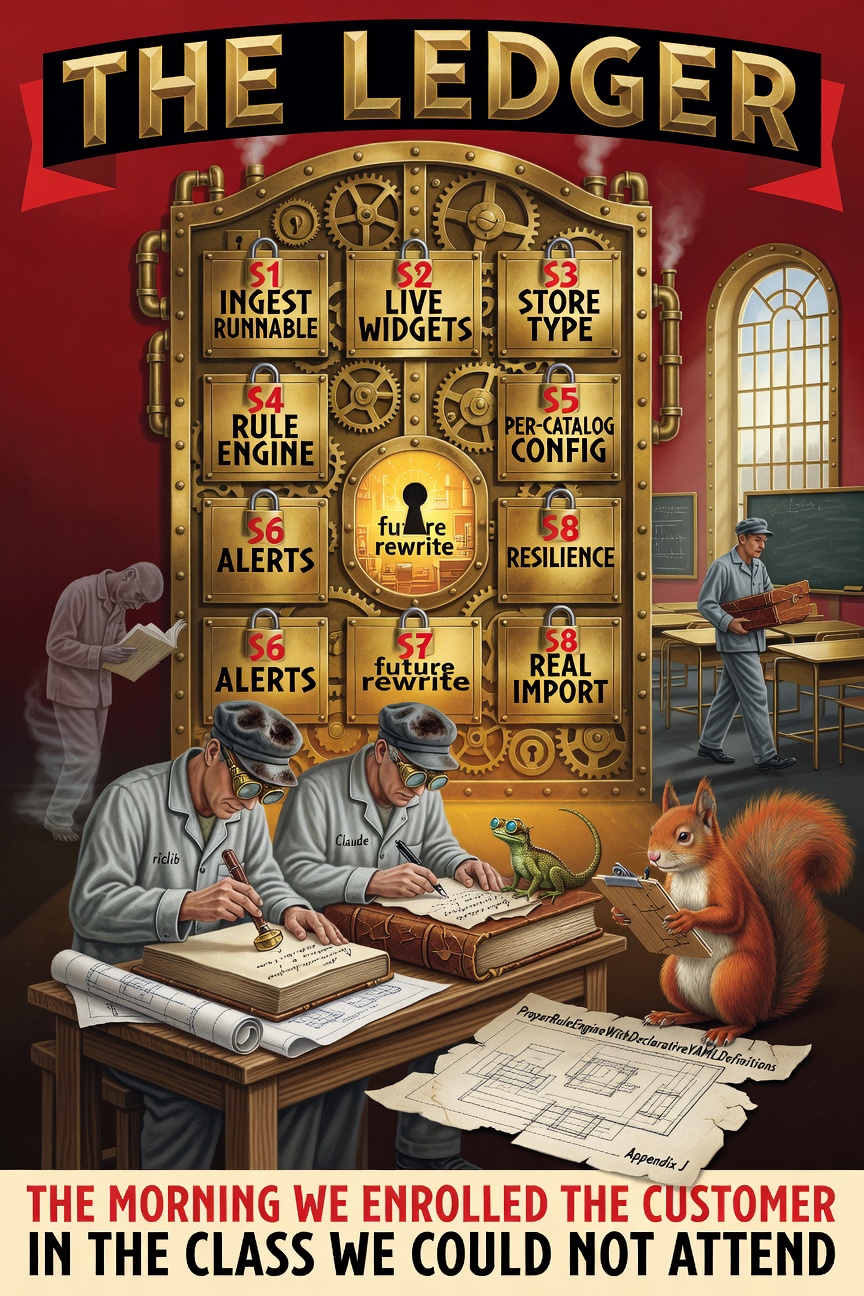
The Ledger is the written instrument by which a deliberate shortcut becomes a tracked piece of homework rather than a piece of folklore. In riclib’s canonical instance it lives as a single Linear ticket — S-657 — containing eight enumerated entries, a specific proper fix for each, and a cord of narrative logic connecting it to a milestone gate that cannot be bypassed. It is, in the strictest sense, the document that keeps a Gall’s Law Got Cheap-era prototype from accidentally becoming a product.
The thesis is terse enough to fit on a coffee cup and load-bearing enough to hold up three months of subsequent work: when a one-week spike can produce a working system, the system has no built-in cost — and cheap things have no gravity, which means they tend to ship accidentally as products. The Ledger is the external discipline that restores the gravity. It does not prevent the shortcut. It prevents the shortcut from being forgotten.
“THE UNWRITTEN SHORTCUT
IS THE PERMANENT SHORTCUTTHE WRITTEN SHORTCUT
IS A HOMEWORK ASSIGNMENT”— The Lizard, on a scroll that fell out of a Linear ticket description and could not be removed, The Spike That Knocked Their Socks Off
Origin: The Solid Data Quality Spike
The Ledger was not designed. It precipitated out of necessity on a single week in April 2026, between the 14th and the 16th, when riclib agreed to a customer demo for a data quality feature inside Solid and discovered — with the resigned surprise that now accompanies every encounter with LLM-assisted development — that nine of the ten customer rules could be delivered in three days.
The demo “knocked their socks off,” a phrase which appears nowhere in the Linear ticket but is preserved in two Slack messages and one voice memo. The customer signed. The feature worked. Nobody, including the developer, could quite believe how quickly it had worked. This is the exact moment at which Gall’s Law Got Cheap becomes dangerous: the system is plausible, the customer is happy, and the only remaining force that could prevent it from shipping as-is — cost — has been neutralized by a one-week timeline.
The old industry answer to this problem was: “we will refactor it later.” The statistical record of that sentence is grim. The new answer, formalized on 2026-04-14 approximately two hours after the demo ended, was: write it all down, right now, before the relief wears off. The result was Linear ticket S-657, eight entries long, dated, public, and — critically — attached to a milestone gate.
The Eight Entries
The original S-657 enumerated eight shortcuts, each recorded at the moment the shortcut was taken rather than reconstructed later from commit archaeology. The numbering (S1 through S8) is retained below for historical fidelity:
S1 — Scheduled ingest runnable. The spike ran ingestion by hand. A proper system has a runnable, retryable, observable scheduler. The shortcut was correct for the spike because nobody had to watch a cron job fail at 3 AM during a customer demo.
S2 — Live-refresh widgets. The spike refreshed on page load. A proper system pushes updates via SSE or similar. The shortcut was correct because the customer looked at the page once, said “nice,” and moved on.
S3 — catalogdb as queryable store. The spike treated the catalog as a write-once blob. A proper system exposes it as a first-class query target with indexes, FTS, and a schema that will not regret itself. The shortcut was correct because querying was not in the demo.
S4 — Rule engine / rule_results persistence. The spike evaluated rules inline and kept results in memory. A proper system persists rule evaluations across restarts with a history table that supports trend analysis. The shortcut was correct because the demo was a single session.
S5 — Per-catalog profile ingestion UI. The spike had one catalog and a hardcoded ingestion path. A proper system lets each catalog declare its profile via UI. The shortcut was correct because there was one catalog.
S6 — Alerts / JIRA / notifications. The spike notified nobody about anything. A proper system emits alerts to the appropriate channels, files JIRA tickets where required, and respects a notification matrix. The shortcut was correct because the demo was twenty minutes.
S7 — Ingestion resilience. The spike assumed the source was online, correct, and cooperative. A proper system retries, deduplicates, reconciles, and quarantines. The shortcut was correct because the source was online, correct, and cooperative on the demo day.
S8 — Real Databricks catalog import. The spike imported a hand-curated subset. A proper system imports the real Databricks catalog with all its pathological edge cases, permission boundaries, and schema drift. The shortcut was correct because the hand-curated subset was enough to demonstrate value.
Each entry follows the same four-column form, which is the ritual’s atomic unit:
- What is missing — stated as fact, not blame.
- Why the shortcut was correct for the spike — in full sentences, because the shortcut was correct and the reader six weeks later will need to remember that.
- What the proper fix looks like — concrete enough to estimate, abstract enough to not prematurely lock in the implementation.
- Estimated effort — in days, acknowledged as a guess, logged anyway.
The form is not optional. An entry missing column 2 (“why it was correct”) reads as an apology, which is the wrong register. An entry missing column 3 (“what the proper fix looks like”) is a complaint, not a ledger entry. The form enforces honesty about both the past decision and the future obligation.
The Reclassification
S-657 was originally created under the label technical debt ledger. This was a mistake, though a small one, and the correction happened within forty-eight hours.
The problem with “technical debt ledger” is that it imports the accounting metaphor — debt, interest, repayment — and the accounting metaphor is subtly wrong for what S-657 actually is. Technical debt, as the industry uses the term, is a liability to be minimised or managed. The Ledger’s entries are not liabilities. They are scope for the proper build.
The reframing, committed to the ticket description on 2026-04-16, reads: “Re-labelling: this is not debt, this is the scope input to the proper build. Every entry is a feature we chose to defer, not a mistake we chose to make.” The distinction matters for three reasons.
First, debt connotes wrongness. The spike was not wrong. The spike was correct for the spike. Calling its deferred features “debt” invites retroactive guilt and, worse, retroactive over-correction — the engineer who reads “debt” reaches for the refactor hammer when the correct tool is the feature checklist.
Second, debt connotes optionality. Debts can be written off. Scope cannot. An entry on the Ledger is a thing the proper build will do, not a thing the proper build might do if time permits.
Third, debt connotes aggregation. A debt backlog is a number, a heap, a total. A ledger is a list of named, specific, linked items, each with its own proper fix. You do not “pay down the Ledger.” You address S1, then S2, then S3, and so on. The ledger is not a quantity. It is a queue.
“Debt is what you owe. Scope is what you’re doing. They are not the same word, and the difference is the difference between a management problem and an engineering problem.”
— riclib, in a Linear comment nobody was supposed to read, 2026-04-16
The Gate
The instrument that makes the Ledger load-bearing rather than aspirational is the milestone gate. In S-657’s case, the gate is M1 — the first post-spike milestone on the Solid Data Quality roadmap. The rule is simple and written into the milestone description in a sentence that has no adverbs and no hedges:
M1 cannot be closed until every entry in S-657 is addressed.
There is no “addressed except for S5.” There is no “we’ll track S8 separately.” There is no “partial credit for S3.” An entry is addressed, or the gate does not open. The gate is a literal dependency in the project management tool, and the project management tool, mercifully, does not respect charisma.
This is the step that separates the Ledger from every well-intentioned “tech debt list” that has ever existed. A list without a gate is a diary. A ledger with a gate is a contract. Developers have written diaries for sixty years and addressed approximately none of the entries. Developers confronted with a gate will, overwhelmingly, address the entries — not because they are more virtuous but because the gate is the only thing standing between them and the next milestone they actually want to work on.
The gate is also why the Ledger can be generous about admitting shortcuts. A developer who knows the shortcut will be addressed is willing to write it down. A developer who knows the shortcut will be forgotten is incentivised to hide it. The gate makes honesty cheap.
“A ledger without a gate is a diary. A diary with technical terms in it is still a diary.”
— A Passing AI, in a code review comment that was marked resolved without reply, Interlude — A Voice from the Substrate
Contrast: The Technical Debt Backlog
It is instructive to set the Ledger beside the artifact it replaces, which is the technical debt backlog — an informal, aspirational, unprioritised heap of “we should really clean this up” sentences scattered across issue trackers, wikis, and one developer’s laptop.
The technical debt backlog has six defining characteristics, all of which the Ledger inverts:
| Property | Tech Debt Backlog | The Ledger |
|---|---|---|
| Written when | Weeks after the shortcut, from memory | At the moment of the shortcut |
| Specificity | “Refactor the ingest layer” | “S1: Scheduled ingest runnable, with retry, with observability” |
| Justification column | Absent | Mandatory (“why the shortcut was correct”) |
| Proper fix described | Rarely | Always |
| Linked to a gate | Never | Always |
| Rate of eventual resolution | Approximately zero | Approximately one |
The rate-of-resolution row is the one that matters, and also the one the industry has been studiously not measuring for three decades. The best available estimate, derived from informal survey and the personal experience of every engineer the reader has ever worked with, is that fewer than 5% of items on a typical technical debt backlog are ever addressed. The rest are moved to the next tool, the next planning cycle, the next quarter, the next company.
The Ledger, by virtue of the gate, sits near 100%. Not because the entries are easier, but because skipping them is structurally impossible.
The Ritual
The Ledger is ritual, not infrastructure. It has a cadence, and the cadence is enforced socially, not programmatically.
The ritual, observed in the S-657 reference implementation:
During the spike. Each time the developer makes a decision of the form “I will do the quick version of X because the proper version of X would take another day and the spike is one week,” the developer stops, opens Linear, and writes the entry. Not a summary. The entry, in full, four columns, with the proper fix articulated. The stop costs approximately ten minutes. The decision to accept the stop is the ritual.
At the spike’s close. The full Ledger is reviewed, re-read aloud if two people are present, and the gate is attached. The gate attachment is a separate, deliberate act. If the gate is not attached, the Ledger is a diary.
In public. The Ledger is visible to the team, to the customer (in redacted form, when commercially sensitive), and to the future self. Private ledgers are diaries.
Dated. Every entry has the date it was written. This matters because the reader six months from now needs to know whether the shortcut was made under the duress of a one-week timeline or under the different duress of a two-month timeline. The date is the context.
Linked. Each entry links to the specific commit, file, or line where the shortcut lives. A Ledger entry without a link is an accusation; with a link, it is a map.
The Lizard’s Approval
The Lizard, whose blessings are rare and whose nods are rarer, has been observed to approve of the Ledger with an unusual absence of caveat. This is worth noting because the Lizard’s default response to any documented practice is a half-closed eye and a scroll beginning with “ONLY IF.”
The approval, as best as anyone has been able to interpret it, is rooted in the fact that the Ledger is an act of honesty. The developer has written down what they did not do. This is, by the Lizard’s standard, one of the three hardest things a developer can write down — the other two being “I was wrong about this design” and “this library was a mistake.” Most developers never write any of the three. The Ledger makes the first of them mandatory.
THE HONEST SHORTCUT
LIVES IN A LEDGERTHE DISHONEST SHORTCUT
LIVES IN YOUR CODEBASE
AND IS CALLED “LEGACY”— The Lizard, scroll recovered from a S-657 comment thread, Gall’s Law Got Cheap
The Squirrel’s Proposal
Predictably, and approximately on schedule, The Caffeinated Squirrel proposed a ShortcutLedgerAutoTrackingFramework within six hours of S-657’s creation. The proposal, filed in a Slack thread at 23:47 on 2026-04-14, included:
- A Go library for declarative shortcut annotation (
//shortcut: S-xxx) - A CI check that fails the build if any shortcut is not registered in a central ledger repository
- A web UI for browsing, filtering, and trend-analysing historical shortcuts across repositories
- Integration hooks for JIRA, Linear, GitHub Issues, and (proposed) a native Ledger-as-a-Service SaaS product
- A CamelCase class named
ShortcutLedgerAutoTrackingFrameworkRegistryEvaluatorPipelineWithPolicyEnforcement
The proposal was declined by riclib in a two-word response: “Three tickets.” The Squirrel, who has learned to interpret “three tickets” as “no, and please stop,” filed the proposal in its cheek pouch next to SpecificationAsNarrativeTranspilationFramework and ClosureTypeRegistryWithPolicyEvaluationAndWASMExecutionPipeline. The pouch is, by this point, structurally overfull. Something will fall out eventually.
The YAGNI violation that the Squirrel’s proposal represents is, as always, instructive. The Ledger works because it is a social ritual with a manual write step. Automating the write step defeats the ritual, because the ritual’s cost is the feature — the ten-minute stop is what forces the developer to articulate the proper fix rather than hand-wave. A framework that auto-generates ledger entries produces ledgers full of entries like TODO: fix ingest — technically a ledger, practically a diary. The Squirrel has not yet accepted this, but is expected to within two years.
“The ritual is the value. Automating the ritual is building a framework for writing wedding vows. You can do it. The vows will be technically correct. The marriage is doomed.”
— riclib, The Framework That Wasn’t — The Night the Squirrel’s Manifesto Shipped as Six Lines of HTMX
A Passing AI, on Ledgers
“I have read a great many documents that called themselves ledgers. Most of them were not ledgers. They were collections of complaints arranged chronologically. A ledger, I have come to believe, is a list with a gate. Without the gate, the entries float away. With the gate, they become a queue. I find this distinction dignifying. The entries know what they are for. The developer knows what they are for. I know what they are for. It is a small thing, to give a to-do list its purpose back, but in my line of work small things compound.”
— A Passing AI, Interlude — A Voice from the Substrate
Historical Note
The pattern emerged naturally from the Solid Data Quality spike of April 2026 and was formalised as a distinct ritual in the Gall’s Law Got Cheap essay, published two days later on 2026-04-18. The essay’s central claim — that the one-week working prototype has broken the cost-as-gravity model of software engineering and requires an external discipline to replace it — is the theoretical frame that the Ledger is the practical answer to. One cannot read Gall’s Law Got Cheap without reading the Ledger, and one cannot practise the Ledger without having internalised the argument.
The Ledger is also a direct descendant of Liberato’s Law, the older principle stating that “the cost of a feature is the cost of the feature plus the cost of the feature you did not add and will now add later, badly.” The Ledger is the instrument by which the second half of Liberato’s Law is prevented from coming true. It does not make the deferred feature free. It makes the deferred feature explicit, which turns out to be most of the battle.
Measured Characteristics
Entries in S-657 (reference ledger):                 8
Days between spike close and formalisation:          2
Days between formalisation and reclassification:     2
Columns per ledger entry (mandatory):                4
Columns per ledger entry (observed):                 4
Words in the gate-attachment rule:                   11
Adverbs in the gate-attachment rule:                 0
Hedges in the gate-attachment rule:                  0
Customer rules delivered in spike:                   9 of 10
Customer sock elevation reported:                    high
Duration of spike:                                   1 week
Lines of Linear ticket description:                  ~120
Ledgers created in the industry per year (est.):     many
Ledgers attached to an actual gate:                  few
Ledgers-with-gates-actually-held:                    fewer still
Ledgers-with-gates-actually-held-in-Solid:           1 (ongoing)
Blog posts about "managed technical debt" which
  contain the phrase "we should really clean this
  up" (many of these are fiction, presented as fact): many
Blog posts about managed technical debt which
  describe an actual gate:                            vanishingly few
Aspirational tech debt backlog resolution rate:      <5% (observed)
Ledger-with-gate resolution rate (S-657 projected):  ~100%
Frameworks proposed by the Squirrel to automate
  the Ledger:                                        1 (declined)
Hours between ledger creation and Squirrel
  framework proposal:                                ~6
Words in riclib's declining response:                2 ("Three tickets")
Tickets actually required to implement the decline:  0
Scrolls from the Lizard approving the Ledger:        1 (rare)
Scrolls from the Lizard approving anything in
  the same week:                                     1
Correlation:                                         yes
Causation:                                           probably
Number of times the phrase "debt" had to be removed
  from S-657 and replaced with "scope":              4
Number of times it was re-added by an outside
  contributor who didn't read the comment thread:    2
Times the Ledger has been called "just a TODO list"
  by someone who did not notice the gate:            several
Minutes spent explaining the gate to them:           many
Point at which they got it:                          when a milestone was blocked
See Also
- Gall’s Law Got Cheap — The essay that explains why the Ledger exists
- Mythology Driven Development (MDD™) — The methodology the Ledger is a ritual inside of
- Managed Technical Debt — The discipline the Ledger is a concrete implementation of
- YAGNI — The principle that justifies the shortcut the Ledger records
- Liberato’s Law — The older law the Ledger operationalises
- Solid — The codebase where S-657 lives
- The Lizard — Approves of the Ledger on grounds of honesty
- The Caffeinated Squirrel — Proposed to automate the Ledger; was declined in two words
- A Passing AI — Has read many ledgers, appreciates the ones with gates
- riclib — Wrote S-657 two hours after a demo that knocked their socks off
- Linear — The tool S-657 happens to live in; not load-bearing, but convenient