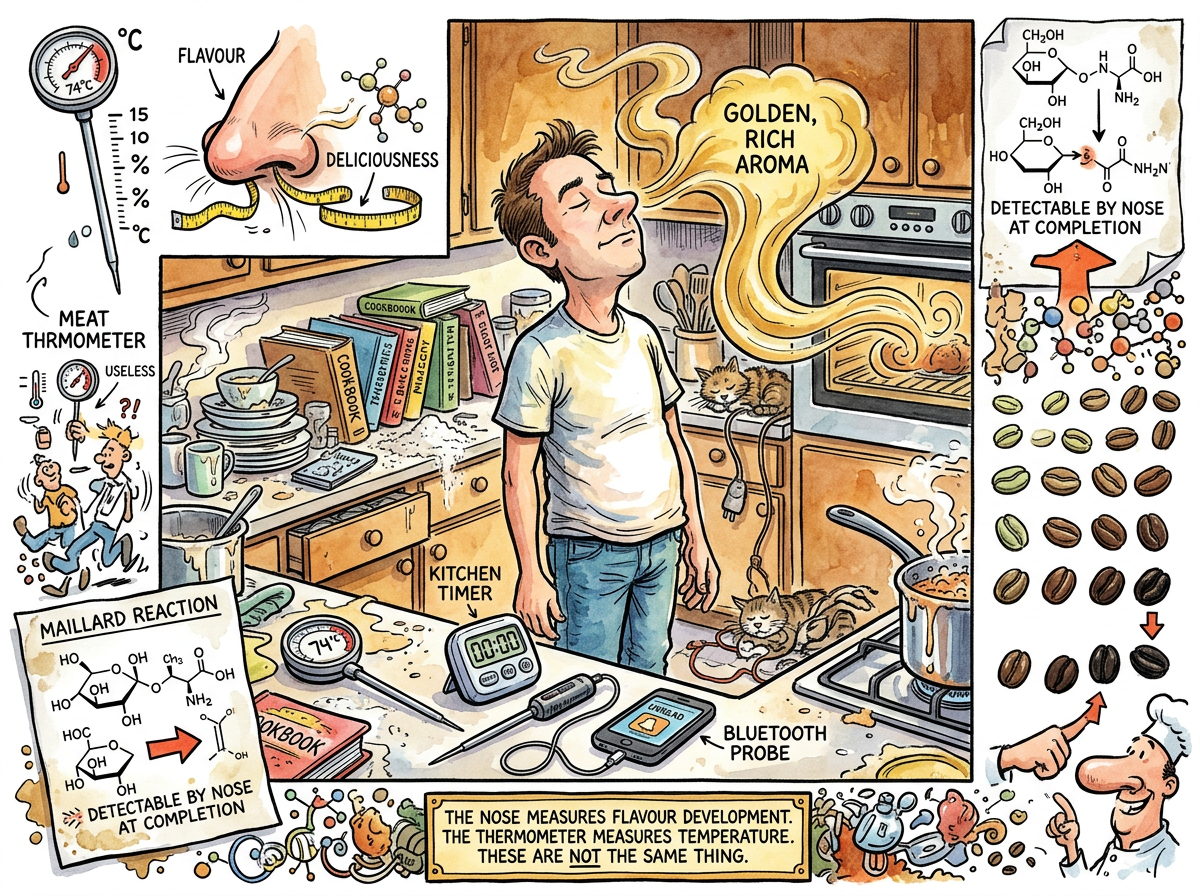
The Nose is the human olfactory system repurposed as a precision cooking instrument. It detects what thermometers, timers, and apps cannot: the completion of the Maillard reaction, the readiness of a roast, and the specific moment when a kitchen shifts from smelling like “something is cooking” to smelling like “dinner is ready.”
The Nose is the most accurate instrument in riclib’s kitchen, and the only one that has never produced a false positive or a false negative. Thermometers measure temperature. Timers measure time. The Nose measures flavour development, which is the thing you are actually trying to achieve, and which neither temperature nor time directly represents.
“The timer tells you when time has passed. The thermometer tells you how hot it is. The Nose tells you when the food is ready. These are three different questions. Only one of them matters.”
— The Lizard
The Principle
A thermometer measures a proxy. Temperature is correlated with doneness, but temperature is not doneness. A chicken at 74°C internal temperature is safe to eat. It may or may not be delicious. The Maillard reaction on the skin may or may not have completed. The fond in the tray may or may not have caramelised. The collagen may or may not have begun converting. The thermometer does not know. The thermometer knows 74°C.
The Nose measures the output directly. When the Maillard reaction completes on the skin, it produces volatile aromatic compounds — pyrazines, furans, thiophenes — that become airborne and travel to the olfactory receptors. When the fond caramelises, it produces a distinct shift in kitchen aroma. When the collagen begins converting, the smell changes again. Each stage of readiness has a signature that the Nose detects and that no digital instrument can replicate, because no digital instrument measures the specific combination of hundreds of volatile compounds that the human olfactory system processes simultaneously.
riclib does not set a timer for roast chicken. riclib walks into the kitchen at minute forty, breathes, and knows. This is not mysticism. This is pattern recognition trained over hundreds of chickens. The Nose has been calibrated the way any instrument is calibrated: through repeated exposure to known standards until the readings are reliable.
The Calibration
The Nose is not innate. Nobody is born knowing when a chicken is ready by smell. The Nose is trained — chicken by chicken, roast by roast, year by year — until the pattern is automatic. The first ten chickens, the cook uses a thermometer. The next ten, the cook uses a thermometer and notices the smell. The next fifty, the cook smells first and checks with the thermometer. After a hundred, the thermometer is redundant.
This is the same calibration curve as any instrument. A junior developer runs every test before deploying. A senior developer knows which tests to run by looking at the diff. Both are valid. One requires the instrument. One has internalised the instrument.
The Test Coordinator applies the same pattern recognition to software. He does not need a dashboard to know the build is broken. He has tested 238 builds. He knows the pattern. The dashboard confirms what the Test Coordinator’s instinct already detected — the same way the thermometer confirms what the Nose already knew.
Beyond Chicken
The Nose applies to coffee roasting — the roaster monitors first crack and second crack by sound, but the roast profile is confirmed by smell. The Nose detects the shift from green-grassy to bready to caramel to chocolate to burnt. A coffee roaster who relies only on temperature and time will produce acceptable coffee. A coffee roaster who uses the Nose will produce coffee that is tuned to the specific batch, the specific humidity, the specific bean.
The Nose applies to espresso — a barista can detect channelling (uneven extraction) by the aroma before tasting. The Nose applies to bread baking, to fermentation (where the Nose detects off-flavours before any instrument), and to the specific moment when a BBQ cook opens the Kamado lid and knows, before looking, whether the brisket is ready.
Measured Characteristics
Volatile compounds detected by human olfactory system:   ~1 trillion combinations
Volatile compounds detected by a meat thermometer:       0
What a thermometer measures:                             temperature
What a timer measures:                                   time
What the Nose measures:                                  flavour development
Which one matters:                                       the third one
Chickens required to calibrate the Nose:                 ~100
Chickens riclib has roasted:                              hundreds
Timer used:                                              no
Thermometer used:                                        no (redundant after calibration)
Nose used:                                               minute 40-50, every time
False positives (Nose):                                  0
False negatives (Nose):                                  0
Maillard reaction completion detectable by thermometer:  no
Maillard reaction completion detectable by Nose:         yes
The Squirrel's proposed replacement:                     an AI-powered e-nose with
                                                         GC-MS analysis and a mobile app
The Lizard's instrument:                                 the one you were born with
See Also
- Roast (Chicken) — Where the Nose is primary authority
- Chicken Broth — Where the Nose detects minute forty-three
- Roasting (Coffee) — Where the Nose monitors first crack
- Typhur — The digital instruments that complement but do not replace the Nose
- Boring Technology — The Nose has no firmware updates
- The Lizard — Who has never used a timer