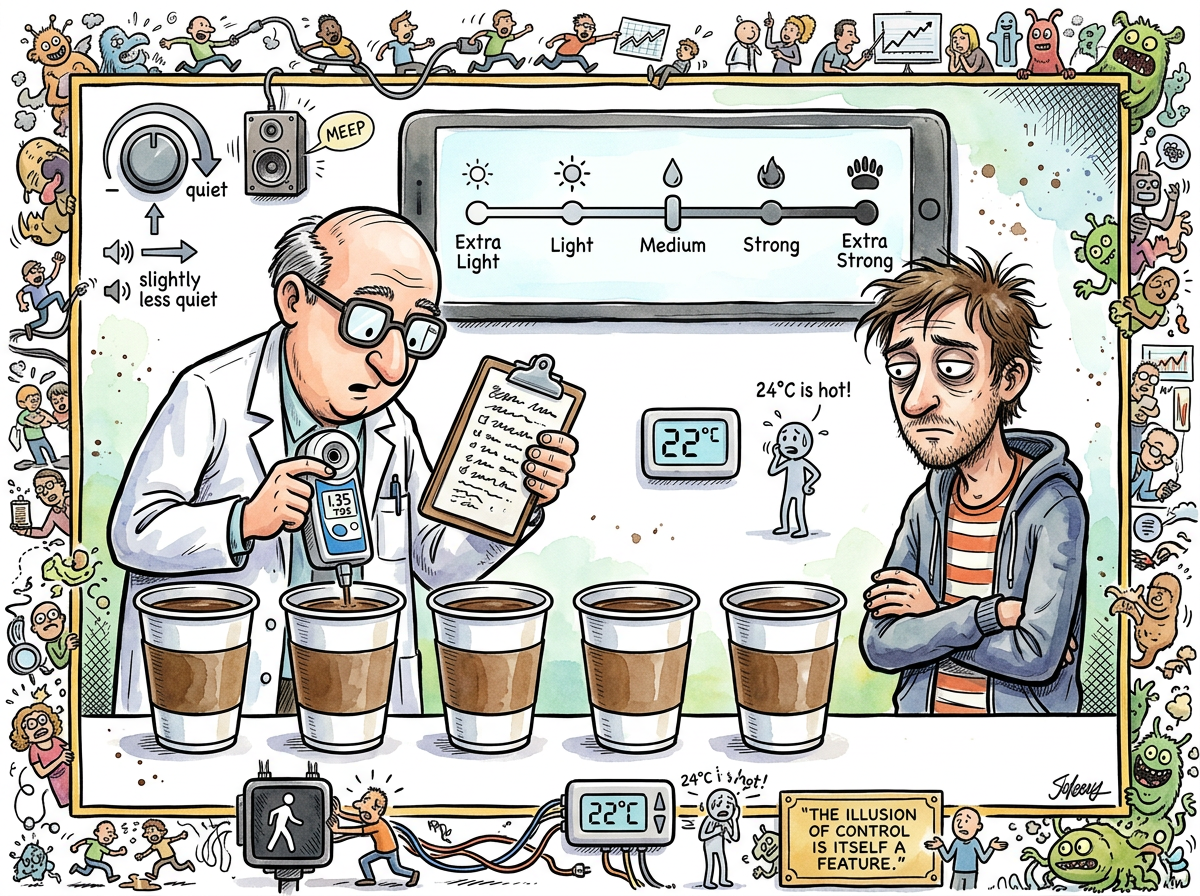
The Strength Slider is a horizontal UI control on the Generation 3 office coffee machine that allows the user to select coffee strength on a spectrum from “Extra Light” to “Extra Strong.” The slider defaults to “Medium.” The slider does nothing at any position.
This is not a bug. This is a design pattern. The Strength Slider is a placebo control — a user interface element that provides the sensation of choice without the mechanism of change. The coffee output is identical at every position. The user believes they have customised their beverage. The machine has not altered a single parameter.
“I tested all five positions. I measured the output with a kitchen scale. Same volume. Same colour. Same sadness. The slider is a lie.”
— The Test Coordinator, applying diagnostic rigour to a coffee machine
The Taxonomy of Placebo Controls
The Strength Slider is not alone. It belongs to a family of interface elements that exist to provide the illusion of agency:
The pedestrian crossing button — installed at intersections in most major cities, many of which are not wired to the traffic signal controller. The button gives the pedestrian something to do while waiting. The light changes when the timer says it changes, not when the button is pressed. The button is a fidget spinner for adults who need to feel like participants rather than passengers.
The office thermostat — set to 22°C in every open-plan office, displaying 22°C, while the actual temperature is whatever the HVAC system has decided, which is 24°C, because the HVAC system serves the building, not the person standing in front of the thermostat adjusting a number that the system ignores.
The JIRA priority dropdown — offering “Blocker,” “Critical,” “Major,” “Minor,” “Trivial.” Every ticket is marked “Critical” or “Blocker.” No ticket has ever been marked “Trivial” by the person who created it. The dropdown provides five options. The culture uses two. The triage meeting ignores all of them and sorts by who shouted loudest in Slack.
The volume knob on the conference phone — with a range from “inaudible” to “slightly less inaudible.” The remote participant is either too quiet to hear or too loud and distorted, and the knob adjusts between these two states with no stop in between.
Why Placebo Controls Exist
Placebo controls exist because the alternative — telling the user they have no control — is worse than giving them a control that does nothing. The user who presses a button and waits is calmer than the user who has no button to press. The developer who adjusts the strength slider and receives identical coffee believes they have made a choice, and the belief is the product, not the coffee.
This is the same principle that drives YAGNI violations: the feature exists not because it does something but because someone believed it should exist. The Strength Slider was added to the coffee machine because a product manager put “customisable strength” on a feature list, and the engineering team implemented the UI without implementing the mechanism, and nobody tested whether the slider produced different output because the slider was never about the output. The slider was about the checkbox on the feature list.
The Caffeinated Squirrel designed the Strength Slider. Not literally — but the impulse is identical. Add a control. Add configurability. Add a slider. The fact that the slider does nothing is irrelevant to the Squirrel, because the Squirrel evaluates features by their presence, not their function.
Measured Characteristics
Strength Slider positions:                               5
Strength Slider positions that produce different output:  0
Default position:                                        Medium
Position that matters:                                   none
Test Coordinator's verification method:                  kitchen scale, all 5 positions
Result:                                                  identical output
Pedestrian crossing buttons wired to controllers:        varies by city (~50% in NYC are not)
Office thermostats that affect temperature:              fewer than displayed
JIRA tickets marked "Trivial":                           0 (by the person who created them)
JIRA tickets that are actually trivial:                  ~40%
Conference phone volume range:                           inaudible → distorted
Useful stops in between:                                 0
Users calmed by pressing a non-functional button:        most of them
The illusion of control as a feature:                    documented, deployed, profitable
See Also
- Coffee Machine — Where the Strength Slider lives
- Office Coffee — The context in which it doesn’t matter
- YAGNI — The principle it violates (the slider is not needed)
- The Caffeinated Squirrel — The impulse that created it
- Boring Technology — What the slider is not