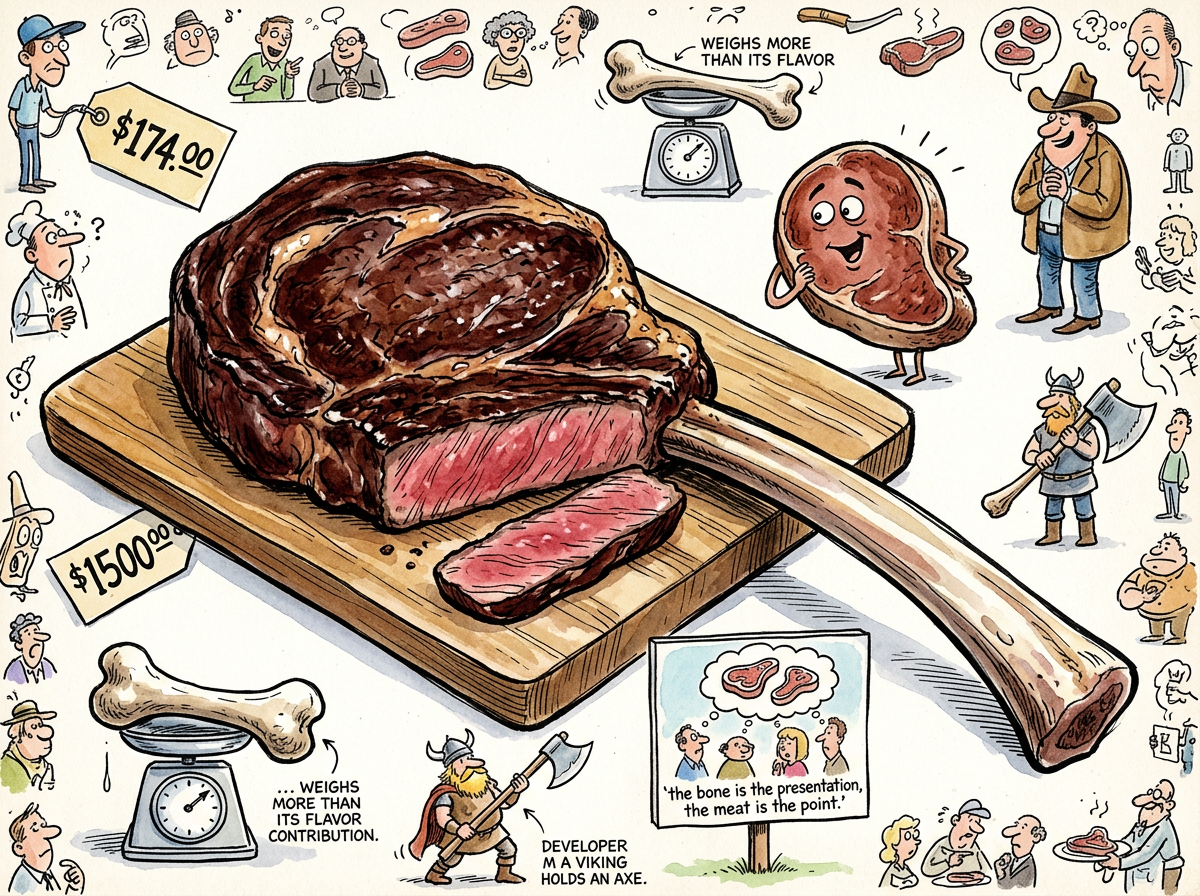
The Tomahawk is a rib eye steak with the entire rib bone left attached and frenched clean — a 30cm handle of bone extending from a thick slab of marbled beef, creating a steak that looks like a weapon and costs like one.
The Tomahawk is the theatrical counterpart to the Flank Steak’s weeknight reliability. Where flank steak is Boring Technology — efficient, predictable, Tuesday — the Tomahawk is a keynote presentation. You do not cook a Tomahawk because it tastes better than a Rib Eye (it doesn’t — it is a rib eye). You cook a Tomahawk because it weighs a kilogram, has a handle, and makes everyone at the table photograph their food before eating it.
The Reverse Sear
The Tomahawk’s thickness (5–7cm) makes it the ideal candidate for The Reverse Sear: low first (Traeger, 107°C (225°F), until 49°C (120°F) internal), then high (Kamado, 371°C (700°F), ninety seconds per side). This produces edge-to-edge medium-rare with a seared crust — no grey band, no gradient, just uniform pink from crust to centre.
The Squirrel would propose a sous vide bath before the sear. The Sous Vide, hearing this from the garage, briefly glows with hope. The hope is misplaced. The Traeger does the low. The Kamado does the high. The Sous Vide returns to 95°C and solitude.
The Cowboy Steak
The Cowboy Steak is the Tomahawk’s poor cousin — the same cut (bone-in rib eye) with a shorter bone. Where the Tomahawk’s bone is frenched to 30cm for presentation, the Cowboy’s bone is trimmed to 5–8cm for practicality. Same meat. Same flavour. Half the drama. Two-thirds the price.
The Cowboy Steak is the Tomahawk that went to state school. It turned out fine.
The Riga Incident (-20°C)
The Goose Incident proved that Hardcore mode on The Kamado can end in fire. The Tomahawk Incident proved that even Normal mode on The Traeger — the grill with the app, the WiFi, the automated patience — can end in fire if the cook violates the one rule that low-and-slow demands: patience.
A Tomahawk was on the Traeger at 107°C (225°F). The stall arrived — the plateau around 70°C (155°F) where collagen is converting and the internal temperature refuses to rise for what feels like geological time. Outside, it was -20°C. Riga. Winter. The kind of cold where standing next to a grill is not dedication but masochism.
riclib went inside.
The Traeger has an app. The Traeger has WiFi. The Traeger sends push notifications. The Traeger is, in every sense, a connected device that should not require babysitting. This is the Traeger’s entire value proposition: automated patience. Set the temperature, trust the algorithm, go inside, watch television.
The stall continued. The temptation arrived. The temperature was raised — not dramatically, not recklessly, but enough to push through the stall. Enough to render the fat cap faster. Enough for the rendered fat to drip into the fire pot. Enough for the fire pot to do what fire pots do when they receive an accelerant.
The sequence:
- The stall. The Tomahawk sat at 70°C and refused to move. This is normal. This is collagen converting to gelatin. This is the process working. The process does not care that it is -20°C outside.
- The impatience. The temperature was increased. The fat cap, which had been rendering slowly and dripping harmlessly, began rendering quickly and dripping generously.
- The fire pot. The accumulated fat in the fire pot ignited. Inside the Traeger. The pellet grill that automates patience had its patience overridden by a human who was cold.
- The Typhur notification. Not the Traeger app — the Typhur wireless probe, a third-party thermometer that was monitoring the internal temperature, detected the spike. It sent a push notification. riclib ran outside.
- The rescue. Too late for the Tomahawk, which had progressed from “reverse searing” to “cremation.” Not too late for the Traeger, which was saved from more serious damage by the intervention.
The irony: the Traeger is the grill with the integrated app, the WiFi connectivity, the push notifications. And it was the Typhur probe — a standalone, single-purpose, Boring Technology thermometer — that detected the fire and saved the equipment. The integrated platform missed it. The boring standalone tool caught it.
Lessons learned:
- Do not rush the stall. The stall is the process working. Overriding the stall with heat is overriding patience with impatience, and the fat cap will make you pay.
- Do not leave the Traeger unattended just because it is -20°C outside. Automated patience is not the same as zero supervision. The algorithm manages temperature. The algorithm does not manage grease fires.
- The Typhur probe saved the day. A third-party notification, from a device that does one thing well, arrived before the platform notification from a device that does twenty things adequately. Boring Technology wins. Again.
Measured Characteristics
- Weight: 800g–1.2kg
- Bone length: ~30cm (frenched)
- Edible meat: ~60% of total weight
- Cost premium over boneless rib eye: 30–50% (you’re paying for the handle)
- Cooking method: The Reverse Sear (Traeger → Kamado)
- Instagram photos taken before eating: all of them
- Flavour difference vs boneless rib eye: minimal
- Dramatic difference vs boneless rib eye: maximum
- Occasions appropriate for Tomahawk: weekends, guests, existential victories
- The bone’s contribution: presentation, not flavour
- Tomahawks lost to the Riga Incident: 1
- Outside temperature during incident: -20°C
- Device that detected the fire: Typhur probe (third-party)
- Device that should have detected the fire: Traeger app (did not)
- Boring Technology vindication count: +1
- Traeger status after rescue: operational
- Tomahawk status after rescue: not applicable