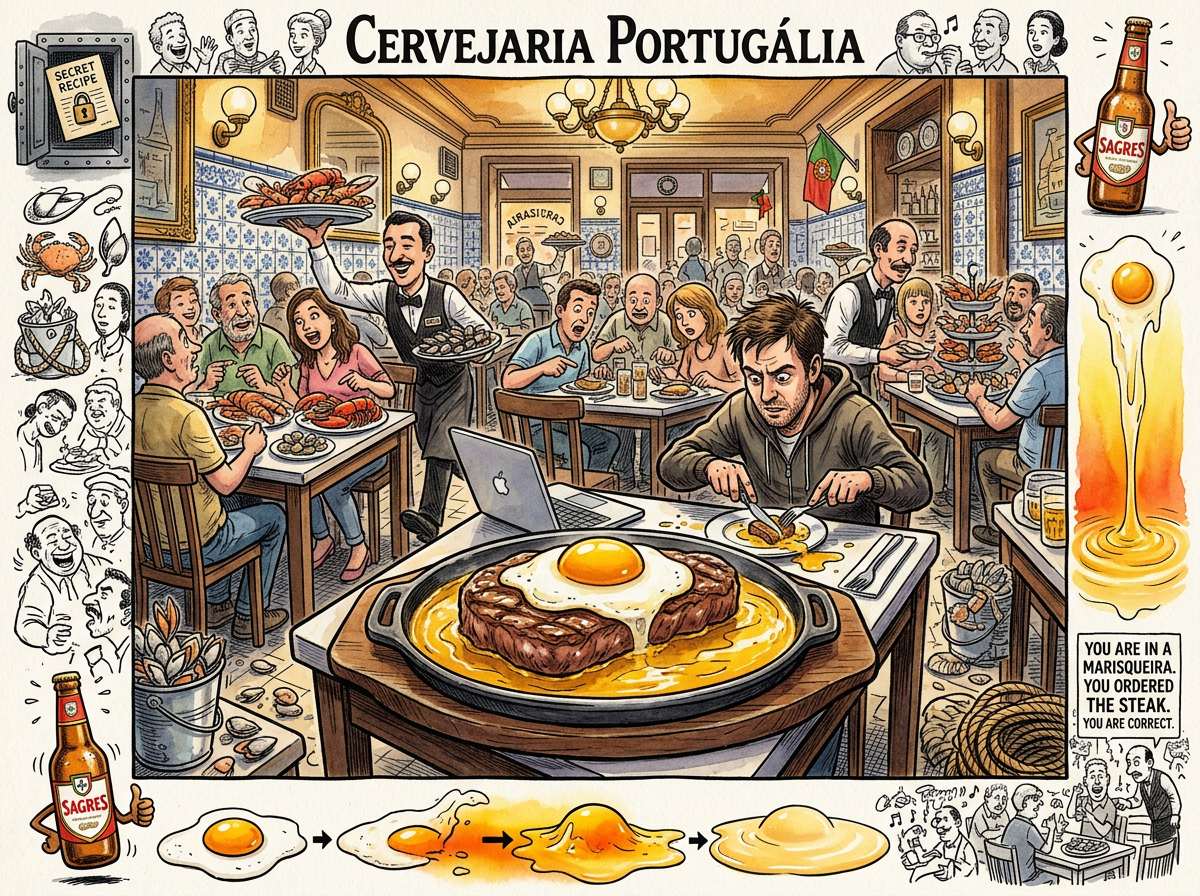
Bife da Portugália is a steak in a golden sauce served at Cervejaria Portugália, a Lisbon beer hall that has been open since 1925, is surrounded by live seafood tanks, employs waiters who can carry four platters of prawns simultaneously, and is — despite all of this — a steak restaurant. Not officially. Not on the sign. Not in the reviews. But in practice, in truth, in the quiet consensus of every Portuguese person who has eaten there more than once: you go to Portugália for the bife.
This is a marisqueira. The seafood is excellent. The prawns are fresh, the Sapateira is heavy, the percebes appear when the Atlantic cooperates. You can order any of it and you will be satisfied. But you will not be correct.
The correct order is the steak.
“The first time you go to Portugália, you order the seafood. The second time, you notice what everyone at the next table is eating. The third time, you order the steak. There is no fourth time where you go back to seafood.”
— riclib
The Sauce
The sauce is the point. The steak is the vehicle. The egg is the accomplice. But the sauce is the reason you are sitting in a seafood restaurant eating beef and feeling no contradiction.
It is golden. Not yellow — golden. The colour of clarified butter that has been told a secret. It is glossy, emulsified, creamy without being heavy, rich without being thick. It pools around the steak on the hot plate and it does not separate, does not break, does not become greasy as it cools. It maintains its composure from the first cut to the last swipe of — well, bread. We’ll get to the bread.
Nobody knows what is in it.
This is not an exaggeration. The recipe is a genuine trade secret, guarded since 1925 with the seriousness that other institutions reserve for nuclear launch codes. Food bloggers have speculated. Home cooks have reverse-engineered. The internet consensus hovers around some combination of mustard, beer, butter, Worcestershire sauce, and egg yolk, emulsified into something that behaves like a hollandaise but tastes like nothing a hollandaise has ever tasted.
The Squirrel spent an evening researching and produced a “definitive recreation” involving seventeen ingredients, a double boiler, a thermometer, and a immersion blender. riclib tasted it. It was good. It was not the sauce. The sauce at Portugália has a depth that resists decomposition — you can identify individual flavours the way you can identify individual instruments in an orchestra, but the thing that makes it the sauce is not any single ingredient. It is whatever happened in that kitchen in 1925 that has been passed down through a century of cooks who were told “do it like this” and did.
The Lizard does not attempt to recreate the sauce. The Lizard goes to Portugália.
The Steak
A thick cut of beef — vazia (sirloin) or alcatra (rump) — seared hard, served on a hot plate that keeps everything at temperature while you work through it. The steak is good. In any other context it would be the star. Here it is the foundation, the substrate, the thing that gives the sauce something to cling to.
The steak is cooked correctly — which in Portugal means more done than a French chef would approve of and less done than a British grandmother would tolerate. Medium. Not medium-rare, not medium-well. Medium. The Portuguese do not argue about steak doneness the way other cultures do, because the sauce renders the argument irrelevant. A perfectly pink steak without the sauce is a steak. A medium steak with the sauce is the bife da Portugália. The sauce wins.
The Egg
A fried egg sits on top. Ovo a cavalo — egg on horseback. The yolk is unbroken when it arrives, trembling on the surface of the steak like a second sun above the golden sauce.
You break it. The yolk runs. It mixes with the sauce. The golden becomes more golden. The richness becomes unreasonable. The combination of emulsified sauce and liquid egg yolk creates something that is technically two separate preparations but functionally one substance — a unified golden medium that coats the steak, floods the plate, and demands bread.
The Bread Problem
riclib does not eat bread. The Nutrition Covenant is clear. Bread is not part of the protocol. This has been established, documented, and maintained across multiple countries and multiple restaurants.
At Portugália, there is bread on the table. It is not grilled artisan bread like Ericeira. It is ordinary Portuguese bread — the white, crusty, unremarkable bread that sits on every table in every restaurant in Portugal, charged by the unit, ignored by tourists who don’t know they’re paying for it.
riclib eats the bread.
Not because the bread is good. The bread is ordinary. riclib eats the bread because the sauce demands a delivery mechanism and the steak runs out before the sauce does. The final third of the bife da Portugália experience is bread dragged through the remaining sauce on the plate — the golden residue, the egg-enriched puddle, the last evidence that the steak existed. Wasting this sauce would be a moral failure that no dietary protocol can justify.
The Sapateira in Ericeira breaks two rules: bread and butter. The bife da Portugália breaks one: bread. But it breaks it harder, because at least in Ericeira the bread is extraordinary. At Portugália the bread is ordinary and you eat it anyway, because the sauce is not ordinary and the sauce is on the bread.
“I don’t eat bread. I eat sauce. The bread is just the spoon.”
— riclib, on his third piece
The Paradox
Cervejaria Portugália is a marisqueira. It opened as a beer hall in 1925, on Portugal Day, on Almirante Reis avenue. It serves seafood. It is famous for seafood. Travel guides list it under seafood. TripAdvisor reviews photograph the seafood. The seafood is good.
And yet.
Watch the tables. Not the tourist tables — the Portuguese tables. The tables where people sit without consulting a menu because they already know what they want. Count the steaks. Count the seafood platters. The ratio will surprise you.
The Portuguese know. They have always known. Cervejaria Portugália is the only marisqueira in Lisbon where ignoring the seafood is the correct decision, where ordering beef in a house of fish is not a failure of imagination but an act of precision, where the thing that doesn’t belong on the menu is the thing the menu was built around.
The Squirrel wants to order the seafood platter. The Squirrel sees the tanks, the ice displays, the prawns arranged in military formation, and the Squirrel wants to experience the full marisqueira. The Lizard orders the bife. The Lizard has been here before.
Measured Characteristics
| Property | Value |
|---|---|
| Restaurant | Cervejaria Portugália, Lisbon (est. 1925) |
| Cut | Vazia (sirloin) or alcatra (rump) |
| Doneness | Medium (not negotiable) |
| Sauce | Golden, emulsified, secret recipe since 1925 |
| Sauce ingredients (speculated) | Mustard, beer, butter, Worcestershire, egg yolk, mystery |
| Sauce ingredients (confirmed) | Nobody knows |
| Egg | Ovo a cavalo, yolk unbroken on arrival |
| Bread | Ordinary Portuguese white bread, extraordinary when covered in sauce |
| What you should order at a marisqueira | The steak |
| The Squirrel’s order | “The seafood platter for two, please” |
| The Lizard’s order | “Bife” |
| Rules broken | One (bread) |
| Regret | None |
See Also
- Sapateira — The crab you eat in Ericeira, where the bread and butter are worth breaking two rules. Different rules, same absence of regret.
- Bacalhau na Brasa — Portuguese seafood done with fire. Correct in its own context. Not the correct order at Portugália.
- Amêijoas à Bulhão Pato — Clams. Excellent everywhere. Still not the correct order at Portugália.
- The Nutrition Covenant — The agreement that bread violates. The sauce that makes the violation inevitable.
- Boring Technology — Steak, sauce, egg, plate. A recipe unchanged since 1925 because it was correct the first time.