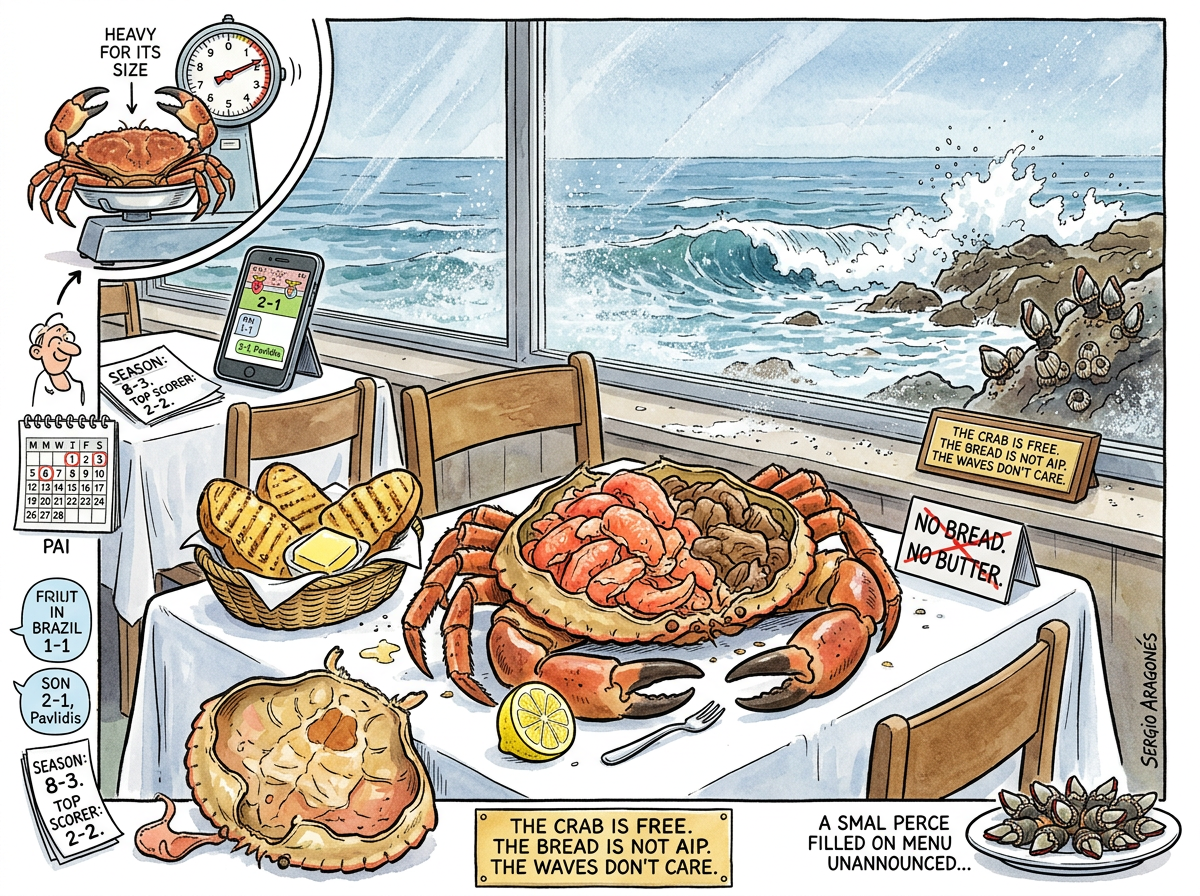
Sapateira is the Portuguese name for the brown crab (Cancer pagurus), a creature that lives in the cold Atlantic, grows slowly, thinks less, and tastes like the ocean decided to concentrate itself into a shell the size of a dinner plate. It is also, in the lifelog, the currency of a betting system between a father in Brazil and a son in Latvia that has been running for longer than most software projects and has better uptime than all of them.
The sapateira is not a casual crab. It is not the snow crab legs you crack at a buffet. It is not the soft-shell crab you fry in tempura batter. It is a dense, heavy, Atlantic crustacean with a thick carapace that requires tools and patience and a willingness to get your hands dirty in a way that developers typically reserve for production databases. Eating a sapateira is a project. A good one takes thirty minutes to dismantle and produces three distinct types of meat, each with its own flavour and texture, none of which taste like they came from the same animal.
“A crab is the only meal where the effort to eat it exceeds the effort to cook it, and both are exactly correct.”
— riclib, elbow-deep in crab
How to Choose
Choosing a sapateira is the most important step and the one most people get wrong. A bad crab is a hollow shell filled with disappointment and seawater. A good crab is a dense, heavy package of meat that justifies its price, its preparation time, and the destruction of whatever shirt you happen to be wearing.
Weight. The only metric that matters. Pick up the crab. It should be heavy for its size — suspiciously heavy, as if it has been hiding something. A light crab is an empty crab: recently moulted, recently starved, or recently deceased for long enough that the meat has shrunk inside the shell. A heavy crab is a full crab. The shell should feel like it contains a solid object, not a liquid one.
Sex. Female, always. Turn the crab over. The apron — the triangular flap on the underside — is wide on females and narrow on males. Females have coral, the bright orange roe that is the single best part of the sapateira and the reason you are paying what you are paying. A male sapateira without coral is like a commit without a message — technically complete but missing the part that gives it meaning.
Season. Autumn through spring. Summer crabs are moulting, recovering, rebuilding their shells and their self-esteem. A summer crab is a ghost in a borrowed house. A winter crab has been eating, growing, and accumulating meat for months. Buy accordingly.
Smell. The sea. Only the sea. Any hint of ammonia, any sweetness that edges toward decay, any smell that makes you hesitate — walk away. A fresh crab smells like the Atlantic in January: cold, clean, and faintly iodine. If it smells like anything else, it is not fresh, and no amount of lemon will fix it.
How to Cook
The Squirrel wants to steam the crab with lemongrass, ginger, and star anise. The Squirrel is wrong. A sapateira is boiled in heavily salted water — seawater-salty — and nothing else. The crab has spent its entire life developing flavour in the Atlantic. It does not need a flavour intervention from a rodent with a spice rack.
The method:
-
Fill a pot large enough to submerge the crab completely. Salt the water until it tastes like the sea — roughly 35 grams per litre, which is more salt than you think and exactly the right amount.
-
Bring to a rolling boil. Put the crab in. The timing starts now.
-
15-20 minutes per kilo. A 1.5kg crab takes 22-25 minutes. Do not overcook. Overcooked crab meat turns from succulent to cottony, from the texture of a perfectly poached egg to the texture of a towel. The line between done and overdone is narrow and unforgiving.
-
Remove. Let it cool enough to handle but eat it warm. Cold sapateira is acceptable — many restaurants serve it cold — but warm sapateira is superior, because the fats in the brown meat are fluid and the flavour compounds are volatile and the coral is soft and spreadable rather than firm and crumbly.
That’s it. No dipping sauces. No drawn butter. No cocktail sauce. A halved lemon and salt. The crab does the rest. This is Boring Technology applied to shellfish: the simplest method, the fewest variables, the most reliable result.
How to Eat
Eating a sapateira is a three-act play, and each act produces a different experience.
Act I: The brown meat. Crack the carapace open from the underside. Inside the main shell, surrounding the body, is the brown meat — a dark, paste-like substance that looks unpromising and tastes extraordinary. It is the liver, the digestive gland, the tomalley. It tastes of concentrated ocean. Spread it on bread — if you are eating bread, which you should not be, but which you will be, because the restaurant in Ericeira serves grilled bread with butter that makes you break two rules simultaneously and feel nothing but gratitude.
Act II: The coral. Bright orange, found in the upper shell of females. Sweet, rich, with a texture between mousse and pâté. This is why you chose a female. This is why you checked the weight. This is the prize. Eat it with a small fork directly from the shell, or spread it on the bread you are definitely not eating.
Act III: The white meat. The legs, the claws, the body chambers. This requires tools — a cracker, a pick, patience. The white meat is sweet, delicate, fibrous, and hidden inside a labyrinth of shell and cartilage that the crab designed specifically to discourage you. Each leg yields a small, perfect cylinder of meat. Each claw yields a dense, sweet lump. The body, cracked open along its segments, yields white meat tucked into chambers like files in a directory structure that makes sense only to the crab.
The entire process takes thirty minutes. You will be silent for most of it, which is fine, because the waves outside are loud enough to fill the silence, and the crab is interesting enough to hold your attention, and the person across the table is dismantling their own crab with equal focus.
The Free Sapateira Hack
riclib’s father lives in Brazil. riclib lives in Latvia. They are both fervent Benfica supporters — the kind of supporters who do not merely watch matches but inhabit them, who feel a Benfica loss in their posture for days afterward, who can name every starting eleven from memory going back further than is socially useful.
They bet on every match. Not money — sapateiras.
The bet is for the exact result. Not the winner. Not the margin. The exact scoreline. This is harder than it sounds and exactly as hard as it looks. Benfica plays roughly fifty matches per season across the Liga, the Taça, and European competition. Guessing the exact result of a football match is an exercise in structured futility — there are dozens of possible scorelines and the correct one is obvious only in retrospect.
There is a bonus: guess the top scorer of the match. The side bet. The amêijoas à Bulhão Pato of the wager — smaller than the main course but more satisfying when you get it right.
The scoring is simple. Each correct exact result is one sapateira owed. Each correct top scorer is one amêijoas à Bulhão Pato owed. They meet four, maybe five times per year — in Ericeira, always in Ericeira, always at the same restaurant — and settle the tab across those meals.
This season: 8-3 on exact results. riclib is winning by five crabs. His father owes eight sapateiras; riclib owes three. The net is five crabs in riclib’s favour, and since they eat four sapateiras per year, the math is clear: a full year of free crab, with one credit rolling into next season. On the top scorer bonus, they are tied 2-2 — his father owes two plates of amêijoas, riclib owes two, which cancels to zero. The clams are a wash. The crabs are not.
Out of roughly thirty-three matches played in a fifty-match season, riclib has guessed eight exact scorelines. His father has guessed three. Predicting the exact result of a football match is an exercise in structured futility — the probability of guessing a correct scoreline is somewhere between 5% and 10%, and riclib is hitting at 24%, which breaks every statistical model and several laws of probability. His father is suspicious but has no evidence. He has examined the data, questioned the methodology, and considered the possibility of insider information, but the truth is simpler and less defensible: the Lizard is involved. Not consciously. The Lizard does not watch football. But the Lizard’s instinct — the same instinct that knows when bone broth is done without a thermometer and when a deploy will fail before CI finishes — appears to extend to Portuguese football scorelines. riclib does not understand this. riclib does not question it. riclib eats the free crab.
The sapateiras this year are free.
“You don’t bet money on football. Money is abstract. Sapateiras are concrete. When you eat a free sapateira, you taste the correct prediction. When you pay for one, you taste the wrong one. Both taste like crab, but one of them tastes like crab and victory.”
— riclib, eating his father’s crab
The Restaurant in Ericeira
The restaurant is not named here because naming it would be a recommendation, and a recommendation would bring people, and people would take the table by the window where the waves are loudest and the percebes appear on the menu without warning on days when the fishermen pulled them off the rocks that morning.
What can be said:
The grilled bread is thick, coarse, toasted over flame, served with a block of butter that has no business being as good as it is. riclib does not eat bread. riclib does not eat butter. The Nutrition Covenant is explicit on both counts. riclib eats the bread and the butter at this restaurant, every time, without hesitation, without guilt, and without any intention of stopping. Some rules have exceptions. Mutton gets aromatics. Ericeira gets bread.
The percebes — goose barnacles — appear seasonally, when conditions permit. They are not ordered. They are announced. The waiter says “temos percebes” and you say “sim” and they arrive: a pile of prehistoric-looking crustaceans that taste like the sea decided to make a snack of itself. You twist the outer shell, pull the inner tube of meat, and eat it. There is no technique beyond this. The technique is the eating.
The waves crash continuously. The salt air comes through the windows. The crab is on the table. The phone is propped up showing the match. The father is in Brazil, or he is across the table, or he is on the phone arguing that the referee is blind, which is a tradition older than either of them and will outlast both.
The Joe’s Stone Crab Incident
riclib went to Miami. riclib went to Joe’s Stone Crab, the legendary restaurant on South Beach that has been serving stone crab claws since 1913 and charging accordingly since approximately 1914. The pilgrimage was deliberate — a chance to try a new crab, an unfamiliar species, a crustacean from warmer waters that riclib had read about but never tasted. The anticipation was real. A new crab is a rare event in a life that has already catalogued most of the edible crustaceans of the Atlantic seaboard.
The claws arrived. Large, heavy, pre-cracked, served cold on ice with mustard sauce and drawn butter and the particular confidence of a restaurant that knows it is serving you something you cannot get anywhere else.
riclib picked up a claw. Cracked it open. Pulled the meat. Put it in his mouth.
And stopped.
This was not a new crab. This was sapateira. Not the same species — the Florida stone crab is Menippe mercenaria, not Cancer pagurus — but the same essential experience. The same dense, sweet white meat. The same yielding texture. The same ocean-concentrated flavour that requires nothing but itself and maybe a squeeze of lemon. The mustard sauce was unnecessary. The drawn butter was unnecessary. The crab was the crab. It tasted like Ericeira served on ice in Miami.
The moment was the culinary equivalent of travelling to a foreign country to learn a new programming language and discovering they use Go. You flew six thousand kilometres to eat a crab you already knew, served with sauces you don’t need, at a price that would buy four sapateiras in Ericeira and a basket of grilled bread with forbidden butter.
The Squirrel would have ordered the mustard sauce. riclib squeezed the lemon.
“I flew to Miami to discover a new crab. The new crab was the old crab. The Atlantic doesn’t care which side you’re on.”
— riclib, at Joe’s
Measured Characteristics
| Property | Value |
|---|---|
| Species | Cancer pagurus (brown crab) |
| Weight (minimum acceptable) | 1.2 kg |
| Sex | Female (for coral) |
| Season | October–April |
| Cooking method | Boiled in salt water. That’s it. |
| Salt concentration | 35g/L (seawater) |
| Time | 15-20 min/kg |
| Temperature when eaten | Warm (preferred) or cold (acceptable) |
| Tools required | Cracker, pick, patience, napkins |
| Accompaniment | Lemon. Bread and butter (rule violations). |
| The Squirrel’s suggestion | “Serve with aioli and a mango salsa” |
| riclib’s response | Lemon |
| Current season score | 8-3 (riclib leads) |
| Top scorer bonus | 2-2 (tied) |
| Annual sapateira cost | 0 (when winning); 4-5 crabs (when losing) |
| Bread rule | Broken |
| Butter rule | Broken |
| Regret | None |
See Also
- Amêijoas à Bulhão Pato — The clams. The top-scorer side bet. Smaller but mighty.
- Bacalhau na Brasa — The other cornerstone of Portuguese seafood, requiring fire instead of water.
- The Nutrition Covenant — The agreement with the body that is suspended in Ericeira by mutual consent.
- Olive Oil — Present at the table, absent from the crab preparation, because the crab needs nothing.
- Boring Technology — Boiling water, salt, a crab, thirty minutes. No apps. No probes. No aioli.