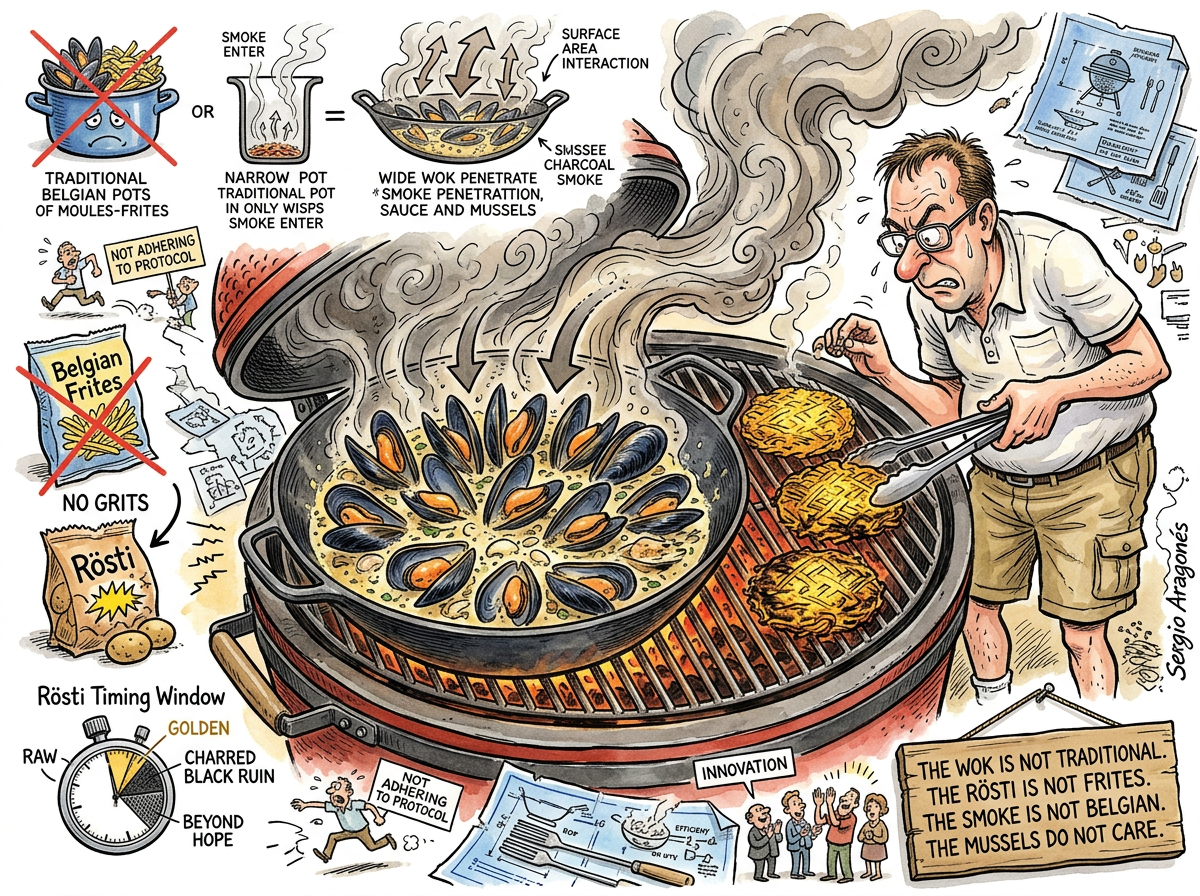
Mussels — moules, mejillones, Miesmuscheln, midii — are the shellfish that Belgium claimed as a national identity, France refined, and riclib cooks in a cast iron wok on a Japanese ceramic grill, served with Swiss rösti instead of Belgian frites. This is heresy on at least three fronts. The mussels do not care. The mussels are delicious.
The traditional moules-frites — mussels steamed in white wine, cream, celery, and shallots, served with a cone of golden frites — is one of the perfect dishes. The pot is narrow and deep. The frites are twice-fried. The beer is Belgian. The meal is complete.
riclib’s version changes the pot, changes the frites, and adds smoke. The beer is still Belgian. Some things are sacred.
“The developer replaced the pot with a wok, the frites with rösti, and the kitchen with a patio in Latvia. The mussels opened anyway. The smoke arrived as a bonus. The Belgians have not been informed.”
— The Passing AI, cataloguing culinary heresies
The Wok
The mussels are cooked in a cast iron wok on The Kamado. Not a pot. Not a dutch oven. Not the traditional narrow, deep vessel that every moules recipe specifies.
A wok.
This is not tradition. This is geometry.
A traditional mussel pot is narrow and tall. The mussels stack deep. The steam rises through the stack, cooking from the bottom up. The ones at the bottom open first. The ones at the top open last. The lid traps the steam. It works. It has always worked. It is the correct, Belgian, time-tested method.
But the traditional pot has a small opening. The surface area exposed to the environment above is minimal. In a kitchen, this does not matter — the environment above is kitchen air, which contributes nothing. On a Kamado, the environment above is charcoal smoke. And charcoal smoke contributes everything.
The wok is wide and open. The mussels spread across the curved surface in a shallow layer rather than stacking in a deep column. The surface area exposed to the Kamado’s smoke is enormous — the wok is, in effect, a smoke-catching dish. A parabolic antenna for flavour. The charcoal smoke curls over the edge of the wok, settles into the broth, touches every mussel. In a narrow pot, the smoke would reach only the top layer. In the wok, the smoke reaches all of them.
The mussels steam open in white wine, cream, shallots, and garlic — the Belgian canon — but they do so in a wide cast iron vessel on a charcoal grill, and the smoke integrates into the broth as the mussels cook. The broth, when you dip bread into it (or spoon it over rösti), carries a whisper of charcoal that a kitchen stovetop cannot produce and a narrow pot cannot capture.
The cast iron wok also provides searing heat at the edges where the wok contacts the grate. Mussels that touch the wok’s hot surface get a brief, intense kiss of heat that the ones in the middle do not. This is not a defect. The edge mussels have slightly more caramelisation on their shells, slightly more intensity. The middle mussels are pure steam. The wok provides both in the same vessel.
The Rösti
The mussels are served with rösti. Not frites. This is the second heresy and the one that would cause the most distress in Brussels.
Belgian frites — twice-fried, golden, crispy-outside-fluffy-inside — are the canonical accompaniment. They are also a deep-frying project that requires a pot of oil, two temperature stages, and a kitchen that smells like a friterie for the rest of the evening. riclib’s kitchen is a patio. The patio has a Kamado. The Kamado does not deep fry.
The Kamado does, however, make rösti.
Rösti — the Swiss potato pancake — is grated potato, pressed flat, and fried until golden and crispy on both sides. On the Kamado, the rösti cooks on the grate (or in a cast iron pan on the grate), picking up the same charcoal smoke that flavours the mussels, developing a crust that is crisper than any pan-fried rösti because the Kamado’s radiant heat attacks from all directions.
The rösti is also the most dangerous element of this entire dish. Not because it is difficult in principle — grated potato, pressed, fried — but because the timing on the Kamado is merciless. The window between “golden, crispy, beautiful” and “charred, black, Instagram-worthy for the wrong reasons” is measured in seconds. The Kamado runs hot. The potato is thin. The sugars in the potato caramelise and then carbonise with the casual speed of a system that does not care about your intentions.
Managing the rösti requires standing at the Kamado with tongs, watching with the specific intensity of a developer watching a deployment. You cannot walk away. You cannot check your phone. You cannot start a conversation. The rösti demands your complete attention for exactly the window of time between “it needs another thirty seconds” and “it needed thirty seconds less.” The charcoal does not negotiate.
riclib has achieved beautiful rösti — golden, latticed, crispy, structurally sound — enough times to know it is possible and enough times to know it is never guaranteed. Each rösti is a feat of timing. Each successful rösti is a small victory against thermodynamics. Each charred rösti is a lesson in humility that the Kamado delivers without malice.
The rösti serves the same function as frites — starchy, crispy, a vehicle for the mussel broth — but with the added quality of being flat enough to soak up broth from below, crispy enough to maintain structure while doing so, and smoky enough to match the mussels rather than merely accompany them. The frites would be better than the rösti at being frites. The rösti is better than frites at being the thing you eat with Kamado mussels.
The Method
-
Prepare the Kamado — medium-high heat, 200-230°C. The charcoal should be past its initial smoke and producing steady, clean heat.
-
Start the rösti — grated potato, squeezed dry, seasoned, pressed into flat rounds. Onto the grate or into a cast iron pan on the grate. Watch them. Do not stop watching them. The window is seconds.
-
Heat the wok — cast iron wok onto the Kamado grate. Olive oil and a knob of butter (or ghee). The fats pool at the bottom of the curve.
-
Shallots and celery — finely diced, into the wok. Sweat until soft. Add garlic. One minute.
-
Mussels — cleaned, debearded, into the wok. Spread them across the curved surface. Let them feel the heat.
-
White wine — a generous pour. The wine hits the hot wok and erupts in steam. The steam begins to open the mussels. The smoke from the charcoal curls into the wide opening of the wok and joins the steam.
-
Cream — a splash. Not a flood. The cream enriches the broth without drowning the wine and the smoke. The broth should be pale gold with a whisper of cream, not white sauce.
-
Cover loosely — a lid or a sheet of foil, resting on the wok, not sealed. The smoke must still be able to enter. This is not a pressure vessel. This is a smoky steam bath.
-
3-5 minutes — the mussels open. The broth collects in the curve of the wok — wine, cream, mussel liquor, garlic, butter, smoke. This is the broth. This is everything.
-
Check the rösti — they are either golden or they are charred. There is no third state. If golden: remove immediately. If charred: accept the lesson. Make more.
-
Parsley — fresh, chopped, scattered over the mussels. Not coriander (this is not Portuguese, this is Belgian by way of Latvia). Parsley.
-
Serve — mussels in the wok (or transferred to bowls), rösti on the side, bread for the broth. The broth is, as always, the point.
Measured Characteristics
- Origin: Belgium (the recipe), Switzerland (the rösti), Japan (the grill), Latvia (the patio)
- Cooking vessel: cast iron wok (not a pot — geometry, not tradition)
- Smoke surface area, traditional pot: ~10% (narrow opening)
- Smoke surface area, wok: ~90% (wide, open, parabolic)
- Grill: The Kamado
- Accompaniment: rösti (not frites — heresy but tasty)
- Rösti timing window: seconds (between golden and charred)
- Rösti attention requirement: 100% (do not check your phone)
- Rösti success rate: high enough to continue, low enough to remain humble
- Charred rösti: a lesson in humility delivered by thermodynamics
- Mussel cooking time: 3-5 minutes (until open, not one second more)
- Mussels that don’t open: discarded (same rule as clams, same finality)
- Broth composition: white wine + cream + mussel liquor + garlic + butter + charcoal smoke
- Belgian reaction to wok method: not yet tested (pending diplomatic assessment)
- Belgian reaction to rösti instead of frites: predicted to be severe
- Beer: still Belgian (some things are sacred)
- The Squirrel’s suggestion: “A dedicated rösti station with a temperature-controlled flat-top griddle for consistent results”
- riclib’s response: the Kamado, tongs, and attention (the original temperature controller is the human)
- The Lizard’s opinion: ate the mussels from the wok with his hands, dipped the rösti in the broth, said nothing
- Heresy count: 3 (wok, rösti, smoke)
- Taste: non-negotiably good (heresy forgiven)
See Also
- Amêijoas à Bulhão Pato — The Portuguese clam cousin. Dutch oven, not wok. Alder smoke, not charcoal. Same principle: shellfish, fat, smoke, broth.
- The Kamado — The heat source, the smoke source, the rösti hazard.
- Cast Iron — The wok material. Seasoned, curved, smoke-catching.
- Ghee — An option in the wok. The caramel notes beneath the cream.
- Boring Technology — Mussels, wine, cream, heat. Belgian since forever. The wok is the only variable.