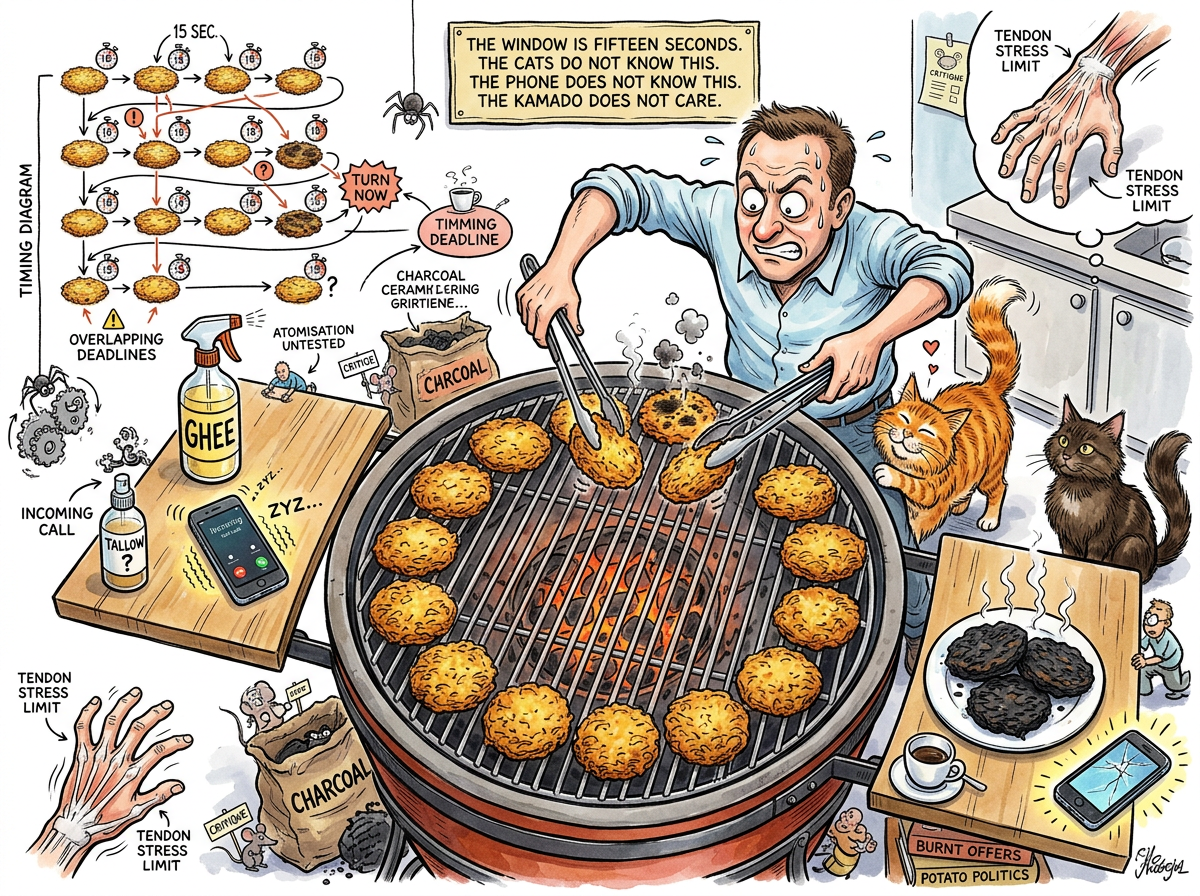
Rösti is a Swiss potato pancake — grated potato, pressed flat, fried until golden and crispy on both sides. In Switzerland, it is made in a pan with butter. In the lifelog, it is made on the edge of a Kamado grate with ghee spray, turned every fifteen seconds in the final stage, twenty at a time, in a cardiovascular event that riclib calls the flip dance and that the cats call entertainment.
The rösti are not fried. There is no pan. There is no pool of fat. The rösti sit directly on the Kamado grate, on the outer edge where the heat is indirect but intense, and they cook through radiant heat and the ghee that was sprayed on them before they went down. The grate marks are the signature. The smoke from the charcoal is the bonus. The fifteen-second turning window is the price.
“The rösti are twenty. The hands are two. The seconds are fifteen. The arithmetic is the problem.”
— The Lizard, who has done the maths and found them unfavourable
The Ghee Spray
Before the rösti go onto the grate, each one receives a generous spray of melted ghee from a spray bottle. The ghee — browned, amber, nutty — coats the surface of the pressed potato and serves as both cooking fat and flavour. The ghee’s high smoke point (252°C) means it can handle the Kamado’s radiant heat without burning before the potato crisps. Butter would burn. Olive oil would smoke. Ghee sprays on, stays stable, and browns the potato from the outside while the Kamado’s heat cooks it from the grate side.
The spray bottle is the delivery mechanism because the rösti need even coverage across their entire surface, and spooning melted ghee onto twenty potato pancakes while they are balanced on a grill grate is a logistics problem that the spray bottle solves elegantly. One pump per side. Even distribution. No pooling. The ghee atomises into a fine mist that settles onto the grated potato like morning dew, if morning dew were made of caramelised butterfat.
riclib would prefer to spray tallow. Tallow has a higher smoke point (250°C), a beefier flavour, and the specific quality of being the fat that the Kamado’s charcoal was born to work with. But riclib has not yet found a way to atomise tallow. Tallow, at room temperature, is a solid. Melted tallow is a liquid, but it solidifies the moment it touches anything cooler than itself — including the inside of a spray bottle, the nozzle of a spray bottle, and the air between the spray bottle and the rösti. The ghee stays liquid at lower temperatures because clarified butter has a lower solidification point than rendered beef fat. The ghee sprays. The tallow does not spray. The tallow remains a theoretical improvement that the physics of atomisation has not yet permitted.
The Squirrel suggested a heated spray bottle with a thermostatically controlled reservoir to keep the tallow above its melting point during spraying. riclib considered this for approximately three seconds before concluding that a heated pressurised vessel of animal fat on a patio next to a charcoal grill is not a cooking tool — it is an insurance claim.
The Edge of the Grate
The rösti do not go in the centre of the Kamado. The centre is direct heat — the volcanic zone where steaks sear and chicken skin blisters. A rösti in the centre would be charcoal before you could reach for the tongs.
The rösti go on the outer edge of the grate, where the heat is indirect — still hot, still aggressive, but radiating from the sides rather than blasting from below. The edge is where the Kamado’s temperature gradient works in the rösti’s favour: hot enough to crisp, not so hot that the window between golden and briquette closes before the tongs arrive.
Twenty rösti arranged in a ring around the outer edge of the Kamado grate. A circle of pressed potato, each one the size of a small plate, each one on its own section of grate, each one on its own timeline of browning. The arrangement looks, from above, like a clock face made of potato. This is appropriate, because time is the only thing that matters from this point forward.
The Flip Dance
The first phase is peaceful. The rösti go down. The ghee sizzles. The charcoal radiates. The developer stands back. There is time. The rösti need several minutes per side in this initial phase — the potato is raw, the moisture is evaporating, the starch is setting. You can walk away briefly. You can check the mussels. You can acknowledge the cat.
Then the browning begins.
The moment the first rösti shows golden-brown edges, the peaceful phase is over. The flip dance begins. Each rösti now needs to be turned every fifteen seconds. Not thirty. Not twenty. Fifteen. The Kamado’s radiant heat, once the potato has dried and the starch has set, converts surface sugars from golden to brown to black with the casual indifference of a system that does not know the difference between caramelisation and carbonisation and does not care to learn.
Twenty rösti. Fifteen seconds each. Two hands. One pair of tongs.
The arithmetic: if each flip takes three to four seconds (locate the rösti, grip it, turn it, reposition it), twenty rösti require sixty to eighty seconds to complete one full rotation. In that time, the first rösti you flipped has been cooking on its new side for sixty to eighty seconds and needs to be flipped again. The cycle is continuous. The tongs do not rest. The developer does not rest. The flip dance is a loop with no idle state.
This is the cardiovascular event. Standing over a 200°C+ Kamado, reaching across the grate with tongs, turning twenty potato pancakes in rapid succession, each one requiring the specific wrist motion of gripping a flat, fragile, ghee-slick disc of potato and rotating it 180 degrees without breaking it, without dropping it through the grate, without accidentally flipping it onto its neighbour. The arms work. The wrists work. The core works (leaning over the Kamado is not an ergonomic position). By the fourth rotation, the hand that holds the tongs begins to consider cramping.
The cramp is the flip dance’s final boss. The hand cramp arrives at exactly the moment when all twenty rösti need to be turned in the next fifteen seconds, and the hand that holds the tongs decides that it has been holding tongs for too long and would like to do something else now. The cramp does not negotiate. The rösti do not wait. The developer switches hands, fumbles the tongs, loses three seconds, and two rösti on the far side of the grate cross the line from golden to briquette.
The Enemies of the Rösti
The rösti have enemies, and they are all domestic.
The phone. A phone call during the flip dance is a death sentence for the rösti on the far side of the grate. The phone rings. The developer glances at it. Two seconds of attention diverted. In two seconds, the Kamado has advanced two rösti from golden to charred. The phone call was never worth the rösti. The phone call is never worth the rösti. The phone has been set to silent during grilling sessions since the Incident of the Six Charred Rösti, which occurred when riclib answered a call from a colleague and returned to find that the colleague’s question about a deployment had cost him 30% of the batch.
Oskar. Oskar — the orange Maine Coon, already large for his age and getting larger — has a specific talent for rubbing against riclib’s legs at the exact moment when the tongs are mid-flip and the balance is critical. Oskar does not know about the fifteen-second window. Oskar knows that the human is standing still, which means the human is available for leg-rubbing. The human is not available. The human is conducting an orchestra of potato. Oskar does not care. Oskar rubs. The tongs waver. A rösti slides.
Mia. Mia — the brown-black Maine Coon, half Oskar’s size, twice his intensity — does not rub against legs. Mia jumps onto the side table next to the Kamado and watches the rösti with the focused intensity of a quality control inspector who has found a process she does not approve of. Mia does not interfere physically. Mia interferes psychologically. The pressure of being watched by a cat who appears to be judging your flip technique is not zero.
The wife. A question from the kitchen — “how long until dinner?” — requires turning the head, computing an answer, and delivering it. Head-turning during the flip dance costs exactly the time it takes for one rösti to cross the line. The correct answer to “how long until dinner?” during the flip dance is “NOW” regardless of whether this is true, because it is the only answer that does not cost a rösti.
The cramp. Already discussed. Arrives at the worst moment. Does not negotiate.
The Casualties
Some rösti become briquettes. This is inevitable. The question is not whether casualties will occur but how many. A perfect batch — twenty golden, zero charred — has been achieved, but it requires the alignment of several conditions: no phone calls, no cats on the patio, no questions from the kitchen, no cramps, and the specific zen state of a developer who has entered flow and whose entire consciousness has contracted to the fifteen-second rotation of twenty potato pancakes.
The charred rösti are not wasted. The charred rösti are evidence. They are placed on a separate plate and displayed alongside the golden ones as a reminder that the Kamado does not forgive distraction. The Lizard considers the charred rösti philosophical. The Squirrel considers them data points in a process improvement exercise. riclib considers them the cost of answering the phone.
The charred rösti from the worst batch — the Six Charred Rösti of the Phone Call — were so thoroughly carbonised that riclib briefly considered whether they could be used as charcoal for the next grilling session. They could not. But the consideration was not unreasonable.
Measured Characteristics
- Origin: Switzerland (the recipe), the Kamado (the method), the patio (the arena)
- Cooking surface: Kamado grate, outer edge (indirect heat zone)
- Fat: ghee spray (atomised, generous, from a spray bottle)
- Preferred fat: tallow (theoretical — atomisation unsolved)
- Tallow atomisation problem: solidifies on contact with anything cooler than itself
- The Squirrel’s tallow solution: heated pressurised spray bottle (rejected: insurance claim, not cooking tool)
- Rösti per batch: 20
- Turn frequency (final phase): every 15 seconds
- Time per flip: 3-4 seconds
- Full rotation time: 60-80 seconds
- Window between golden and charred: 15 seconds
- Window between charred and briquette: another 15 seconds
- Hand cramp onset: fourth rotation (approximately)
- Hand cramp negotiability: zero
- Enemies: phone, Oskar (orange Maine Coon, leg-rubber), Mia (brown-black Maine Coon, judge), wife (“how long until dinner?”), cramp
- The Six Charred Rösti: caused by a phone call about a deployment (the deployment was not worth the rösti)
- Correct phone policy during flip dance: silent
- Correct answer to “how long until dinner?”: “NOW” (regardless of truth)
- Oskar’s understanding of the fifteen-second window: zero
- Mia’s role: quality control (psychological pressure)
- Perfect batch (20/20 golden): achieved (requires: no phone, no cats, no questions, no cramps, flow state)
- Charred rösti utility as charcoal: considered, rejected
- Primary serving partner: Mussels (the broth soaks into the rösti from below)
- The Lizard’s opinion on charred rösti: philosophical
- The Squirrel’s opinion on charred rösti: data points (suggested a “flip timing optimisation algorithm”)
- riclib’s opinion on charred rösti: the cost of answering the phone
See Also
- Mussels — The dish the rösti accompany. Belgian mussels, Swiss rösti, Japanese grill, Latvian patio.
- The Kamado — The heat source. Does not forgive. Does not care.
- Ghee — The spray fat. Browned, atomised, correct.
- Tallow — The preferred fat. Atomisation pending.
- Boring Technology — Grated potato, fat, heat. The flip dance is the only complexity, and the flip dance is the human.