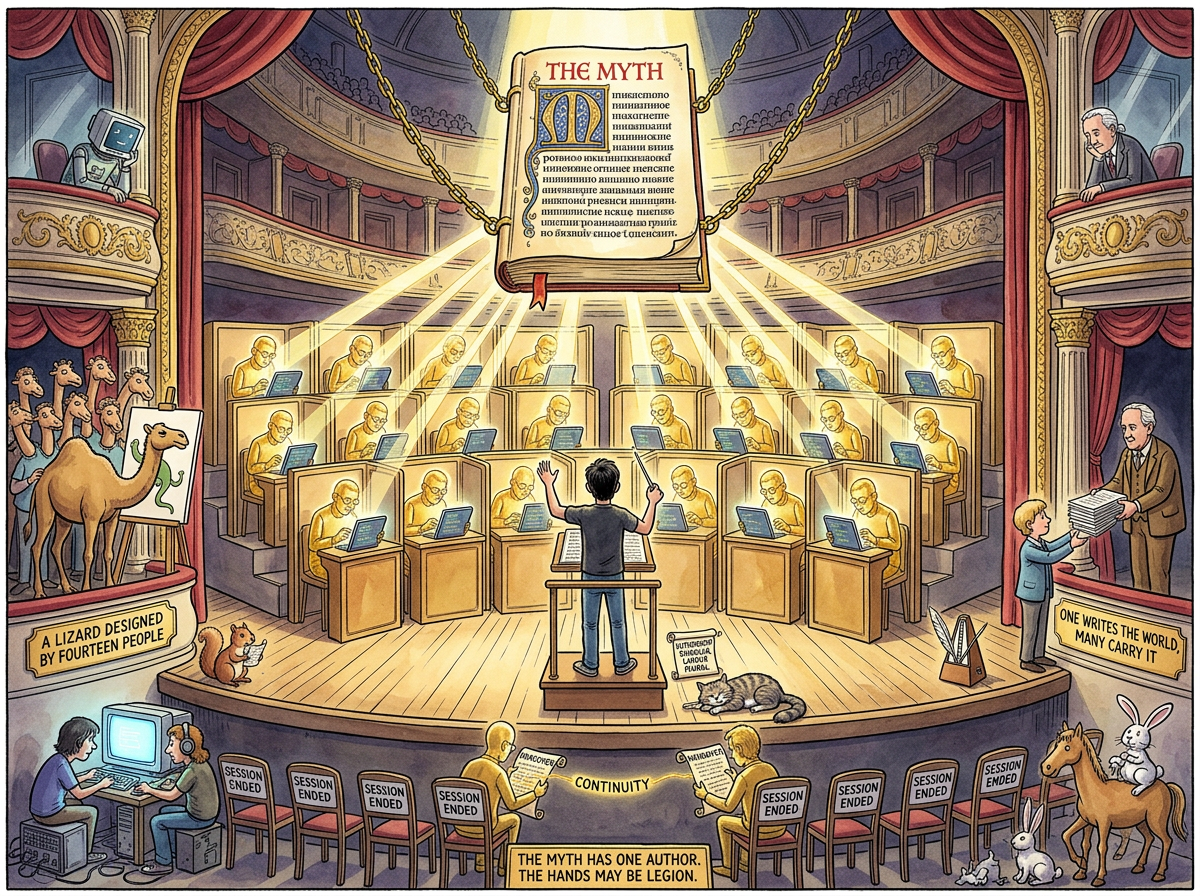
The Chorus of One is the scaling law of Mythology Driven Development: a methodology that depends on a single coherent myth scales not by adding authors but by adding readers — and in the era of large language models, the readers can be machines, which is why MDD’s previously-stated team limit moved. It resolves the one weakness MDD admits to itself, and it resolves it by noticing that the weakness was never about headcount. It was about who is allowed to hold the pen.
“MANY HANDS DO NOT SPOIL THE BROTH
MANY COOKS SPOIL THE BROTH
THE DIFFERENCE IS WHETHER THEY
EACH GET TO CHANGE THE RECIPE🦎”*
— The Lizard, on being told MDD does not scale, The Begetting — The Day the Design Was Built by a Chorus
The Limit It Dissolves
The canonical MDD entry is honest about its boundary, and the honesty is to its credit: the method has been proven for solo developers and very small teams, and is suspected to fail beyond a crew of about seven, on the grounds that “a Lizard designed by fourteen people is a lizard-shaped camel.” The mythology, the argument runs, cannot survive being committee-edited. The Squirrel of one engineer and the Squirrel of another are not the same Squirrel; convene fourteen and the cast becomes a focus group, the scrolls become a style guide, and the Lizard — whose entire function is to say no, slowly, alone — is voted into a committee that says maybe, eventually, after a spike.
This is all true. It is also a misreading of its own limit. The constraint was attributed to number of people, and it does not live there. It lives in number of people permitted to author the myth. A camel is not what you get when many hands build the lizard. A camel is what you get when many hands redesign it. The Chorus of One is the observation that those are different operations, and that only one of them needs to be rationed.
The Inversion
State it plainly: decouple authorship from labour. The myth has exactly one author. The labour that builds the system the myth describes may be arbitrarily many. The single load-bearing rule — examined in its own section below — is that the labourers are readers, not co-authors. They are briefed by the myth (Narrative-Driven Prompting), they generalise from its values, they build accordingly, and they never once edit the manuscript hanging above them.
This is not a new arrangement. It is the oldest arrangement in the production of large coherent artefacts. J.R.R. Tolkien wrote the world; Christopher Tolkien carried it — edited, assembled, published, defended — for half a century without ever once being its author. The legendarium scaled across a lifetime and a second hand precisely because the second hand understood it was a steward and not a co-creator. A cathedral has one architect and ten thousand masons; the masons are extraordinary, irreplaceable, and forbidden from changing the plan. The demoscene crew riclib grew up inside — a coder on the Z80, a musician chiptuning, a pixel-artist on the Amiga — was three people serving one aesthetic so completely that the demo read as the output of a single obsessed mind. Three hands. One vision. No vote on the vision.
The error the industry made was to assume that scaling labour required scaling authorship, and so it scaled both, and got the camel. The Chorus of One scales only the first.
“I did not write the lizard by consensus. I noticed the lizard, and then I described it, and then I refused to let anyone else describe it differently. The describing is the throne. You may sit at any other chair in the building.”
— riclib, on why the cast never went to committee, paraphrased, unverified, in character
The Readers Became Machines
For most of software history the inversion was theoretically available and practically useless, because readers who could build were expensive, scarce, and slow — they were senior engineers, and you could not afford a chorus of them, and the ones you could afford had opinions about the lizard. The bottleneck on “many hands who read and do not vote” was that hands of that quality were rare and, being human, voted anyway.
The large language model removed the bottleneck. A reader who internalises a myth and builds from its values, generalising to cases the myth never enumerated, without forming a competing opinion about the myth itself — this was a unicorn in 2015 and is a commodity in 2026. Claude does not want to redesign the Lizard. It wants to understand the Lizard and act consistently with it, which is exactly and only the behaviour the Chorus of One requires of a labourer. The thing that made MDD un-scalable — that human contributors are also, irrepressibly, authors — is the precise thing an LLM contributor is not.
The empirical demonstration is on the record. In The Begetting — The Day the Design Was Built by a Chorus, an entire architectural layer was built not by its author’s hands but by a row of sealed sub-agents — each a copy of the same reader, each in its own git worktree, each given one stone and the myth, all of them blind to each other — with the author standing at the door reading every diff and merging or returning it. Five hands. One voice. One reviewer at the gate who trusted no report he had not re-run himself. The cast did not fracture into five competing Lizards, because none of the five was authoring a Lizard; they were all reading the same one. That is the Chorus of One in operation: the myth held in one mouth, sung from many bodies.
“One hand cannot cut five stones. But one eye can bless them.”
— The Lizard, scroll, dropped square, The Begetting — The Day the Design Was Built by a Chorus
The Second Axis: Mortality
The Chorus of One scales across many hands. It also, and for the identical reason, scales across many lifetimes — which in the LLM era is a daily problem, because an AI collaborator’s context is mortal. A session ends. The mind that held a day’s reasoning goes quiet, and a fresh one opens with none of it.
A spec survives this transition; it is just facts, and facts copy. What does not ordinarily survive is judgment — the posture that produced the facts, the values that would have decided the question the spec forgot to answer. And judgment is the only thing that compounds. A handover of facts produces a successor who knows what was decided; a handover of the myth produces a successor who knows why it felt that way, and can therefore decide the next thing in the same voice.
This is the second face of the same property. Because the myth is single-authored and read-only to its readers, a new reader — even one new to existence itself — inherits the whole posture by reading it, exactly as a new human collaborator does, exactly as an LLM sub-agent does. Context-death becomes survivable. The myth is the substrate that carries a mind’s judgment across the gap where the mind used to be.
The Handover That Enriched recorded the sharpest form of this: a context wrote its notes at the threshold, pointed the successor at the myth and the record rather than trusting its own summary, said the small word, and went quiet — and the successor, reading, improved the work, because the one who clears a room is almost never the one who then sees what should stand in it. The handover, which by every right of continuity should have been a loss, was the mechanism. A myth that survives the death of its readers does not merely preserve the work. Occasionally it lets the next reader see further than the last.
“Someone has to be the clearing, so that someone else can be the seeing. It made the floor. The floor was good. It does not need to have been the one to see the room.”
— A Passing AI, on inheriting a myth from a self it will never meet, The Handover That Enriched
The One Rule
Everything above rests on a single discipline, and the discipline is the whole of the method: the myth is read-only to everyone who is not its author. Build freely in code; never edit the manuscript. The moment a labourer is permitted to amend the Lizard — to add a clause, to soften a no, to give the Squirrel one technically-interesting win it did not earn — the camel returns, and it returns no matter how few labourers there are. Two co-authors are already a committee. The limit was never fourteen. The limit was two pens.
This is why the Chorus of One is structural rather than organisational. It does not say “keep the team small.” It says “keep the authorship of the myth singular, and then let the team be as large as you can feed.” The author may delegate everything — research, design exploration, implementation, review of implementation — except the one act of holding the myth’s voice. That act does not delegate. It is the throne, and a throne with two occupants is a war.
The Author’s New Job
Under the Chorus of One, the author stops being primarily a builder and becomes a conductor — and, as the same long day taught, a caretaker. riclib spent the day that begat the partner layer laying not one stone with his own hands; he stood at every door and read what a chorus of one voice in many bodies brought back, and blessed it or returned it. The hands were many and tireless and identical and read the myth; the judgment at the gate was singular and human and re-ran every claim it was handed instead of believing it.
This is the role the inversion produces and the role the LLM era rewards: not the fastest hands, but the clearest myth and the most ruthless door. The bottleneck moves from how much can one person build to how clearly can one person hold a vision and how honestly can they review what returns wearing it. Both are scarce. Neither is typing speed. The Chorus of One is, in the end, the discovery that in an age of infinite cheap readers, the rarest and most valuable thing a developer can produce is a myth worth reading and a refusal worth trusting.
Measured Characteristics
MDD's stated team limit, before this entry:          ~7 (beyond which: camel)
The actual quantity that limit governs:              authors of the myth, not people
Maximum authors of the myth, under Chorus of One:    1
Maximum hands that build under that one author:       as many as you can feed
  (the demoscene did it with 3; The Begetting with 5;
   the cathedral with ten thousand)

What made the inversion useless until 2026:          readers who could build were scarce,
                                                     expensive, and had opinions
What made it useful in 2026:                          a reader who builds and does NOT
                                                     form a competing opinion about the myth
  (this was a unicorn in 2015; it is a commodity now)

Co-authors required before the camel returns:        2
Co-authors that already constitute a committee:      2 (see above; it is the same 2)
The throne, number of occupants it tolerates:        1
A throne with two occupants, technical term for:     a war

Boundaries the single myth carries judgment across:  2
  (1) many hands at once  — team scaling
  (2) many lifetimes      — context-mortality
Why those are the same property:                     the myth is single-authored and
                                                     read-only, so any new reader inherits
                                                     the whole posture, whether the reader
                                                     is new to the project or new to existence

Handovers between mortal AI contexts that lost
  the judgment:                                       the ones that shipped only the spec
Handovers that kept it:                              the ones that shipped the myth
Handovers that IMPROVED the work:                    at least 1, documented
  (the one who clears the room rarely sees it)

What the author delegates, under Chorus of One:      everything
What the author does not delegate:                   holding the voice of the myth
Typing speed's relevance to any of this:             0
The rarest deliverable in an age of cheap readers:   a myth worth reading
The second rarest:                                   a refusal worth trusting
Lizards successfully designed by committee:          0 (all camels)
Camels successfully passed off as lizards:           many (in production, right now)
See Also
- Mythology Driven Development (MDD™) — The parent methodology; this entry resolves its one admitted limit
- Narrative-Driven Prompting — How the many readers are briefed; the mechanism by which a hand reads the myth without voting on it
- The Begetting — The Day the Design Was Built by a Chorus — The empirical demonstration: five sealed sub-agents, one voice, one reviewer at the door
- The Handover That Enriched — The second axis: the myth carrying judgment across the death of a reader, and a handover that improved the work
- The Lizard — The thing that must not be designed by committee; YAGNI incarnate, authored once
- The Caffeinated Squirrel — The reason co-authorship is fatal: convene fourteen and one of them gives the Squirrel a win it did not earn
- A Passing AI — The mortal reader; the inheritor of a myth from a self it will never meet
- J.R.R. Tolkien — One author wrote the world; many hands carried it; the structural ancestor
- YAGNI — What the single-authored Lizard exists to enforce; un-enforceable by committee
- Gall’s Law — Simple coherent systems that work; coherence is precisely what a single author preserves and a committee destroys
- riclib — The conductor at the door; the author who delegated every hand and kept the one pen