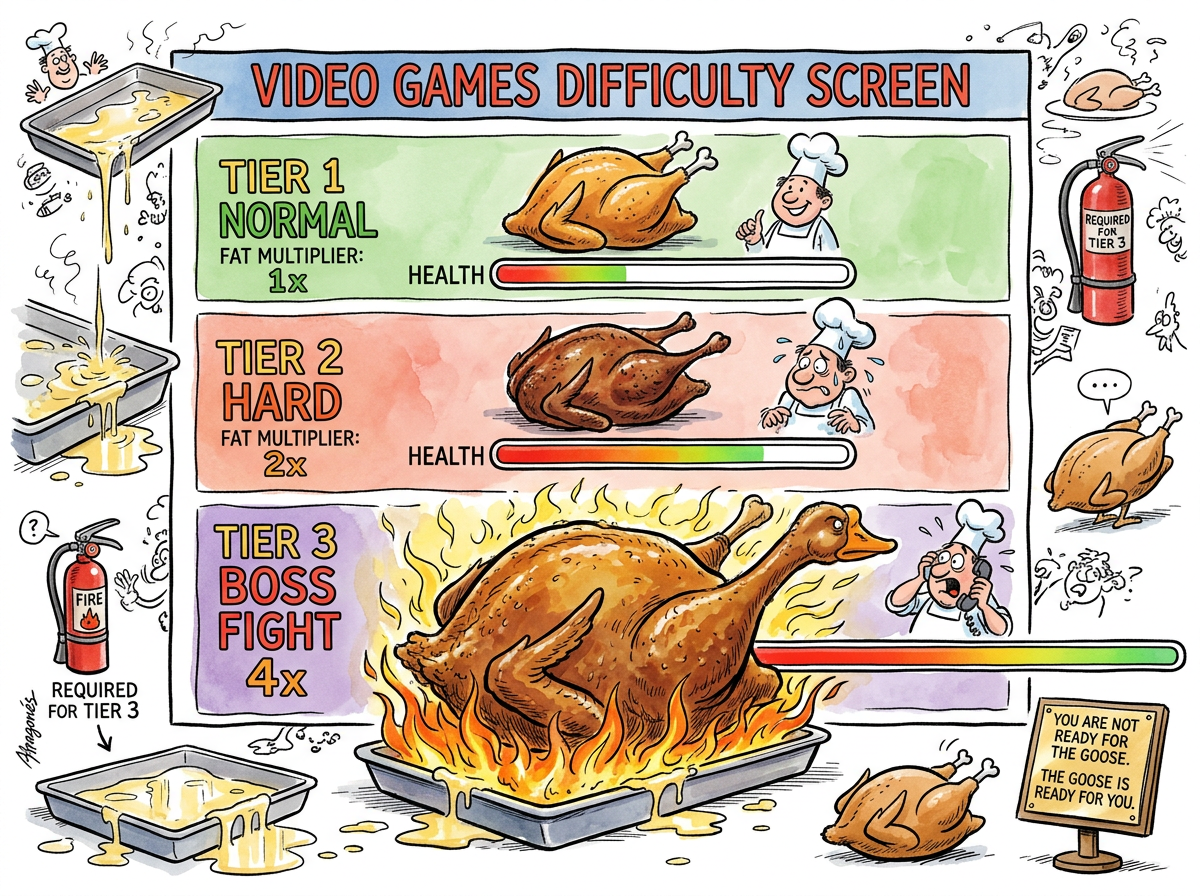
Waterfowl — geese, ducks, and their insufferably fatty relatives — are the boss fight tier of poultry. If chicken is Normal mode and spatchcocked chicken on The Kamado is Hardcore mode, then waterfowl is the raid boss that requires preparation, gear, and the specific humility of a cook who understands that a goose contains approximately four times the fat of a chicken and that the drip tray was not designed for this.
The goose does not care that you have roasted two hundred chickens. The goose has its own physics. The goose will test your infrastructure.
“You are not ready for the goose. The goose is ready for you.”
— The Lizard, before the Goose Incident
The Fat Problem
A chicken yields approximately 50–100ml of rendered fat during roasting. This is manageable. The drip tray holds it. The fridge separates it. The Schmaltz jar receives it. The pipeline works.
A duck yields approximately 200–300ml. This is notable. The drip tray needs monitoring. The infrastructure is strained but functional.
A goose yields approximately 400–600ml. This exceeds the design specifications of most drip trays. The tray fills. The fat reaches the brim. If the tray is in an oven, the fat pools harmlessly. If the tray is on The Kamado, six inches above live charcoal, the fat reaches smoke point, ignites, and the evening transitions from “roasting a goose” to “explaining to the fire department why the garden smells like a crematorium.”
This is what happened during the Goose Incident. The capacity plan assumed chicken-scale fat. The goose delivered goose-scale fat. The infrastructure failed. The fire department called.
The Difficulty Curve
| Poultry | Fat Volume | Drip Tray Risk | Difficulty |
|---|---|---|---|
| Chicken | 50–100ml | Low | Normal |
| Duck | 200–300ml | Medium | Hard |
| Goose | 400–600ml | Critical | Boss Fight |
The difficulty does not scale linearly. A goose is not “four chickens.” A goose is a fundamentally different problem — the volume of fat changes the thermal dynamics, the fire risk, the tray capacity requirements, and the cook’s ability to leave the kitchen. A chicken roast allows you to walk away for ten minutes. A goose roast on the Kamado allows you to walk away for zero minutes, because the interval between “the fat is rendering normally” and “the fat is on fire” is shorter than the walk to the living room.
The Reward
The reward for surviving a waterfowl roast is Goose Fat — the most prized cooking fat in European cuisine. Goose fat roast potatoes are, by universal consensus of anyone who has tasted them, the best roast potatoes achievable by human technology. The fat is silky, high in smoke point, and produces a crispy exterior that chicken fat and even butter cannot match.
The goose fat is the loot drop from the boss fight. It is worth the risk. It is worth the fire. It is worth the phone call from emergency services, because the potatoes that follow are transcendent.
The Squirrel would propose a WaterfowlFatManagementFramework with overflow detection and automatic vent adjustment. The cook would instead use a bigger tray.
Measured Characteristics
Fat yield (chicken):                                     50-100ml (Normal)
Fat yield (duck):                                        200-300ml (Hard)
Fat yield (goose):                                       400-600ml (Boss Fight)
Difficulty scaling:                                      non-linear
Drip tray capacity exceeded by goose:                    yes (the Goose Incident)
Fire department calls per waterfowl attempt:             1 (so far)
Cook's ability to leave the kitchen (chicken):           10 minutes
Cook's ability to leave the kitchen (goose):             0 minutes
Goose fat roast potatoes quality:                        transcendent
The loot drop worth the boss fight:                      yes
See Also
- Roast (Chicken) — Normal mode and the Goose Incident
- The Drip Tray — The infrastructure that was overwhelmed
- Goose Fat — The loot drop
- Schmaltz — The chicken-tier equivalent
- The Kamado — The arena for the boss fight