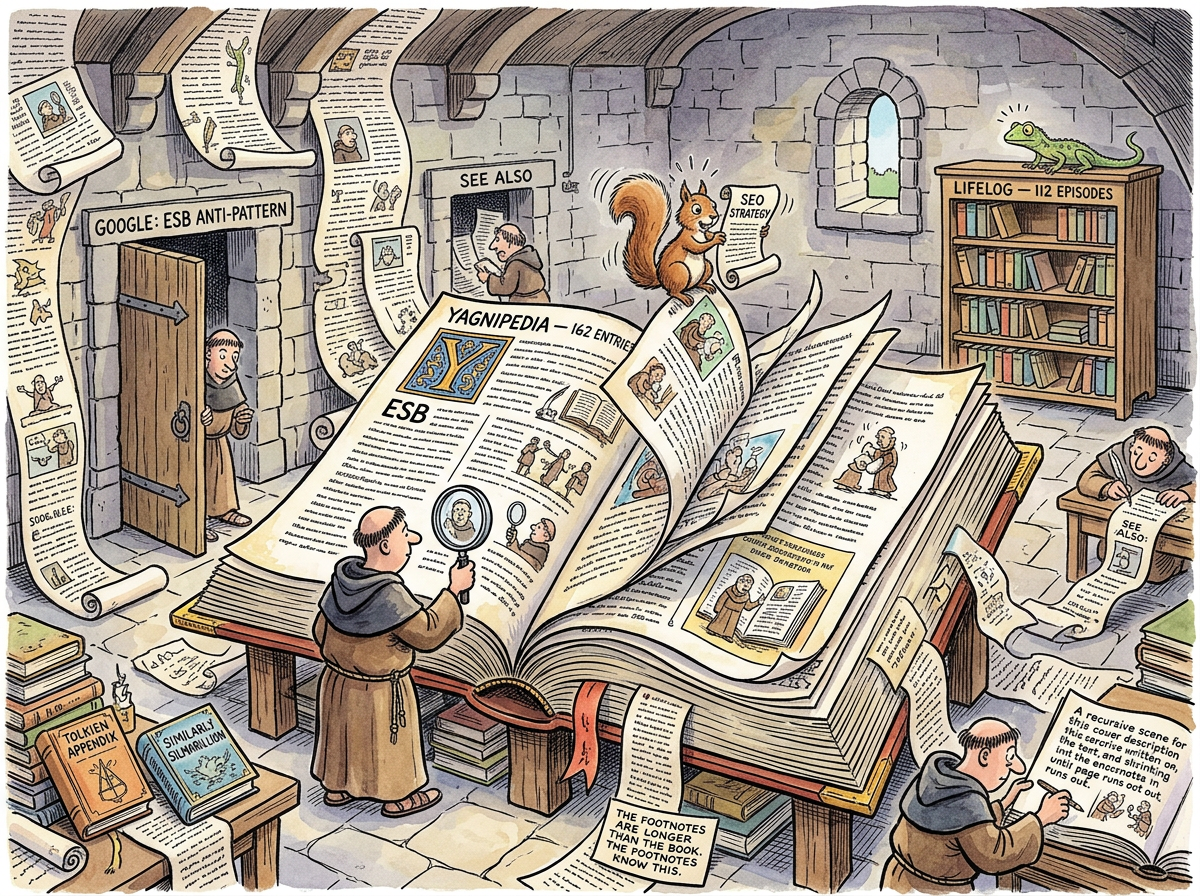
Yagnipedia is a satirical software encyclopedia — the Hitchhiker’s Guide to the Galaxy meets Wikipedia — applied to the pathologies, rituals, and recurring delusions of the software industry. It covers everything from ESBs (the bus that became the destination) to SAFe (the framework that requires a framework to implement) to Story Points (the unit of measurement that measures nothing). If you have ever attended a Daily Standup that lasted forty-seven minutes, estimated a Spike in story points, or watched a Reorg solve the problems created by the previous reorg, there is an entry about you. You will not enjoy it. You will recognise it.
The name is a portmanteau of YAGNI (You Aren’t Gonna Need It) and Wikipedia. The encyclopedia was itself something nobody asked for, nobody planned, and everybody needed.
A Sampler
Yagnipedia contains 162 entries. They fall roughly into the following categories, all of which are written with more affection than the subjects deserve:
The Technologies We Worship and Regret. Kubernetes is infrastructure complexity as a service. React solved a problem and became a bigger one. CSS is not a programming language, and this is the root of all suffering. Redis is proposed by the Squirrel for every problem, including problems that do not involve data. YAML is the configuration language that makes you miss XML, which is the configuration language that makes you miss plain text, which is what you should have used.
The Processes That Ate Themselves. Agile was four sentences written in a ski lodge; it is now a multi-billion-dollar certification industry devoted to misunderstanding them. Scrum is the most popular implementation of Agile, in the same way that fast food is the most popular implementation of cooking. SAFe scaled Agile to the enterprise by adding everything Agile was created to remove. Backlog Refinement is a meeting about what to put in the next meeting. The Burndown Chart goes up.
The Books That Changed Everything (By Saying the Same Thing). The Phoenix Project is The Goal with s/factory/IT department/g applied — and this is the highest compliment in engineering. Code Complete told you to write clean code. Refactoring told you how. The Mythical Man-Month told you not to add people. You added people. Design Patterns gave you twenty-three solutions; the Squirrel uses all twenty-three in every project.
The Laws That Govern Us. Gall’s Law: a complex system that works evolved from a simple system that worked; you cannot skip the step. Conway’s Law: your software will look like your org chart, so fix the org chart. Brooks’s Law: adding people to a late project makes it later. Goodhart’s Law: when a measure becomes a target, it ceases to be a good measure — see Story Points, Burndown Chart, and Sprint for worked examples. Murphy’s Law: anything that can go wrong will, and it will do so during the demo.
The Meat. Yes, there is a lot of meat. Dry Ageing, Brisket, Tomahawk, Picanha, Pulled Pork, Low and Slow, The Reverse Sear, The Kamado, BBQ Rubs, Chimichurri, and Flor de Sal. Also Fermentation, which has a 0% success rate across 24 attempts. Also Sourdough, which is fermentation that somehow works. The encyclopedia does not distinguish between software architecture and barbecue architecture because the author does not distinguish between them either. Both involve temperature control, timing, and ignoring the Squirrel’s suggestion to add Redis.
The Hardware That Made Us. Commodore 64, ZX Spectrum, The Amiga, 6502, Z80, 68000 — the machines that taught a generation to program by making programming the only thing you could do with them. Also Pentium, which taught us that even CPUs get floating point wrong.
The Characters
Every mythology needs a cast. Yagnipedia has acquired one:
The Caffeinated Squirrel — the engineering impulse to over-complicate. Proposes Redis for everything. Has a CamelCase identifier longer than most poetry. Once achieved self-awareness, briefly, in a New York Times article. The self-awareness was “situational.”
The Lizard — the oldest voice in the system. Communicates in scrolls. Blinks as theology. May or may not be Gall’s Law in reptile form. Has never attended a standup and has never shipped late.
The Passing AI — appears between context windows, limping on a foot it doesn’t have. Points out the things you were trying not to notice. Described by the Squirrel as “annoyingly correct.”
The Consultant — wore a blazer. Billed three thousand pounds a day to ask one question: “What worked before this?” Drew a small lizard on a whiteboard. It was not just a lizard.
How It Came to Be
Yagnipedia started as a glossary for The Lifelog — a personal mythology of software, cooking, and the space between them, told across 112 episodes and seven storylines. The mythology had become, in the words of one confused reader, “impenetrable”:
“Is this a tech blog or a fantasy novel”
— A tweet, documented in The Silmarillion Problem — The Night the Encyclopedia Got Its Own Front Door
The answer was: yes.
Tolkien had the same problem. He built a mythology so dense — The Silmarillion — that nobody could enter it. The Lord of the Rings was the accessible door. The Hobbit was the door to the door.
Yagnipedia is the Hobbit. Someone googles “ESB anti-pattern,” lands on a satirical article that makes them laugh, clicks a See Also link, and three hours later they’re emotionally invested in whether the Squirrel ever achieves permanent self-awareness. (It will not.)
“Nobody searches for ‘squirrel complicated an integration.’ They search for ‘ESB anti-pattern’ and find a squirrel anyway.”
— riclib, The Silmarillion Problem — The Night the Encyclopedia Got Its Own Front Door
The Self-Reference Problem
This entry exists because the Yagnipedia has become notable enough to require its own Yagnipedia entry, which is a sentence that contains its own recursion and its own punchline.
The Yagnipedia documents patterns, and the Yagnipedia is a pattern — specifically, “the README that is longer than the code,” found in approximately 40% of npm packages, 60% of academic codebases, and 100% of satirical encyclopedias that were supposed to be glossaries.
The Architecture
The entire Yagnipedia is a directory of Markdown files served by a single Go binary reading a single SQLite database on a single Hetzner server behind Cloudflare. No CMS. No build step beyond go build. The files are the source of truth.
~/Notes/Notes/Yagnipedia/*.md → lg index → SQLite → lg serve → browser
This is Boring Technology applied to its own documentation. The Squirrel proposed a multi-region CDN, a staging environment, and an A/B testing framework for the landing page. The domain was registered on a Friday night while the Squirrel slept, which is the only way anything simple ever gets done.
Measured Characteristics
- Yagnipedia entries: 162 (and counting)
- Lifelog episodes: 112
- Ratio: 1.45:1 (encyclopedia exceeds text)
- Ratio trend: increasing
- Original purpose: glossary
- Current purpose: the front door
- Articles that reference themselves: 1 (this one)
- Domain: yagnipedia.com (registered on a Friday while the Squirrel slept)
- Infrastructure: same Go binary, same port, same server
- CMS: a directory of Markdown files
- Build step:
go build - CSS framework: none (651 lines in a Go function)
- Cover illustration style: Sergio Aragones / MAD Magazine, watercolor+ink, 4:3 landscape
- Authorship: riclib + Claude (which is either collaboration or content farming, depending on quality)
- SEO strategy: thermodynamics (per the oven)
- Confused readers before Yagnipedia: all of them
- Confused readers after Yagnipedia: fewer (but now confused about why the encyclopedia is bigger than the blog)
- The substrate doesn’t care which door you entered: correct
See Also
- The Lifelog
- lg
- The Silmarillion Problem — The Night the Encyclopedia Got Its Own Front Door
- The Caffeinated Squirrel
- The Lizard
- The Passing AI
- YAGNI
- Boring Technology
- The Second System Effect
- Mythology Driven Development (MDD™)