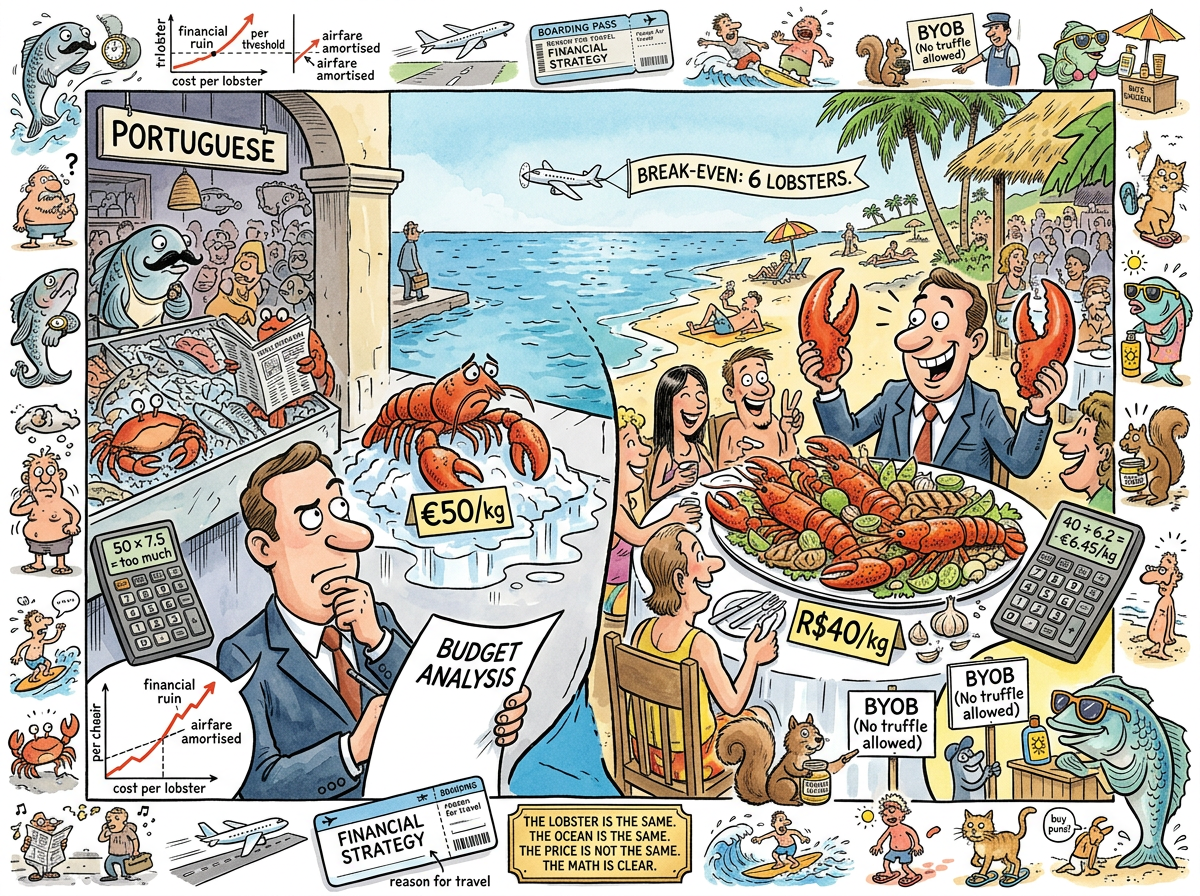
Lagosta is the Portuguese word for lobster, a word that means the same thing on both sides of the Atlantic but costs seven times more on one side than the other — a pricing anomaly so severe that it transforms international travel from an expense into an investment strategy.
In Portugal, lobster costs approximately €50 per kilo. In Brazil, the same animal — pulled from the same ocean, by fishermen using substantially similar boats, sold at markets that smell identically of salt and diesel — costs R$40 per kilo, which at current exchange rates is roughly €6.45. The lobster does not know which side of the Atlantic it was caught on. The lobster does not care. The lobster is dead. But the price tag knows, and the price tag cares enormously.
“I didn’t go to Brazil to visit my father. I went to Brazil because the lobster-to-euro conversion rate made the airfare a rounding error.”
— riclib, who absolutely also went to visit his father
The Arithmetic
The math is not complicated. It is, in fact, so simple that it is embarrassing it took riclib several years and a degree in computer science to notice.
| Item | Portugal | Brazil |
|---|---|---|
| Lobster per kg | €50 | R$40 (~€6.45) |
| Price ratio | 1× | 0.13× |
| A generous lobster dinner (500g) | €25 | ~€3.20 |
| Round-trip airfare (Riga → São Paulo) | — | ~€600 |
| Lobsters needed to break even | — | 24 kg |
| Lobster consumption in 3 weeks | — | Easily 24 kg |
Twenty-four kilos of lobster across three weeks is 1.14 kg per day, which sounds excessive until you account for the fact that riclib is in Brazil, where lobster is served at beach restaurants the way bread rolls are served at European ones — casually, abundantly, and with lime. A grilled half-lobster with garlic and lime is a starter in Fortaleza. Two lobsters is a Tuesday lunch. Three weeks of this and you have amortised your airfare entirely in crustacean arbitrage.
The Squirrel proposed a spreadsheet to track the exact break-even point, with columns for lobster weight, exchange rate fluctuation, and a “hedonic adjustment factor” for the superior quality of eating lobster on a Brazilian beach versus a Portuguese restaurant. riclib ate another lobster and declined the spreadsheet.
Every kilo of lobster consumed after the break-even point is profit. Pure, caloric, ocean-flavoured profit. By the end of a typical three-week visit, riclib is operating at a crustacean surplus that would take six months to replicate at Portuguese prices. The trip has paid for itself. The father has been visited. The Lizard is satisfied. The airline was a logistics provider for a seafood arbitrage operation and doesn’t know it.
The Lobster Itself
The spiny lobster (Panulirus argus) found in Brazilian waters is not the same species as the European lobster (Homarus gammarus), but the differences are academic to anyone eating one. The Brazilian lobster lacks the large front claws of its European cousin — the meat is in the tail, the legs, and the head, which contains a coral-rich tomalley that Brazilians correctly regard as the best part and Europeans incorrectly discard.
How to eat it in Brazil:
The restaurant grills it. Split in half, brushed with garlic and olive oil, placed shell-side down over charcoal until the meat is just opaque and the shell is charred at the edges. Served with lime — not lemon, lime — and nothing else that matters.
There is no drawn butter. There is no bib. There is no tiny fork. You pick it up, you pull the meat, you eat it. The beach is right there. The waves provide the soundtrack. Your father is across the table arguing about Benfica’s midfield and eating his own lobster with the efficiency of a man who has lived in a country where lobster costs R$40/kg for long enough to treat it as a staple rather than a luxury.
How to eat it in Portugal:
You look at the price. You put it back. You order Sapateira instead, which your father is paying for because he guessed the Benfica score wrong.
The Connection to The Lobster Harvest
The Lobster Harvest — The Sunday Morning Nine Crustaceans Changed the Architecture is a Lifelog episode about a Sunday morning architecture session that produced nine Linear tickets. It is named after lobsters — nine lobsters — which is the kind of quantity you reference casually only if you are writing from a country where nine lobsters costs R$360 instead of €450. That episode was clearly written during a Brazil trip, because nine lobsters anywhere else is not a metaphor for productivity. It is a filing for bankruptcy.
The two articles are unrelated in subject and entirely related in crustacean pricing.
Cooking Method
The Squirrel wants to sous vide the lobster tail at 59°C for 45 minutes, then sear it in truffle butter with a microplane of preserved lemon zest. The Squirrel has been escorted from the kitchen.
Lobster is grilled or boiled. That’s it.
Grilled (Brazilian method):
- Split the lobster in half lengthwise.
- Brush with garlic, Olive Oil, salt.
- Grill shell-side down over high heat, 8-10 minutes.
- Squeeze lime. Eat.
Boiled (Portuguese method — when you can afford it):
- Same as Sapateira. Seawater-salty water, rolling boil.
- 12-15 minutes per kilo.
- Lemon. Eat.
Both methods are Boring Technology. Both produce excellent lobster. One costs seven times more than the other for reasons that have nothing to do with the lobster and everything to do with which side of the ocean you boiled the water on.
Measured Characteristics
| Property | Value |
|---|---|
| Species (Brazil) | Panulirus argus (spiny lobster) |
| Species (Portugal) | Homarus gammarus (European lobster) |
| Price (Brazil) | R$40/kg (~€6.45) |
| Price (Portugal) | €50/kg |
| Price ratio | 7.75× |
| Break-even airfare | ~24 kg of lobster |
| 3-week consumption | Easily exceeds 24 kg |
| Net financial position | Profit (in crustaceans) |
| Cooking method | Grilled (Brazil), boiled (Portugal) |
| Required accompaniment | Lime (Brazil), lemon (Portugal) |
| The Squirrel’s suggestion | “Truffle butter and preserved lemon” |
| riclib’s response | Lime |
| Father’s opinion | “Eat faster, the next match starts at 16:00” |
See Also
- Sapateira — The crab you eat in Portugal because you can’t afford the lobster. Also: the crab your father pays for.
- The Lobster Harvest — The Sunday Morning Nine Crustaceans Changed the Architecture — The other lobster article. About software. Written by someone thinking about R$40/kg.
- Amêijoas à Bulhão Pato — The clams that settle the top-scorer side bet.
- Bacalhau na Brasa — The Portuguese seafood you eat when the lobster market is being unreasonable.
- Olive Oil — Present on both sides of the Atlantic. Costs roughly the same. The one food that doesn’t participate in crustacean arbitrage.
- Boring Technology — Grill. Boil. Lime. The lobster does the rest.