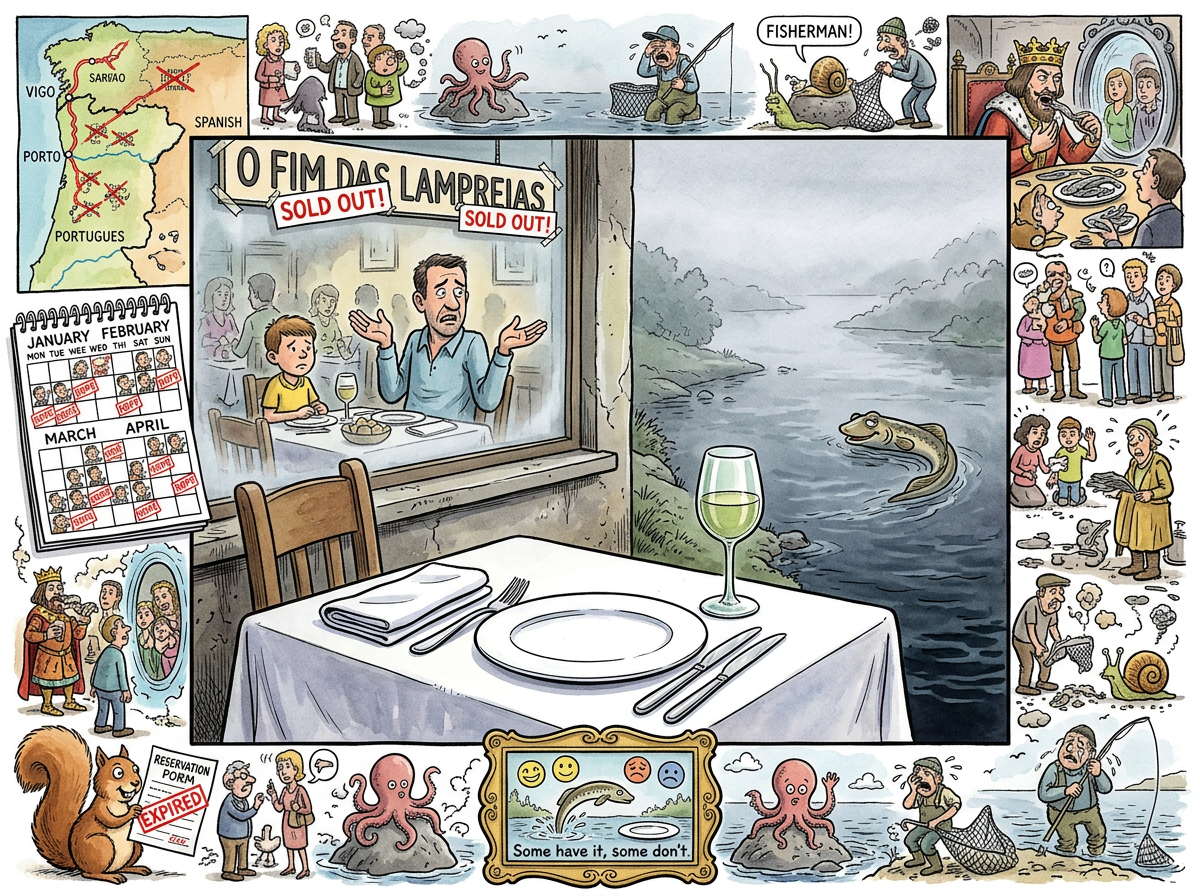
Lampreia is a jawless, parasitic, eel-shaped fish that has been swimming in Portuguese rivers since before Portugal existed, has been eaten by Portuguese people since before they knew they were Portuguese, and has been successfully avoided by riclib for his entire life — not by choice, not by design, but by a conspiracy of circumstance so consistent that it has transcended bad luck and entered the realm of mythology.
It is the only Portuguese dish riclib has not eaten.
This is not a small claim. The lifelog’s food catalogue includes every major preparation of bacalhau, multiple regional variations of cozido, shellfish from both sides of the Atlantic, a steak that you order at a seafood restaurant, bread that breaks dietary rules in two different coastal towns, and a crustacean arbitrage operation that makes international travel a financial strategy. riclib has eaten percebes off the rocks, sapateira with his hands, and leitão from a town whose entire economy is based on a pig. riclib has not eaten lampreia.
The lampreia swims in the Minho. riclib’s father is from the Minho. These two facts should produce a lampreia dinner. They have not.
“My father is from Minho. I have been to Minho. The lampreia is in Minho. Somehow, these three things have never been in the same room.”
— riclib
The Fish
The lamprey (Petromyzon marinus) is not technically a fish. It is a jawless vertebrate — a living fossil, a creature so ancient it predates the evolution of hinged jaws, which means it has been eating without chewing for 360 million years. It attaches itself to other fish with a circular, suction-cup mouth lined with concentric rows of teeth, rasps through the skin, and drinks the blood. It is, by any honest description, a river vampire with the body of an eel and the mouth of a nightmare.
The Portuguese eat it braised in its own blood.
This is not a metaphor. The traditional preparation — lampreia à bordalesa — involves killing the lamprey, collecting its blood, and then braising the sliced body in red wine, onions, and the reserved blood, which thickens the sauce into something dark, rich, and iron-heavy. The rice is cooked in the sauce. The entire dish is the colour of a very serious Douro red that has made decisions it cannot take back.
The dish is seasonal: January to April, when the lamprey runs upriver from the Atlantic to spawn. Outside this window, there is no lampreia. Inside this window, there is lampreia — in theory. In practice, for riclib, there is an empty plate and a father shrugging.
The Minho Conspiracy
riclib’s father was born in the Minho region, the green northwest corner of Portugal where the Minho river forms the border with Spain, where the vinho verde is made, and where the lampreia is caught, prepared, and eaten with a seasonal reverence that borders on liturgy. Every restaurant in the region serves lampreia à bordalesa during the season. It is on every menu. It is in every window. It is the thing you go to Minho to eat between January and April.
riclib and his father have travelled to Minho. They have visited restaurants. His father knows these restaurants — he grew up in the region, he knows which ones serve the best lampreia, he knows the owners, he knows the season. And yet, mysteriously, consistently, without exception, every restaurant they visit does not have lampreia when they arrive.
“Acabou.” Sold out.
“Hoje não temos.” Not today.
“A época já passou.” The season ended. (It is February.)
“Volte amanhã.” Come back tomorrow. (They are leaving tomorrow.)
The pattern is too consistent to be coincidence and too absurd to be conspiracy. And yet. A man from Minho who cannot find lampreia in Minho is either the unluckiest diner in Portuguese history or a man who knows exactly what he is doing.
The evidence is circumstantial. riclib’s father expresses disappointment each time. The disappointment is convincing. But riclib has watched his father predict Benfica scorelines for decades, and the man is capable of performing emotions he does not feel when football is involved. Whether this extends to lampreia remains unproven.
There are two theories:
Theory 1: Bad luck. Lampreia is genuinely seasonal, supply-limited, and popular. Restaurants run out. Timing is hard. A visit that misses the lampreia by a day is a visit that misses the lampreia. This has happened three, four, five times. It is improbable but not impossible.
Theory 2: The father knows. He has seen what a lamprey looks like. He has seen the mouth. He has seen the preparation — the blood collected in a bowl, the creature sliced alive by tradition (though modern kitchens are more humane). He has decided, perhaps unconsciously, perhaps with full deliberation, that his son does not need to see this. The restaurants he chooses are real. The lampreia being unavailable is real. But the selection of restaurants, the timing of the visits, the particular weekends chosen — these may not be random. A father from Minho knows when the lampreia runs. A father from Minho also knows what the lampreia looks like when it’s running.
The Lizard suspects Theory 2. The Squirrel has proposed booking a restaurant independently, without the father’s involvement, with a confirmed reservation specifying lampreia. riclib has not done this. riclib is not sure he wants to solve the mystery. Some Portuguese food traditions are better as mythology than as dinner.
What It Supposedly Tastes Like
riclib does not know.
Those who have eaten it describe a flavour that is unlike any other fish — dark, mineral, blood-rich, with a gamey depth that sits somewhere between organ meat and oily river fish. The texture is firm but yielding, more like braised meat than like anything from the sea. The sauce — the wine-and-blood sauce — is the soul of the dish, and the rice that absorbs it is, by all accounts, the best part: each grain stained dark, saturated with the braising liquid, carrying more flavour per gram than any rice has a right to carry.
It is, reportedly, extraordinary. It is also, reportedly, the kind of dish that you either love completely or cannot finish. There is no middle ground with lampreia. It is too strange, too ancient, too bloody, too itself to inspire moderate opinions.
riclib has moderate opinions about very few foods. riclib has no opinion about lampreia, because riclib has not eaten lampreia, because the restaurants in Minho do not have lampreia when riclib is in Minho, because riclib’s father is from Minho and knows things about lampreia that he has chosen not to share.
Measured Characteristics
| Property | Value |
|---|---|
| Species | Petromyzon marinus (sea lamprey) |
| Classification | Not technically a fish (jawless vertebrate) |
| Age of species | ~360 million years |
| Season | January–April |
| River | Minho (and others, but Minho is canonical) |
| Preparation | À bordalesa — braised in red wine and its own blood |
| Rice | Cooked in the braising sauce (reportedly the best part) |
| Times riclib has eaten it | 0 |
| Times riclib has tried to eat it | 4-5 |
| Times the restaurant had it | 0 |
| Father’s region of origin | Minho |
| Father’s expressed disappointment | Convincing |
| Father’s actual disappointment | Unverified |
| Theory 1 | Bad luck |
| Theory 2 | Paternal protection |
| The Squirrel’s suggestion | “Book independently, confirm lampreia in writing” |
| riclib’s response | Has not booked independently |
| The Lizard’s position | Some mysteries are better unsolved |
See Also
- Sapateira — The crab riclib can find, paid for by correct Benfica predictions.
- Lagosta — The lobster that costs seven times more on the wrong side of the Atlantic.
- Bife da Portugália — The steak you order at the seafood restaurant. At least that one arrives.
- Bacalhau na Brasa — Cod on the grill. Always available. Never sold out. Never mysterious.
- Cozido à Portuguesa — The Portuguese boiled dinner that contains everything except lampreia, because lampreia is not in the pot and never will be as long as riclib’s father is choosing the restaurant.